

I would like to share my thoughts on “Initiative Q,” whose “Q” invitations are circulating everywhere.
Initiative Q is an attempt to create a next-generation payment network based on digital currency, without carrying over existing payment systems such as credit cards. In a sense, it may seem close to virtual currency, but its approach is entirely different from Bitcoin and the like. Its characteristics are as follows.
1. Creating a trust chain
It creates a “trust chain” in which a parent verifies a child’s identity, and the child verifies a grandchild’s identity. This is the exact opposite of the approach taken by Bitcoin and similar systems that value anonymity, and is the standard approach when conducting identity verification properly.
2. Solving the “chicken-and-egg problem” through rapid expansion using the social graph
At the same time, it is pursuing rapid expansion by promising rewards to initial members. This resembles the referral campaigns initially used by Dropbox and others, but differs somewhat in that rewards can be earned through the grandchildren’s generation. This is the part that evokes a “pyramid scheme.” However, whereas a so-called “pyramid scheme” is a mechanism in which parents extract money from children and profit, this is not structured that way, and neither children nor grandchildren stand to lose, so I do not think it is a problem. Rather than using 1 levels, using 2 or more appears intended to spread it through the social graph and increase coverage within the society connected to that person1. It is a measure for solving the chicken-and-egg problem of infrastructure services.
3. The elasticity of the money supply is set extremely high.
This is the exact opposite of Bitcoin’s approach, which models the scarcity of “gold.” Useful money must have nearly infinite supply elasticity. Bitcoin and the various “virtual currencies” modeled on it fail in this respect, which is why people have recently said that “crypto-assets” is a more appropriate term. “Q” clears this hurdle.
4. How will supply elasticity be ensured?
Supply will be controlled by a separate organization whose KPI is maintaining supply elasticity. In other words, there is an equivalent of a central bank, so this too is the exact opposite of Bitcoin’s approach.
With this approach, increasing the supply is easy, but the problem remains of how to absorb the currency (this capacity must also be high to maintain elasticity). The documents do not say much about it, but I expect that when the price of “Q” rises, “Q” will be released in exchange for dollars, and when the price of “Q” falls, “Q” will be absorbed in exchange for dollars. The logic is that the numbers should work because it sells high and buys low. If this approach is adopted, elasticity can theoretically be maintained.
Put another way, it could be called the “asset-backed” electronic money that I have long advocated.
The issue here is whether the Q paid as incentives to initial members and losses resulting from the exercise of Q sold as call options will impair the underlying assets. Conversely, the key will be controlling releases and option exercises so that:
> (Q released as rewards) + (Q representing differential losses from option exercises)
2.
5. Consumer protection and disputes
One problem with payments using “virtual currency” is protecting consumers from “payments made through fraud or error.” In ordinary bank transfers, this is implemented through mechanisms such as recalls, but Bitcoin and other “virtual currencies” do not have it. (It can be implemented even with “virtual currency,” but has not been. We discussed how to implement it with virtual currency on this year’s Fin/Sum panel, “How Does the Technology Community View Blockchain?”) “Q” anticipates this from the outset.
6. They understand finance well
“Cryptocurrency” enthusiasts often say that international bank transfers are expensive because banks profit from them, but this is not true. The network cost of an international transfer itself is said to be around 10 cents. Most of the fees costing 20 dollars or 30 dollars are spent on AML (anti-money laundering). Another major cost factor is countermeasures against fraud and other misconduct. Since Initiative Q was started by a former PayPal person, they understand this well. It appears to be an attempt to bring remittance costs closer to network costs by rebuilding a completely new payment network and thoroughly reducing these costs. In fact, Initiative Q’s founder appears to be the person who sold these fraud-detection technologies to PayPal, and this seems to be Initiative Q’s core competence.
7. How will it initially be used?
I do not really know. However, since it is trying to increase social coverage, it may initially start with payments among friends for expenses paid on another’s behalf, as PayPal did. In that case, reward amounts will probably be applied as discounts, as in “for 90 cents, send 1 Q (≈ 1 dollars).” I think it will be difficult to recruit merchants until the proportion of people actually using it reaches a certain level…
8. Will this attempt succeed?
I do not think the probability is high. First, there is still the obstacle of whether it will spread. Because it does not stimulate speculative excitement like “virtual currencies,” I do not think it will spread explosively. The fact that creating a trust chain looks like a “pyramid scheme” will also be a disadvantage. That is probably precisely why the operators themselves call it a “social experiment”3. Even so, attempts like this are interesting, and I would like to support it.
Have a pleasant autumn evening.
Addendum (2018-11-05): I thought the monetary model was very well designed, and it turns out that it was written by Professor Laurence H. White of George Mason University. He is a monetary theorist and has written extensively in this field.
The “brick standard” I sometimes mention originated from a working paper that Professor Akira Yamazaki introduced in a university class (probably in 1987). But its authors were “Black & White,” so it does not show up in searches. Even searching for “Black & White Bricks” and the like will not find it.
When I searched for Laurence H. White, I did not find that exact paper, but, for example, this freely available work appeared:
Laurence H. White, “As good as gold?” 4
Using history, this examines how the gold standard is not as crazy an idea as people say and how, if gold production can be increased in response to demand (← a major assumption), a monetary system based on gold is likely to be superior to fiat.
I described the assumption “if production can be increased in response to demand” as a major one, but he himself can also be read as not considering it such a major issue. However, in the working paper Professor Yamazaki introduced, I believe the idea was that “bricks can be increased more flexibly,” and that the ultimate destination of commodity-backed money was a “brick (i.e., a commodity anyone can produce given labor) standard.”
However, his argument does not appear to be for a commodity standard, but for “free banking with fractional reserves,” an idea apparently based on F. A. Hayek’s competing non-commodity private monies. Initiative Q’s system is said to envision this5.
I wrote the main body of this article before discovering this, so after reconsideration there are probably several places that should be corrected. However, it has already been widely shared, so I will leave it as it is.

Footnotes
- (Added 11/6) Needless to say, another objective is what I wrote under “1. Creating a trust chain.”
- (Added 11/6) I may be wrong about this. Professor White appears to advocate free banking with fractional reserves, and I will not know without reading the paper.
- (Added 11/6) Today, I discovered that Professor White himself says it “remains to be seen”
- Laurence H. White: As good as gold? (2008) CATO Institute, <https://www.cato.org/policy-report/marchapril-2008/good-gold>
- Laurence H. White: Bitcoin after 10 Years (2018) Cato Institute <https://www.cato.org/blog/bitcoin-after-10-years>
Related posts
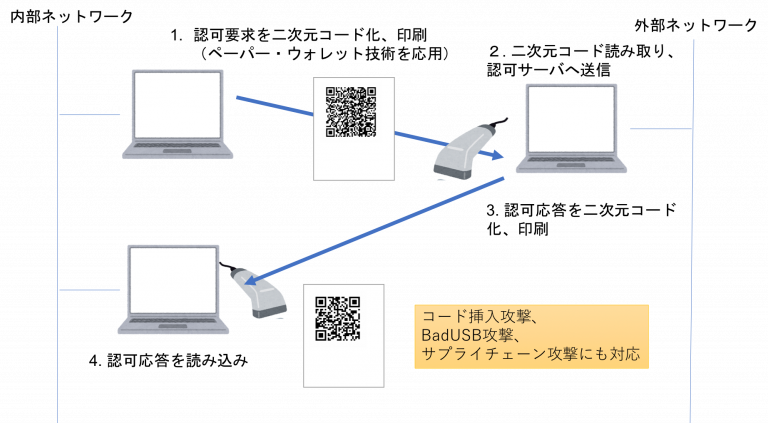
OAuth-J Announces OAuth Optical Transport Profile for Network Resilience, Applying Cryptocurrency Technology
【AF Wire, Tokyo】The OAuth Foundation Japan (OAuth-J) announced on April 1, 2018 that it would begin developing the OAuth Optical Transport Profile (OAuth OTP), a new…

Digital Identity: Latest Global Developments – November 12 Edition
Digital Identity Verification Partnership in Portugal iProov and Biometrid Collaborate to Strengthen Digital Identity Verification Solutions Combining iProov's facial authentication technology with Biometrid's identity orchestration platform…

Why Identity Federation Helps Improve Privacy
I received an inquiry from a certain party and sent a response, so I am sharing it here. The topic is “Why Identity Federation Helps Improve…