
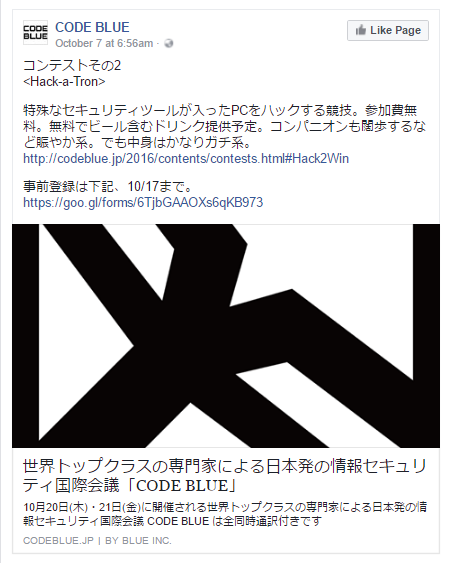
There is a conference called CODE BLUE. According to the organizer, it is “an international information-security conference originating in Japan, featuring world-class security experts”1, and I had long heard that its program was substantial. This year it will be held in Tokyo on October 20 and the 21th.
The organizer posted the following announcement about it on its Facebook page.
People who often attend international conferences may have flinched when they saw this wording. In fact, the following thread arose somewhere. Let me reproduce it under the Chatham House Rule2.
Person A: So they are actually touting cosplay companions…
It gives me the impression that they are immature as an international conference. I was fairly surprised. Is it meant to be like RSA Conf? There are communities seriously discussing Codes of Conduct and even what qualities should be required of the person who strikes the gong, so it is disappointing to see things head in this direction.
Person B: This means that the people responsible for this contest section are completely unaware of issues such as gender bias. Perhaps because they added more attractions this year, they also seem to have increased the staff too much to supervise everyone fully. Judging from what Japanese security people say on Twitter and Facebook, though, it seems entirely unsurprising… Right now they are all excited about the Russian female student’s maid cafe. Because this started in Japan, my impression is that they have unwittingly put the immature side of Japan’s security community on full display. First of all, it is pathetic.
Person A: I think personal preferences are a matter of freedom (and I am familiar with that kind of culture  ?), but I had assumed the conference was mature enough to be mindful of such things. (I have never attended…)
Especially if it is an international conference that invites people from abroad, I am rather surprised that they were not conscious of this.
Well, in Japan this probably would not anger sponsors, and perhaps it is characteristically Japanese in that sense.
Person B: The Japanese security community is immature first and foremost because it fails to distinguish between personal preferences and the problem of unconsciously bringing those preferences directly into a public event such as a conference. Even if Kana, the founder of CODE BLUE, understands that point, the staff involved seem to be almost all men, and many other than a few individuals apparently have no experience attending overseas conferences, so they probably do not notice it at all. Perhaps they think of it as a security-industry Comic Market.
Person A: I knew the founder was a woman, which honestly made it all the more surprising.
It feels like a wasted opportunity; I hope they can reach maturity. (There seem to be many people involved.)
Person C: Hmm. I understand the idea of Japanese “cool,” but they really need some sense of international risk…
Person A: Maybe it is the RSA style.
Person E: I thought booth babes had been banned at RSA.
Person A: Oh, I did not know that… That makes it even harder to comment…
Person F: There is this, for example. http://www.networkworld.com/article/2902752/security0/rsa-conference-bans-booth-babes.html
Person B: Sexual-harassment incidents have occurred repeatedly at DEFCON and CCC and have been pointed out or reported. It seems to me that people in Japan’s security community may not know much about what the problems are.
There was also the case a few months ago in which Jacob Appelbaum was dismissed from the Tor Project over sexual harassment. Because the allegations of his misconduct were considered substantiated, PacSec and the original CanSecWest announced that Jacob would be barred for 5 years.
Person G: I imagine they simply do not know the facts. Perhaps they cannot even conceive of them. If the international community learned about Japan’s gender ratio and lack of employment opportunities for marginalized people, Japan would be excluded immediately.
Person E: In a sense, this means the organizer has failed at risk management. I thought security was about risk management. Is it different in Japan?
Person B: Europe sometimes seems unaware of sexist behavior, depending on the place. I have also heard from a woman who moved from the United States to work at T-Mobile that there is quite a lot of sexism even in the Netherlands, to her dismay.
Person D: Perhaps there is a risk that this happens more easily when the gender composition on the management side is skewed. At organizations I am involved with, I try to pay attention to diversity in gender and age groups as much as possible.
Person G: Diversity matters. It lets you see many things that would otherwise remain invisible.
Person D: The security industry still has a long way to go on diversity.
Person G: That is true of IT generally, and of Japanese society as well.
Person E: Japan is still an apartheid society. I think most people are not even aware of that. You can see it in accommodations for people with disabilities, too. For example, school integration3 has not progressed.
Person D: Accommodations for people with disabilities… I remember having an extraordinarily hard time in the past at the school to which a totally blind student of mine transferred.
Person E: I think the recent death of a totally blind person who fell from a train platform, which has often appeared in the news, is another manifestation of this. Because integration[1] has not progressed, people do not know how to interact with one another, and incidents like that occur. In Japan, the response tends to be a hardware solution such as platform doors, but that is not a fundamental solution. Platform doors solve only the problem of falling deaths on that platform. It was not as though the platform was deserted; ideally, another passenger should have stepped in naturally to assist. But in Japan, even well-intentioned people do not know how to approach someone, while people with disabilities likewise do not know how to engage, so communication never takes hold.
Person H: It would be a shame not to show the organizer such valuable observations on the original post.
Footnotes
- (Source) http://codeblue.jp/2016/
- None of the initials overlap with labels such as “Person A.” Incidentally, Person E is me.
- Strictly speaking, this would probably be called normalization. I use “integration” here because people unfamiliar with the background could misunderstand what I mean.
Related posts

International Cybersecurity Conference to Be Held in Okinawa on 11/7 and 8
TBSNews i reports that the government will hold an international conference on cybersecurity in Okinawa Prefecture in 11 this year. The conference will take place on…

5 Misconceptions Seen in the Fake Beethoven Affair
To be honest, Mamoru Samuragochi's name was completely off my radar until Twitter posts about this incident began appearing . I had no idea that he…

Is Personal Data the Oil of the New Era?
Comments by Professors Shishido, Inatani, and Wakameda appeared in the Nikkei. What Should Law Be in the Digital Age? (Multiple Perspectives) The rapid development of digital…