
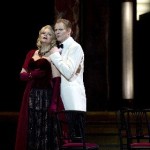
Popular music sometimes contains pieces so similar to classical works that they seem like quotations. Masashi Sada’s “Serenade” is one of them; the moment I heard it, I was astonished and thought, “Wow, it’s The Merry Widow!” Looking closely, I see that Katsuhisa Hattori composed it. Of course he could not have been unaware of the resemblance, so I think it was used as an homage.
Well, please listen.
“Serenade”
Lyrics: Masashi Sada
Music: Katsuhisa Hattori

“The Merry Widow: Lippen schweigen”
Lyrics: Leo Stein and Victor Léon
Music: Lehár

I love The Merry Widow. I have also written a separate article titled “The Merry Widow at the Paris Opera / Palais Garnier: DIE LUSTIGE WITWE,” so please take a look. “Lippen schweigen” is the climax near the end.
| Lippen schweigen, ‘s flüstern Geigen, Hab’ mich lieb! All’ das Bangen, all’ das Sehnen, Was wir sagen, sagt das eine Blick allein. Lippen schweigen, Geigen sagen: Hab’ mich lieb! Mit den Augen sagen wir uns so viel. Mit den Augen sagen wir uns: Hab’ mich lieb! | Though lips say nothing, the violins whisper: “Love me!” All the anxiety, all the longing, A single glance says it all. The lips are silent, but the violins say: “Love me!” All the feelings our eyes exchange, Our eyes tell each other: “Love me!” |
Masashi Sada’s “Serenade” is also a song that whispers love without words, so this can be considered a perfect quotation.
Though Lips Say Nothing: The Sweet Waltz from Lehár’s The Merry Widow
Lehár’s masterpiece The Merry Widow (Die lustige Witwe) is an operetta that caused a sensation in Vienna at the beginning of the 20 century. Among its numbers, the duet “Lippen schweigen,” which appears near the end, has continued to captivate audiences in particular.
◆ A Melody Resounding at the Peak of Love
This song is the climax of Act 3. It is sung when the protagonists Hanna and Danilo, after repeated misunderstandings and romantic maneuvering, finally communicate their feelings. Singing that “though lips say nothing, the heart speaks,” the duet expresses love swelling beyond words through an elegant waltz melody.
“Though the lips are silent, love speaks through the eyes”—this moment is a quintessential romantic finale in operetta.
◆ Musical Appeal: A Waltz Redolent of Vienna
Above all, this duet’s appeal lies in its flowing waltz. The swaying triple-meter rhythm seems to turn the lovers’ racing hearts directly into music. The melody is extremely memorable and naturally draws the audience in.
The beauty of the moment when their voices overlap is also exceptional, creating the sensation of heart and body dancing as one on a ballroom floor.
◆ Emotion Dwelling Between Words and Silence
The title “Lippen schweigen” is itself symbolic. A declaration of love does not necessarily require words; feelings also dwell in silence. This beautifully embodies the essence of operetta: music itself can express emotion.
Conclusion
“Lippen schweigen” from The Merry Widow is more than a simple love duet. It is a story of profound emotion dwelling precisely in silence, and of love spoken by the music itself.
If you have not heard it, please listen to one of its great performances. Its beauty will surely captivate you.
Music-Related Articles
- New Discovery: Mozart Works for Flute and Harp Premiered on 6/21 (6/23 Performance Recording Also Added)
- A Visit to the Mendelssohn House in Leipzig — The Difficulties Faced by the Mendelssohn Family and Women
- Year-End Greetings: Fauré’s “In Paradisum” from Requiem, Op. 48—In Memory of Andrew Nash
- The Background, Lyrics, and Recommended Performances of Giordani’s “Caro mio ben (My Beloved)”
- An Unusual Theme Song for the Annals of Anime History — The Secrets of the Latin Lyrics to “Lilium (White Lily)”
- VTuber Chima Machita’s “Lilium” and “Caro mio ben”
- Bach’s “Toccata and Fugue in D Minor, BWV 565”: Originally a Violin Piece?
- Season’s Greetings—Bach: Siciliano (Flute and Spinet)
- “Michishirube” at the Setting of Violet Evergarden
- A Recommended Hidden Gem: Damase—Quartet for Flute, Oboe, Clarinet, and Piano
Related posts
New Discovery: Mozart Works for Flute and Harp Premiered on 6/21 (6/23 Performance Recording Also Added)
Across 250 Years: Mozart’s “Unpublished Autograph” Found in Paris Reveals the Genius Behind the Legend An “Anonymous” Treasure Sleeping in a Corner of the Library On…
A Visit to the Mendelssohn House in Leipzig — The Difficulties Faced by the Mendelssohn Family and Women
Year-End Greetings: Fauré’s “In Paradisum” from Requiem, Op. 48—In Memory of Andrew Nash
Here are my customary year-end greetings. This year I had begun preparing to perform “Lilium”, but after learning of the death of my close friend and…