
Is Bach’s “Toccata and Fugue in D Minor, BWV 565” by Someone Else?
One of J.S. Bach’s best-known works is the “Toccata and Fugue in D Minor, BWV 565.” It is famous for its opening “da-da-daaa, da-da-da-da-daaa” passage.

This iconic “Toccata” has actually been questioned as to whether it is truly by Bach ever since its first publication in 1833. There are several reasons.
- No autograph manuscript by Bach survives, and the oldest copy dates only from the latter half of the 18th century, leaving the work’s origins unclear.
- The fugue’s style is unusual. In particular, no other organ fugue in Bach’s entire career presents its subject alone or ends with a minor-key plagal cadence.
- The fugue’s counterpoint is sparse.
- It uses motivic-thematic development (suggesting music from the generation after J.S. Bach).
- It requires C#, uncommon on organs in J.S. Bach’s time, making it unplayable on ordinary organs of the period.
- etc.
For these reasons, the work has been said perhaps not to be authentically by Bach. Leading theories include:
- The theory that it was composed by Peter Kellner (1705-1772) (Claus, 1998)1;
- The theory that it was composed by Bach’s pupil Cornelius Heinrich Dretzel (1697-1775) (Hall, 2013) 2; or
- The theory that it was composed by Bach’s second son, C.P.E. Bach (1714-1788) (Gaiilit, 2022) 3
among others.
The Kellner (Johann Peter Kellner) Theory
Johann Peter Kellner was an organist and composer active in northern Germany who knew J.S. Bach well. He may have been Bach’s pupil, though this is uncertain. What is certain is that he contributed greatly to disseminating J.S. Bach’s works. In particular, his contribution is considered a major reason we can access Bach’s 6 cello sonatas today.
The Kellner theory appears to arise because the earliest manuscript of the work was attributed to his pupil Johannes Ringk. However, many now reject it, both from comparisons of compositional style and because handwriting analysis indicates that the manuscript was not by Johannes Ringk.4Still, let us hear a piece by Kellner.

The Dretzel (Cornelius Heinrich Dretzel) Theory
Cornelius Heinrich Dretzel was an organist and composer active in southern Germany and a pupil of J.S. Bach. Because of the region where he worked, his compositional style is said to show a marked Italian influence.
Dretzel is known to be the true composer of the Prelude BWV 897, once also attributed to Bach, so he is the first composer considered when a work attributed to Bach feels compositionally anomalous. In 2013, The Diapason5 published a paper (Hall, 2013) in which musicologist Jonathan Hall noted a “very high stylistic correspondence” between Dretzel’s keyboard works (particularly Divertimento Armonico) and BWV 565. Give it a listen. They certainly sound similar.

Incidentally, almost none of Dretzel’s music survives. Even IMSLP (the International Music Score Library Project) lists only these 1 pieces, and he does not appear in the Naxos Music Library either. What a pity.
The C.P.E. Bach (Carl Philipp Emanuel Bach) Theory
Popular works attributed to Bach, such as Siciliano BWV 1031 and BWV 1020, are considered to have been composed by J.S. Bach’s second son, Carl Philipp Emanuel Bach (C.P.E. Bach), who has likewise been proposed as a candidate.
The C.P.E. Bach theory is relatively recent, proposed by Michael Gailit in the music journal The Diapazon in 2022. It cites reasons including the following.
- “There is almost nothing visually in common between the score of BWV 565 and J.S. Bach’s other keyboard works, but countless similarities can be found with C.P.E. Bach’s keyboard works” (author’s note: I agree),
- “BWV 565 uses motivic-thematic development6” (apparently a new discovery in Gailit (2022)),
- “C.P.E. Bach destroyed a large quantity of his own scores, so it would be natural for works absent from his catalogue to exist,”
- In 1755 and 1776, Princess Anna Amalia, youngest sister of Frederick 2, whom C.P.E. Bach served, commissioned 2 organs with full compass on every manual and pedalboard7 and could therefore perform the work unchanged,
These are among the points cited. Let us listen briefly to his Fantasia and Fugue in C Minor for organ, Wq 119/7.

However, none of these theories has decisive evidence. All that can perhaps be said is that, if it is an organ work, it probably dates from the generation after J.S. Bach. Personally, I think it sounds like Dretzel.
Was BWV 565 a Violin Piece?!
Of course, others insist that it is by J.S. Bach. Some argue that its sparse counterpoint is because it was originally written for a stringed instrument such as the violin. I first encountered the theory that the work was originally for strings in 2022.
バッハのトッカータとフーガニ短調 BWV 565、本来はオルガン曲じゃなくてバイオリンなどの弦楽器ソロ曲の編曲じゃないのかという指摘、確かになぁ。オルガンみたいに多声部書きやすい楽器のためだったらバッハはもっと稠密に書くだろうなぁ。
This theory was advanced by musicologist Peter Williams in a 1981 paper (Williams, 1981)8(though Williams himself considers it not to be by J.S. Bach) and by Bruce Fox-Lefrish (Fox-Lefrish, 2004)9. They argue that many elements of its structure, figures, and passagework are unusual for an organ piece but more natural for a violin work. The sparse fugue writing also makes sense if it was for solo violin. Major violin-like features include the following.
Major Violin-Like Features
- Frequent use of arpeggios and single-note figures
The broken chords (arpeggiated passages) heard at the opening and throughout the sections are techniques commonly used in Baroque solo violin works. On the organ they sound sonically weighty, but on the violin they naturally arise as a technical demand to sound chords in rapid succession.. - Wide range shifts and streams of single notes
The expanded range created by a violinist shifting position, and continuous single notes (legato lines and rapid passages), suit a solo string work better than an organ work.. - Use of double stops and thin harmonic treatment
Progressions in double stops such as thirds and sixths, together with conspicuously thin harmony in places, are also characteristic of violin works. Organ writing generally fills out the harmony, but BWV 565 is said to contain many passages that deliberately create a sense of space.. - Bariolage-like motives (interplay between open and fingered strings)
Beginning with the fugue subject, bariolage-like patterns—the rapid alternation of an open string and other strings on the violin—appear throughout. This treatment is technically effective on a string instrument rather than a keyboard..
Versions actually played on the violin also exist, and some passages make the theory feel persuasive. So please listen to this solo-violin version of the Toccata and Fugue.
Toccata and Fugue, Solo Violin Version

Acknowledgments
This article was inspired by yamauchi_toru, a regular at the “Jusankai” gatherings we host, and his note article “Musicians and History/Society -42: On the Debate over Authentic and Spurious Works by J.S. Bach.” I offer my sincere thanks for providing this opportunity.
Other Articles in the Music Category
- New Discovery: Mozart Works for Flute and Harp Premiered on 6/21 (6/23 Performance Recording Also Added)
- A Visit to the Mendelssohn House in Leipzig — The Difficulties Faced by the Mendelssohn Family and Women
- Year-End Greetings: Fauré’s “In Paradisum” from Requiem, Op. 48—In Memory of Andrew Nash
- The Background, Lyrics, and Recommended Performances of Giordani’s “Caro mio ben (My Beloved)”
- An Unusual Theme Song for the Annals of Anime History — The Secrets of the Latin Lyrics to “Lilium (White Lily)”
- VTuber Chima Machita’s “Lilium” and “Caro mio ben”
- Bach’s “Toccata and Fugue in D Minor, BWV 565”: Originally a Violin Piece?
- Season’s Greetings—Bach: Siciliano (Flute and Spinet)
- “Michishirube” at the Setting of Violet Evergarden
- A Recommended Hidden Gem: Damase—Quartet for Flute, Oboe, Clarinet, and Piano
Footnotes
- Claus, Rolf-Dietrich. 1998. Zur Echtheit von Toccata und Fuge d-moll BWV 565. Verlag Dohr, 2nd ed. Cologne. ISBN 3-925366-37-7.
- Hall, Jonathan B. 2013. BWV 565: Composer Found?. The Diapason. https://www.thediapason.com/content/bwv-565-composer-found. (retrieved 2025-07-19)
- Gailit, Michael. 2022. Exploring the unknown of BWV 565, Part 6. The Diapason. https://www.thediapason.com/content/exploring-unknown-bwv-565-part-6 (retrieved 2025-07-19)
- Gailit, Michael. 2022. Exploring the unknown of BWV 565, Part 5. The Diapazon. September 2022 issue, pp 19–21 https://www.thediapason.com/content/exploring-unknown-bwv-565-part-5 (retrieved 2025-007-19)
- an international scholarly journal specializing in keyboard music, including organ music, with a history of more than 100 years
- Motivic-thematic development is a method of constructing music by breaking a theme into motives and developing them. C.P.E. Bach was probably the first to use it.
- meaning they could play every semitone within the range of the period
- Williams, Peter. 1981. BWV 565: A Toccata in D Minor for Organ by J. S. Bach?. Early Music (July 1981), pp330–337.
- Fox-Lefriche, Bruce. 2004. The Greatest Violin Sonata that J. S. Bach Never Wrote,” Strings (October 2004), pp44–55.
Related posts
Season’s Greetings—Bach: Siciliano (Flute and Spinet)
Season's greetings once again this year. I present Bach's Siciliano, mainly against a backdrop of scenery from Sicily. The flute I am using was made in…
Season’s Greetings—J. S. Bach: Sheep May Safely Graze (Flute, Piano, Spinet, and Marimba)
https://www.youtube.com/watch?v=qP9l47YJuzc To everyone who has supported me this year: 2020 was the year I opened my independent practice amid the coronavirus pandemic, and although I wondered…
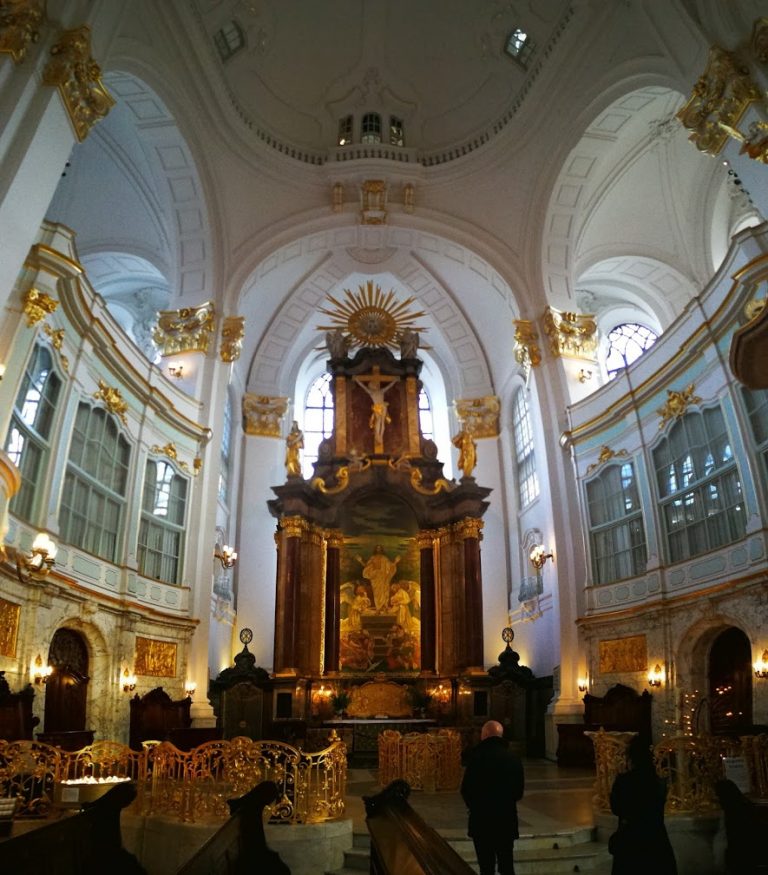
Visiting C. P. E. Bach’s Grave: St. Michael’s Church in Hamburg
Because I was traveling from Berlin to London on Sunday and had Saturday free, I went to pay my respects at the grave of C. P.…