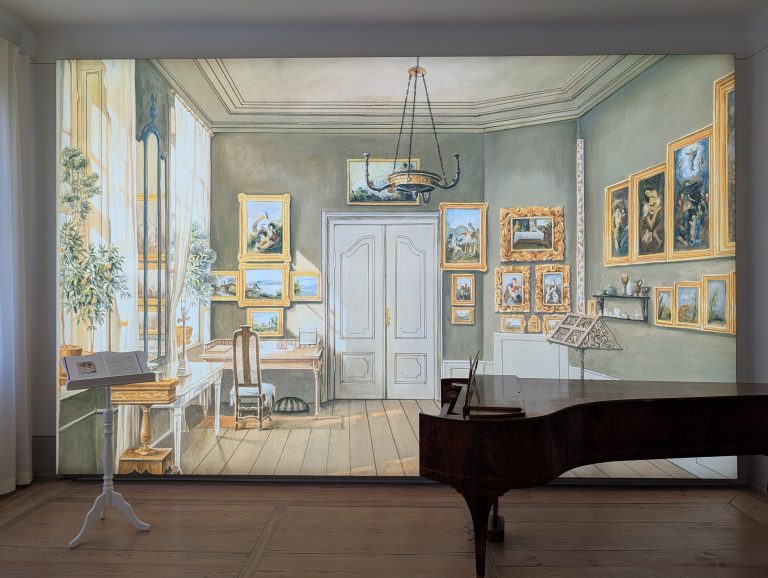

On the recent anniversary of the atomic bombing, August 6, we held a cimbalom concert in the Annex Hall of the Museum of Kyoto, the model for the CH Postal Company in “Violet Evergarden,” which airs today (November 25) on Friday Road Show. As an encore, we performed “Michishirube,” the ending theme for season 1 of the series. The work conveys the horrors of war, while Violet begins her journey from the CH Postal Company in search of the meaning of “I love you” as she struggles with PTSD. With the war in Ukraine having begun this year, I thought of those at Kyoto Animation who were killed in the arson attack while creating this work, those who rose again afterward, and those who died in the atomic bombing commemorated on this anniversary. It seemed to me the ideal setting and piece through which to contemplate a world without war.
This contains some spoilers, but for those unfamiliar with it, “Violet Evergarden” is an extraordinarily beautiful anime produced by Kyoto Animation. Set around Germany at a time resembling World War I, it tells of a girl raised as a weapon who has closed off her heart. Just as the “Major,” her final commanding officer, treats her as a human being and she begins to regain her humanity, she loses both arms on the battlefield. After the war, she tries to live while searching for the meaning of the words “I love you,” spoken by the Major just before he was declared “killed in action.” Her missing arms are replaced with advanced prosthetics, enabling her to type. In a society where many people are still illiterate, she works at the CH Postal Company as an Auto Memories Doll, writing letters for others, while seeking the meaning of “I love you.” Through Kyoto Animation’s crystal-clear artwork, the drama quietly builds layer upon layer around war-related PTSD, autism, typists as women at the forefront of entering white-collar work at the time, the scars of war that remain in society, what it means to live and die, and the meaning of it all. It is long, but it is an anime I very much hope you will watch.
For this performance we used the cimbalom, an instrument frequently played in Ukraine, which is being invaded this year. The performer, Junko Sakimura, played together with Ukrainian musicians in the Czech Republic in October.
The cimbalom belongs to the dulcimer family of instruments found across Eastern and Central Europe.1Smaller versions are also used in military bands, so Violet herself might perhaps have heard one. Please listen while imagining that as well.

If you enjoyed it, please subscribe to the YouTube channel.
From the concert organized by the Kansai Cimbalom Association,
“The Melancholy Sound Returns to Kyoto 2022”
- Piece: Michishirube (lyrics: Minori Chihara; music: Daisuke Kikuta)
- Cimbalom: Junko Sakimura
- Piano: Junko Shimizu
- Piano tuning: Kenji Shinohara
- Cimbalom adjustment and tuning: Kenji Koide
- Cimbalom owned by Rumi Tsukahara: Bohák Luxury Prestige
- Platinum sponsors: Rumi Tsukahara and Misako Ogura
- Supported by: Honorary Consulate General of Hungary in Osaka
- Recording location: Annex of the Museum of Kyoto
- Recording date: August 6, 2022
- Filming and editing: Tonescape
Bonus
Part of Leidenschaftlich appears to be based on a town called Cochem on the Moselle River, near Trier, a city with Roman heritage where an OAuth Workshop was held. The area is famous for its scenic beauty. Heidelberg also appears to have served as a model. I would like to visit someday.
Footnotes
Related posts
Song for June 15: Hakushū Kitahara and Kōsaku Yamada’s “Kono Michi”
In 1922, Hakushū Kitahara and Kōsaku Yamada launched the magazine Poetry and Music to unite poetry and music, establishing a modern song style that made use…

New Discovery: Mozart Works for Flute and Harp Premiered on 6/21 (6/23 Performance Recording Also Added)
Across 250 Years: Mozart’s “Unpublished Autograph” Found in Paris Reveals the Genius Behind the Legend An “Anonymous” Treasure Sleeping in a Corner of the Library On…