
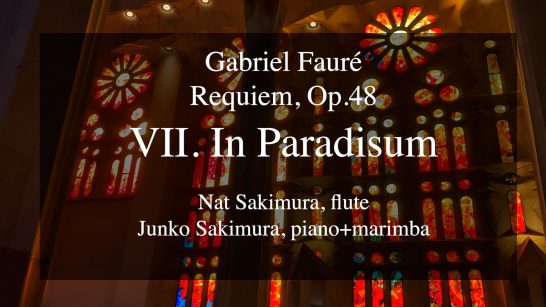
Here are my customary year-end greetings. This year I had begun preparing to perform “Lilium”, but after learning of the death of my close friend and ally Andrew Nash, I abruptly—though this was 3 months ago—changed to “In Paradisum,” the final movement of Fauré’s Requiem. This performance is dedicated to Andrew, and to all who live on through the work they left behind, with remembrance, gratitude, and quiet hope.
About Fauré’s “In Paradisum,” the Final Movement of the Requiem
One distinctive feature of Gabriel Fauré’s Requiem, Op. 48, is its inclusion at the end of In Paradisum.
This is not part of the traditional Requiem Mass, but belongs to the burial rite and is sung as the body is carried out of the church. Fauré deliberately chose this conclusion to avoid the fear and judgment often emphasized in settings centered on the Dies Irae. Instead, he portrays death as a gentle transition and release, ending not in fear but in light, comfort, and quiet hope. By placing In Paradisum as the final movement, Fauré transformed the Requiem into a farewell filled with peace, rest, and the hope of being led into paradise.
In Paradisum — Lyrics and Translation
| Latin | English Translation |
| In paradisum deducant te angeli, in tuo adventu suscipiant te martyres, et perducant te in civitatem sanctam Jerusalem. Chorus angelorum te suscipiat, et cum Lazaro quondam paupere aeternam habeas requiem. | May the angels lead you into paradise. At your arrival, may the martyrs receive you and lead you into the holy city, Jerusalem. May the choir of angels receive you, and with Lazarus, once poor, may you have eternal rest. |
About Andrew Nash
This video was made 3 months after the death of Andrew Nash, in his memory. Andrew was an outstanding identity professional and an irreplaceable friend. I had the privilege of working with him at Kantara Initiative and the OpenID Foundation, where his influence on the global digital identity ecosystem was profound and enduring.
He was instrumental in creating the Shared Signals Framework, which has recently attracted attention from the U.S. government and others; he authored its 2013 white paper1. He brought together vision, technical rigor, and a rare instinct for what actually works. More generally, he may be better known as the author of “PKI: Implementing and Managing E-Security” (RSA Press).
On a more personal note, I once invited Andrew to be a keynote speaker at OpenID Summit Tokyo 2011. In 2013, his future wife, Pam Dingle, visited my home in Japan. Over the years I visited Pam and Andrew’s home many times for RSA bootstrap parties and other gatherings, and together with many Identirati friends left my signature beneath the floorboards. During a home-renovation project, Andrew told me in the workshop he had built for the renovation that he hoped someday to build a piano. He never had the opportunity to realize that dream, but it remains a vivid reflection of his creativity and love of music.
About the Video
I filmed every video clip used here. They feature sacred and historic places that resonate deeply with the spirit of In Paradisum:
- Sagrada Família, Barcelona
- Glasgow Cathedral, Scotland
- Cathedral of Santiago de Compostela, Spain
- Toledo Cathedral (Primate Cathedral of Saint Mary), Spain
- Chapel of the Royal College of Noble Maidens, Toledo, Spain
About the Audio
Flute: Natsuhiko Sakimura; piano and marimba: Junko Sakimura. I also produced the choir and orchestral tracks.

Footnotes
Related posts
When Software Becomes Staff: Governance, Security, and Safety for Agentic AI
Below is the transcript of my keynote speech at EIC 2026 on May 19, 2026. The slides are provided as a PDF at the end of…
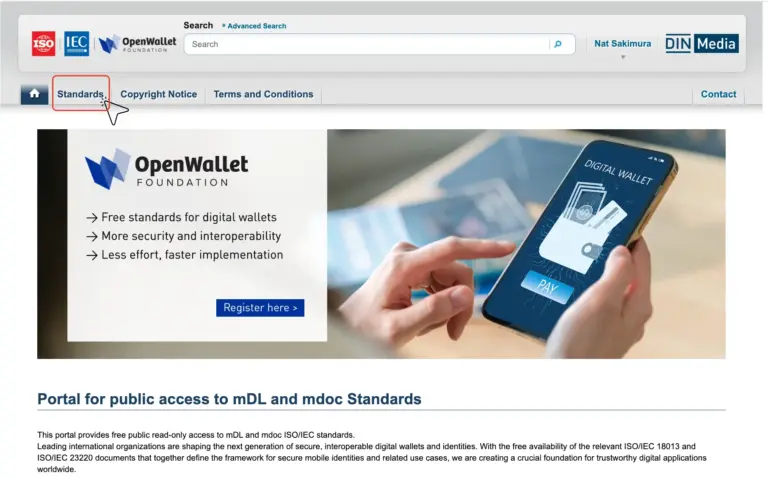
mDL/mdoc Standards Are Now Available to Access Free of Charge
As I shared in real time with those who follow me on X, standards related to mDL/mdoc are now available to access free of charge at…

IPA’s Mr. Tsuda Receives FORBES Japan’s “30 Under 30” Award
Mr. Tsuda of IPA, whom I think is one of the ID geeks, has been selected for FOEBES JAPAN 30Under30 2026. He is the second member…