
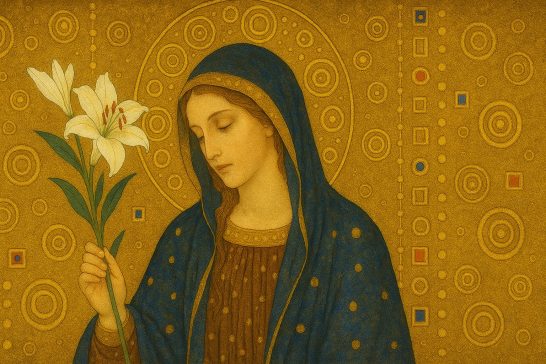
About the Music
Lilium (White Lily) is a song with Latin lyrics written for the anime Elfen Lied1 by Kayo Konishi and Yukio Kondo (MOKA☆) . In the opening sequence, it plays over imagery inspired by Gustav Klimt’s paintings2; it also appears as a music-box version, which becomes a key to memory within the story, and is used as incidental music at the climax.
There are also many cover versions, including one by VTuber Chima Machita, which has been viewed more than 3.2 million times, as well as an organ version, and a flute version.
The lyrics consist of 4 stanzas. The stanzas draw respectively on Psalm 37:30, James 1:12, and the Gregorian chant “Kyrie eleison,” as well as the medieval Latin Marian hymn Ave mundi spes Maria (“Hail Mary, Hope of the World”). For details, see Table 1. This background has led people in the West to describe the song as hymn-like. There are, in fact, records of performances by choirs in Kyiv, Ukraine, Chile, and elsewhere. (There are also reports of performances in churches across denominational lines, but I could not verify them.) Furthermore, in June 2025, it appears to have ranked at No. 1 on the J-Pop Top Songs chart of the Ukrainian iTunes Store.

Themes of Elfen Lied
The manga and anime tell an extremely violent story3. I had been reading it since the time of its serialization4. Elfen Lied is a science-fiction suspense story about a new human species with the potential to destroy humanity, known as the “Diclonius”5; its protagonist is a Diclonius girl named Lucy.
Within the work, the state isolates and controls the Diclonius because they could supplant humanity. Their origins and symbolism can be interpreted through religion and evolutionary theory, and as a metaphor for excluded minorities. In the real world, excluded minorities usually possess little physical force; in this story, they wield overwhelming power. That difference gives us still more to think about.
In the story, Lucy comes to live with Kouta, a young man she meets by chance, and the people around him, while confronting the tragic fate and harsh past of humanity and the Diclonius. It is a blood-soaked tale of pure love and psychological suspense that explores grave themes such as violence and love, discrimination, and forgiveness. It is also a provocative work that, in the world after the 9/11 terrorist attacks, confronts us with the question of what discrimination is. It contains a great deal of splatter violence. The theme song Lilium (White Lily) plays as though purifying it all.
The Lyrics of Lilium (Latin, Provisional English Translation, and Sources)
To understand this song, we should first know its lyrics and where they come from. Table 1 presents the lyrics in Latin, translation, and their sources. I have kept the translation as close as possible to the source texts. (Moka☆’s own freer rendering is available here.)
| Latin | Translation | Source |
|---|---|---|
| Os iusti meditabitur sapientiam, Et lingua eius loquetur iudicium. | The mouth of the righteous speaks wisdom, and his tongue speaks justice. | Psalm 37:30 |
| Beatus vir qui suffert tentationem, Quoniqm cumprobatus fuerit accipiet coronam vitae. | Blessed is the one who perseveres under trial, because, having stood the test, that person will receive the crown of life promised to those who love God. | James 1:12 |
| Kyrie, ignis divine, eleison | Lord, divine fire, have mercy. | A passage composed by the lyricists, inspired by established religious expressions, scripture, and hymn texts such as “Kyrie eleison,” “Beatus vir,” and “Ave mundi spes Maria.” |
| O quam sancta, quam serena, Quam benigma , quam amoena esse Virgo creditur! O castitatis lilium | O how holy, how serene, how kind, how lovely the Virgin is believed to be! O lily of chastity. | Quoted from the medieval Latin Marian hymn “Ave mundi spes Maria” (a parallel translation appears at the end). |
Here, “the righteous” means a person who follows God’s teachings and lives with integrity. The question, then, is what “God” refers to here. Is the voice of DNA the voice of God? The “mouth” and “tongue” symbolize the person’s words and deeds.
The next stanza—“Blessed is the one who perseveres under trial, because, having stood the test, that person will receive the crown of life promised to those who love God”—means more than a believer simply enduring and overcoming hardship. By maintaining hope and love rooted in faith, and persevering to the end, a person grows toward human and spiritual maturity and receives the blessing of eternal life: entry into the Kingdom of God.
The following line, “Lord, divine fire, have mercy,” is an invocation containing a deeper religious symbol and an urgent plea to be purified by God’s purity and power, represented by fire.
The final stanza, “How merciful, how full of loving affection—O pure white lily,” is a phrase of salvation: the Virgin Mary, symbolized by the white lily, brings people peace and aspiration, comfort and an ideal to emulate. This is where the song’s title, Lilium (White Lily), appears. The phrase castitatis lilium is quoted from Ave mundi spes Maria, which in turn alludes to Matthew 6:28: “And why take ye thought for raiment? Consider the lilies of the field, how they grow; they toil not, neither do they spin.” Here, the white lily symbolizes an innocent soul and purity adorned by God—within Christianity, generally the Virgin Mary. Its weight becomes apparent when set alongside the story and the use of this song at the anime’s climax. I have also included, at the end of this article, an appendix containing Ave mundi spes Maria and a discussion of its religious context; please have a look if you are interested.
Sheet Music
I do not believe official sheet music for the anime opening version has been published. (There is no soundtrack release either…) On the other hand, the composers have published an arrangement for mixed choir and sheet music and a CD for a solo-piano version. I bought them as well. Figure 2 shows a reference performance of the piano-accompanied version. (Personally I prefer the pipe-organ accompaniment, but it can only be heard by buying the CD.) I think this version expresses the composers’ intent well. Incidentally, I believe this was the version that, in June 2025, reached No. 1 on the J-Pop chart of the Ukrainian iTunes Store.

Many other choir videos feature ensembles from Kyiv, the capital of Ukraine. In light of the current situations in Ukraine and Palestine, I am thinking of using this piece for my greeting this year6. This article is partly preparation for that project.
Incidentally, when the conflict in Ukraine began, I held an emergency workshop about it in the United States. A fairly large room was filled to capacity, and we had an earnest exchange of views.

Moreover, the vice-chair of the OpenID Foundation (I am its chair) is Ukrainian—and is from the conflict region itself. That is another reason I feel this project is worthwhile.
(Appendix A1) Ave mundi spes Maria (“Hail Mary, Hope of the World”): Parallel Translation and Context
A.1 Parallel Translation of Ave Mundi Spes Maria
Table 3 presents a parallel translation of Ave mundi spes Maria.
| Latin | Translation |
|---|---|
| Ave mundi spes Maria | Hail Mary, hope of the world. |
| Ave mitis, ave pia, | Hail, gentle one; hail, merciful one. |
| Ave plena gratia. | Hail, one full of grace. |
| Ave virgo singularis, | Hail, singular Virgin, |
| Quae per rubum designaris | prefigured by the bush |
| Non passum incendia. | that did not suffer the flames. |
| Ave rosa speciosa, | Hail, lovely rose, |
| Ave Jesse virgula: | hail, shoot of Jesse7. |
| Cujus fructus nostri luctus | whose fruit has loosened |
| Relaxavit vincula. | the bonds of our sorrow. |
| Ave cujus viscera | Hail, whose womb, |
| Contra mortis foedera | against the covenant of death, |
| Ediderunt Filium. | brought forth the Son. |
| Ave carens simili, | Hail, one without equal, |
| Mundo diu flébili | to a world long in mourning |
| Reparasti gaudium. | you restored joy. |
| Ave virginum lucerna, | Hail, lamp of virgins, |
| Per quam fulsit lux superna | through whom the heavenly light shone |
| His quos umbra tenuit. | upon those held in shadow. |
| Ave Virgo de qua nasci, | Hail, Virgin, from whom |
| Et de cujus lacte pasci | and at whose milk |
| Rex caelorum voluit. | the King of Heaven willed to be born and fed. |
| Ave gemma caeli luminarium. | Hail, jewel among the lights of heaven. |
| Ave Sancti Spiritus sacrarium. | Hail, sanctuary of the Holy Spirit. |
| O quam mirabilis, | O how wondrous |
| Et quam laudabilis, | and how worthy of praise |
| Haec est virginitas! | is this virginity! |
| In qua per Spiritum | In it, through the Spirit, |
| Facta Paraclitum | the Paraclete was conceived |
| Fulsit foecunditas. | and fruitfulness shone forth. |
| O quam sancta, quam serena, | O how holy, how serene, |
| Quam benigna, quam amoena | how kind, how lovely |
| Esse Virgo creditur! | the Virgin is believed to be! |
| Per quam servitus finitur, | Through her, servitude ends, |
| Porta caeli aperitur, | the gate of heaven opens, |
| Et libertas redditur. | and freedom is restored. |
| O castitatis lilium, | O lily of chastity, |
| Tuum precare Filium, | pray to your Son, |
| Qui salus est humilium: | who is the salvation of the lowly, |
| Ne nos pro nostro vitio, | that for our sin |
| In flebili judicio | he may not subject us to punishment |
| Subjiciat supplicio. | at the sorrowful judgment. |
| Sed nos tua sancta prece | But by your holy prayer, |
| Mundans a peccati faece | cleansing us of the filth of sin, |
| Collocet in lucis domo. | may he place us in the house of light. |
| Amen dicat omnis homo. | Let every person say “Amen.” |
A.2 Theological Background
(1) Central Themes of Mariology
This poem is an expansive celebration of Mary’s distinctive role in Catholic theology. It gives particular emphasis to the following three points.
- Mediator in Salvation History
- The invocation “hope of the world” (spes mundi) symbolizes Mary as the gateway through which salvation in Christ comes into the world.
- The expression porta caeli (“gate of heaven”) suggests her role as the path through which divine grace reaches humanity.
- Fulfillment of Old Testament Types
- The “bush that burned without being consumed” (rubum designaris non passum incendia) refers to the miracle of Moses’ burning bush in Exodus 3, and symbolizes the mystery of bearing the Son of God while remaining a virgin.
- The “shoot of Jesse” (Jesse virgula) is a reference to Isaiah 11:1 and emphasizes the Messiah’s lineage.
- The Union of Virginity and Motherhood
- The succession of phrases beginning “How holy, how serene…” strongly evokes the Catholic doctrines of the Immaculate Conception and perpetual virginity.
- At the same time, titles referring to Mary as the Mother of God (Theotokos) recur, portraying her not merely as a model believer but as a central figure in salvation history.
(2) Relationship to Christology
- Mary is always praised as the path to Christ. Here too, references such as “the Son” (Filium) and “King of Heaven” (Rex caelorum) make it clear that the ultimate end is the worship of Christ.
- Theologically, praise of Mary leads directly to praise of Christ. Its foundation is the idea of Marian mediation: one reaches God through Mary.
A.3 Examples of Biblical Allusions
| Expression in the Poem | Biblical Reference | Symbolic Meaning |
|---|---|---|
| The bush that burned without being consumed | Exodus 3:2 | A symbol of purity: the Virgin bears the Son while remaining a virgin |
| The shoot of Jesse | Isaiah 11:1 | A sign of the Messiah’s lineage (the House of David) |
| The gate of heaven | Genesis 28:17, Revelation 21:12 | Heaven and earth are joined through Mary |
| The rose | Song of Songs 2:1 | A symbol of divine love and Mary’s virtue |
| The lily (castitatis lilium) | Matthew 6:28 (the lilies of the field)8 | A symbol of chastity and purity (an innocent soul, purity adorned by God) |
A.4 Liturgical Context
(1) Occasions When It Is Used
- Feasts of the Virgin Mary
- On major feasts, especially the Assumption of Mary (August 15) and the Immaculate Conception (December 8), it may be used as a hymn at Second Vespers in the Liturgy of the Hours.
- Special Acts of Marian Consecration
- After the Rosary, it may be sung as one of the Marian antiphons.
- Monastic Traditions
- It tends to be sung in religious orders with strong Marian devotion, such as the Cistercians and Benedictines.
(2) Musical Tradition
- From the Middle Ages through the Renaissance, it was often set in a Gregorian-chant style or in polyphony.
- Renaissance composers in particular, including Josquin des Prez and Palestrina, created polyphonic settings; it was also used as a text for liturgical Masses and motets. Figure 3 shows Palestrina’s version.

A.5 Summary of the Theological Message
This poem
- joins Old Testament symbols (types) to their New Testament fulfillment,
- has a theological structure that leads through Mary to salvation in Christ, and
- serves within the prayer of the Church as a text supporting both personal devotion and public liturgy.
In other words, this is not merely a poem but a hymn in which biblical theology, doctrine, and liturgy converge.
Footnotes
- Today, I suspect an anime like this could no longer be made because of “political correctness.”
- Analysis: Examining the Paintings in the Elfen Lied Opening Sequence — A Comparison with Gustav Klimt’s Paintings offers a detailed comparison
- The manga and anime have different storylines.
- 2002, issue 27, through 2005, issue 39, in Young Jump
- The term refers to women with special abilities who have a pair of 2 horns protruding from the sides of the head and invisible arms called “vectors.”
- although I cannot promise it. There is also the considerable problem of how to reduce a four-part mixed-choir score for flute…
- the father of King David in the Old Testament
- “And why take ye thought for raiment? Consider the lilies of the field, how they grow; they toil not, neither do they spin.”
Related posts
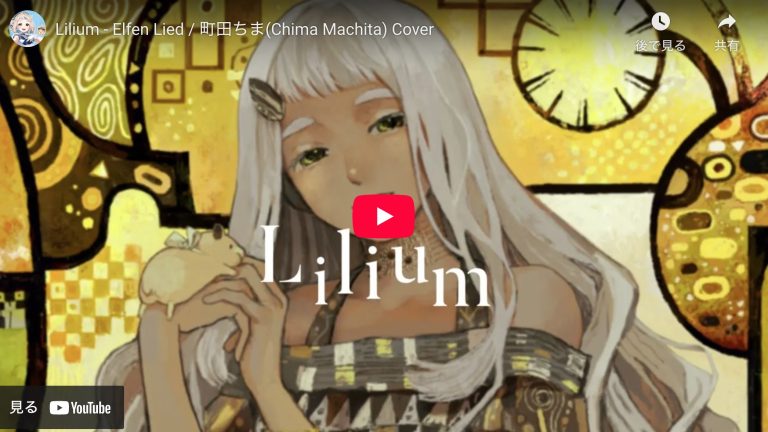
VTuber Chima Machita’s “Lilium” and “Caro mio ben”
This article was originally inspired by Chima Machita's singing, but it became too long after substantial additions, so I am splitting it into 2 articles. Revised…
Greetings to Everyone Who Helped Me This Year: Fauré’s “Pie Jesu”
December has already passed its 3 out of 1 mark. As every year, it has flown by, and it was another year that I somehow managed…

The Background, Lyrics, and Recommended Performances of Giordani’s “Caro mio ben (My Beloved)”
The Background of Caro mio ben “Caro mio ben” is an Italian song (arietta) from the 18th century. In Japanese, its title means “My beloved.” The…