
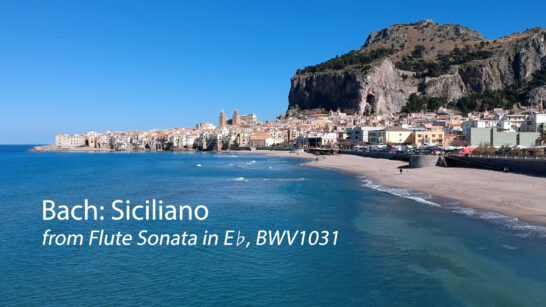
Season’s greetings once again this year. I present Bach’s Siciliano, mainly against a backdrop of scenery from Sicily. The flute I am using was made in London in the 1920s: a cocuswood Louis flute with serial number 81. The instrument accompanying it is a TOKAI spinet (a small harpsichord) that was probably made about 40 years ago. The flute underwent a thorough overhaul this year and is now in quite good condition.
This Siciliano is among Bach’s most famous pieces, but it is also a work suspected of being spurious. Its style is slightly different from Bach’s. It has been suggested that a student wrote it based on a piece by Bach’s contemporary Quantz, and that Bach then revised it. It is attributed to Bach because his son, the great composer C.P.E. Bach, recorded it as such (for more about him, see my blog post “C.P.E. Bach, Father of Classical Music—Anniversary of His Birth: 300 Years”). However, some have also suggested that the son recorded his father’s name on a work that he himself, as his father’s student, had written and his father had revised1.
Many things happened this year as well. I lost several people close to me2. The state of the world is also looking bleak, and noncombatants, including many women and children, are being massacred. Each day makes me wonder why humanity does not learn from history. Given these circumstances, unlike in an ordinary year, I chose a secular piece. I had actually considered performing Fauré’s In Paradisum or the hymn Veni Emanuel, but they mention place names3….
The video accompanying the piece mainly shows scenes from Sicily. Mount Etna and the lighthouse in Syracuse appear. May the peaceful scenery and music bring peace to your hearts. I wish you a pleasant close to the year.

Footnotes
- For details, please see “Bach’s Siciliano Isn’t Really by J.S. Bach, Is It…?”.
- Mr. Matsushita, Vittorio, and Morio
- Jerusalem and Israel, respectively
Related posts
Bach’s Siciliano Isn’t Actually by J. S. Bach, Is It…?
One piece frequently performed as a work by J. S. Bach is the “Siciliano.” It was originally from Flute Sonata BMV 1031, as its movement 2.…
Season’s Greetings—J. S. Bach: Sheep May Safely Graze (Flute, Piano, Spinet, and Marimba)
https://www.youtube.com/watch?v=qP9l47YJuzc To everyone who has supported me this year: 2020 was the year I opened my independent practice amid the coronavirus pandemic, and although I wondered…
Bach’s “Toccata and Fugue in D Minor, BWV 565”: Originally a Violin Piece?
Is Bach's “Toccata and Fugue in D Minor, BWV 565” by Someone Else? One of J.S. Bach's best-known works is the “Toccata and Fugue in D…