
Syrinx, written in 1913, is surely an irreplaceable part of every flutist’s repertoire. Pieces known for solo flute were so rare at the time that, before this one, we have to go all the way back to C.P.E. Bach’s Sonata in A Minor from 1763. Written under such circumstances, this piece richly expresses a variety of emotions through a single melodic line and became a turning point that greatly expanded the possibilities of flute music thereafter.
Syrinx was written as incidental music for Gabriel Mourey’s play “Psyché.” It was intended to be performed offstage during the play, and as for the story that it was originally titled “The Flute of Pan,” and so forth, please see the Wikipedia article 1.
Today’s topic, however, is the mysteries surrounding this piece. Several mysteries have been raised.
- There is a theory that it was originally written without bar lines, which Marcel Moyse 2 later added, producing the version handed down to us today.
- In the JOBERT edition edited by the dedicatee Louis Fleury 3, the B note in the penultimate bar bears an accent (musical example 1), but the discovery of a handwritten score (musical example 2) showed that it was originally a diminuendo.
Let us begin with the first mystery. Its source appears to be something Marcel Moyse said. According to an article written in 1991 4, one afternoon at a party, with Moyse watching, Debussy strode over to a piano beside a small statuette and wrote the piece, which Moyse premiered that evening. The score had neither bar lines nor phrase markings; Moyse later added all of them. Yet while Debussy was being praised by those around him, the score vanished into the pocket of “a certain flutist famous for appropriating scores.” It remained missing until, after that flutist died, his widow brought his scores to Moyse for help disposing of them.
This account has attracted much criticism. Jean-Pierre Rampal apparently described it as a misconception on Moyse’s part and, in the following month’s 5, said that the piece had been written as incidental music for the play mentioned at the outset, dedicated to Louis Fleury, and premiered by him. This is the commonly accepted view in France and still appears to have support today. If so, the claim that “there were no bar lines” would seem to be an urban legend. Nevertheless, for reasons discussed below, I think this story may not be entirely false.
The 2nd mystery is that, ever since the JOBERT edition (1927) edited by the dedicatee Louis Fleury, many scores in circulation have indeed shown an accent (musical example 1).
(Musical example 1) The final section of Syrinx. The “B” in the 2nd bar from the end bears an accent.

(Source) Editions JOBERT 6
In fact, many editions published since then 7 have followed it, and as a result many performances accent this note. Let us listen to Jean-Pierre Rampal.

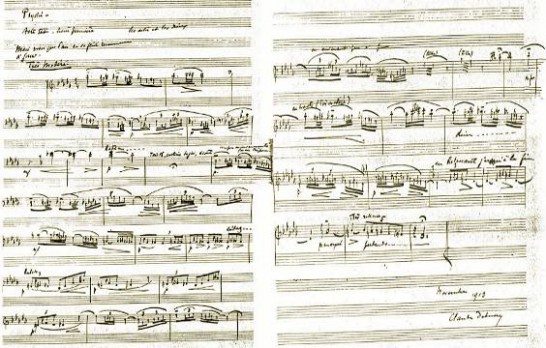
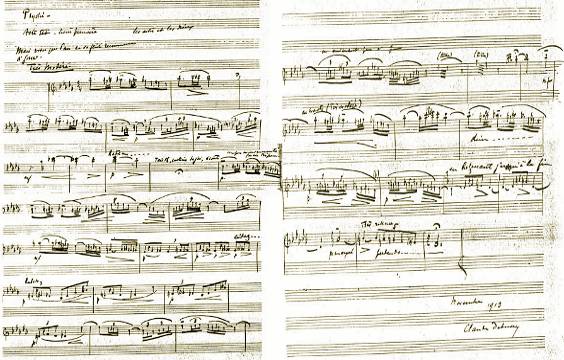
However, in 1993, a purported handwritten score (musical example 2) was published in which it is clearly a diminuendo.
(Musical example 2) Facsimile of the purported autograph score
(Musical example 2a) Enlargement of the final section
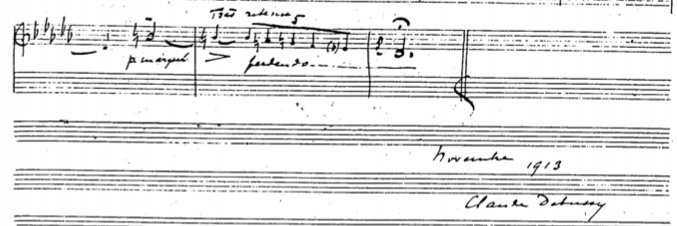
The accent on this “B” had been puzzling because it did not fit the text’s image of drifting off and one’s consciousness growing hazy. If it is a diminuendo, however, it feels exactly right. This was pointed out to me on Sunday, and when I saw musical example 2, I could not help exclaiming, “I see!” in utter admiration.
This is what it sounds like.

Emmanuel Pahud is superb. “Yes, this is how it has to be!” I thought… but apparently the matter is not so simple. In musical example 2 (and musical example 2a), there is what looks like Debussy’s signature at the bottom right of the right-hand page. That is the troublesome part. Anyone who has seen Debussy’s letters and the like may think, “Wait a minute.” Debussy’s autograph signature looks like this.
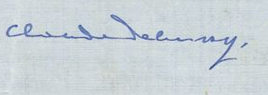
(Figure 1) Debussy’s signature 8
Yes. They are completely different. In fact, handwriting analysis apparently suggests that this score is neither in Debussy’s hand nor in that of Fleury, to whom it was dedicated 9.
Now we have a problem. The “handwritten autograph score” that seemed to offer decisive evidence may be a fake.
Thus, with the autograph manuscript lost, the truth about this piece may remain shrouded in darkness forever. If there is one ray of hope, it is that a performance by Moyse, a contemporary, survives.

In this performance, it is a diminuendo rather than an accent…. But that raises the question of why Fleury edited it as an accent. Could his eyesight have failed in old age? The publication was in 1927, so Fleury was… wait, he was already dead…. He died in 1926. Does that mean the flutist Moyse mocked was Fleury? To begin with, Moyse’s account is very specific, isn’t it? Composing it at a piano beside a small statuette at an afternoon party, and so on…. Would someone of Moyse’s stature really need to invent such details? The mystery only deepens. And what if the “signature” reading “Claude Debussy” on that “autograph score” was simply Moyse noting who had composed it? I would very much like to see Moyse’s handwriting 10. As the long autumn nights draw in, the mystery grows deeper still 11.
Well, we cannot know the truth, but for my part I would like to adopt the diminuendo interpretation, which better suits the musical conception.
Footnotes
- Syrinx http://ja.wikipedia.org/wiki/シランクス
- Marcel Moyse (May 17, 1889 – November 1, 1984), an exceptionally renowned flutist known as the father of modern flute technique. http://ja.wikipedia.org/wiki/マルセル・モイーズ
- Louis Fleury (1878 – 1926), French flutist.
- Marcel Moyse recalled, “Debussy was asked to compose some music inspired by a statuette of a shepherd playing his pipe. On the afternoon of the party, Debussy strolled over to the piano adjacent to the statuette and rapidly wrote his little Syrinx. He handed me the manuscript to perform that evening. The composition lacked even a bar line or phrase marking; all markings on the manuscript were mine. The little work was almost lost to flutists when Debussy showed the manuscript to another flutist who was singularly adept in appropriating manuscript copies of flute works from the library. The manuscript conveniently found itself in the flutist’s coat pocket while Debussy was engaged in conversation with admirers. After the thieving flutist died, his widow, in need of money, called me to her assistance in disposing of the deceased’s collection of flute music. In the collection was, of course, the original and only copy of Syrinx.” Performance Guide: Interpreting Syrinx by Roy E. Ernst and Douglass M. Green. Flute Talk February 1991
- Flute Talk March 1991
- Debussy, C.: Syrinx, Editions JOBERT (1927, Renewed 1954)
- “Debussy, ‘Syrinx,’ and the Autograph Manuscript” is informative. http://www.ne.jp/asahi/jurassic/page/talk/pahud/syrinx.htm
- Fraser’s Autographs: Claude Debussy Incidentally, as of 2014/10/5, it is priced at £2250.
- http://www.flutetunes.com/tunes.php?id=163 To an amateur eye, however, the handwriting of the music itself looks plausible, so perhaps someone added only the name later. Could it perhaps have been Marcel Moyse?
- His handwriting in 1972, when he was over 80 years old, can be found at http://www3.tokai.or.jp/satou/flute/. Unlike Debussy’s, it slants forward, and in that respect it matches musical example 2a.
- There is one more mystery. According to Jane F. Fulcher’s “Debussy and His World,” p. 138, the fragment of “Syrinx” included in a book Fleury published during his lifetime apparently differs substantially from the “Syrinx” we know today. Perhaps the incidental music “Syrinx” dedicated to Fleury and the piece “Psyché” that we now know as “Syrinx” are separate works.
Related posts
“Doppler: Andante and Rondo, Op. 25” in the Mirror
About Franz Doppler Franz Doppler (1821-1883) was a Hungarian-Austrian composer, conductor, and flutist. As the composer of the famous “Hungarian Pastoral Fantasy,” he is known to…
On the 230th Anniversary of Kuhlau’s Birth
I seem to have an affinity for composers who remain in the historical record but are relatively obscure. While sorting through a pile of scores at…
Season’s Greetings—Bach: Siciliano (Flute and Spinet)
Season's greetings once again this year. I present Bach's Siciliano, mainly against a backdrop of scenery from Sicily. The flute I am using was made in…
You must be logged in to post a comment.