
To be honest, Mamoru Samuragochi’s name was completely off my radar until Twitter posts about this incident began appearing 1. I had no idea that he had somehow been celebrated as a “modern Beethoven.” Apparently, he was said to have a grade 2 physical disability due to profound acquired hearing loss, to have completed symphonies, and to have been highly praised by critics, but the truth was different—a rather pungent story. I am doubly an amateur: merely a music lover, and someone who has learned a fair amount about hearing impairment because a person close to me has it. Even so, public misconceptions around this affair are so egregious that I decided to write another installment in my misconception series.
- The misconception about the concept of composition
- The misconception that Mr. Niigaki used Mamoru Samuragochi’s name because circumstances prevented him from appearing publicly
- The misconception that those composition instructions were remarkable
- The misconception that Beethoven had profound hearing loss
- The misconception that contemporary music is incomprehensible
Those are the 5 misconceptions. Please read this casually.
1. The misconception about the concept of composition
One of the first things circulated in this affair was the famous diagrammatic set of composition instructions. Some people seem to think it could itself be called composition, but of course it cannot. At most it is like presenting one short melody, having someone build a piece from it, and then calling the work the composition of the person who supplied the melody—oh, apparently Japan does call that composition (laughs).
The strange distinction that the person who writes the melody is the composer while the person who constructs it in sound is the arranger is itself a major misunderstanding. The real artistic act is assembling the piece. We should stop calling the melody writer the composer and the person who turns it into a piece the arranger. Such thinking presumably also enables the fake Beethoven’s staging about “music descending upon him.”
For quite some time I have written a blog series called Music Topics. It basically finds pieces with similar melodies and says, “They sound alike,” but it is also intended to protest the odd melody-centered situation today, especially in Japan. A melody is only raw material. In architectural terms, it is at most a carved column. If someone uses it to make a magnificent building, we do not call the column’s maker the building’s creator. Yet this “transcendently absurd thing” is accepted in music. Commercial music business practices, lawyers who do not understand music, and many other problems are probably involved.
Returning to writing music from these “composition instructions,” the architectural analogy would be that the client (Mr. Samuragochi) said, “I want this kind of house,” and the architect (Mr. Niigaki) made the actual house. Mr. Niigaki is of course the composer, but because the misconception above is widespread, funky opinions emerge that perhaps the “client” may be called the “architect.”
This affair is an excellent opportunity for Japanese copyright law to reconsider what composition means, and ideally to correct itself. Under Japanese copyright law, astonishingly, in “theme and variations” the composer is apparently the person who wrote the theme. By classical-music common sense, the true composer is obviously the person who wrote the variations. A quick investigation suggests Italian copyright law explicitly designates the writer of the variations as composer in this case. Japan should follow suit and at least fix this much.
2. The misconception that Mr. Niigaki used Mamoru Samuragochi’s name because circumstances prevented him from appearing publicly
“Why did Mr. Niigaki not publish the pieces under his own name?”
Many people apparently had this question. Mr. Samuragochi also seems to have said that circumstances prevented Mr. Niigaki from appearing publicly.
But anyone with even a little musical experience can immediately see an extremely simple reason:
“I would not want to publish such an embarrassing piece under my own name.”
That is all.
I have heard only tiny portions under Mamoru Samuragochi’s name, such as the 3rd movement of Symphony No. One HIROSHIMA, but it is cloyingly Romantic—frankly, anachronistic. Perhaps Mr. Niigaki thought, “What awful taste,” yet treated it as craftsmanship: “The client wants this, so I will make the best thing possible within those constraints.” (As craftsmanship fulfilling a client’s wishes, however, I think it is of exceptionally high quality.)
Incidentally, publishing such anachronistic music under another person’s name is a classical-music tradition. Consider Kreisler: he published his own pieces under the names of old composers and kept performing them everywhere. The work known as “Adagio by Albinoni” (an Italian Baroque composer) was not written by Albinoni but was written by Remo Giazotto in 1958. The piece known as “Ave Maria by Caccini” (an early-Baroque Italian composer) was written in 1970 by Russian composer Vavilov. Anyone with decent ears can immediately recognize either as a forgery, yet in Kreisler’s case the world was apparently thoroughly fooled until he revealed it himself. (Though many people probably noticed….)
Looking carefully, the Mamoru Samuragochi affair likewise seems to have contained numerous oddities, but fundamentally it did not emerge until an insider disclosed it. The parallel structure is interesting.
Kreisler revealed his authorship after critic Leopold Schmidt wrote in a Berlin newspaper that “Kreisler’s playing was insensitive, but the unpublished Josef Lanner piece he performed rivaled Schubert.” Kreisler retorted, “A piece I wrote could hardly rival Schubert” 2. In a sense, this resembles the current affair. Perhaps Mr. Niigaki felt: “That embarrassing piece is being hailed as a masterpiece of the century. What nonsense. Surely I must correct this.”
Yet critics seem unchanged across the ages. What is wrong with them? Do they have no ears at all? Plenty of embarrassing criticism seems to have appeared this time too; it is strange. Still, each person presumably has their tastes and principles, and those differences must be tolerated.
So I have a request for such critics: regardless of what happened, please continue promoting works under Mamoru Samuragochi’s name. A different author’s name should not change a work’s intrinsic value. If critics or musicians reverse themselves now, I will seriously question their fitness 3.
3. The misconception that those composition instructions were remarkable
When the affair became public, the diagrammatic instructions for Symphony No. 1 HIROSHIMA circulated, along with scattered comments that they were “well written” or “amazing.”
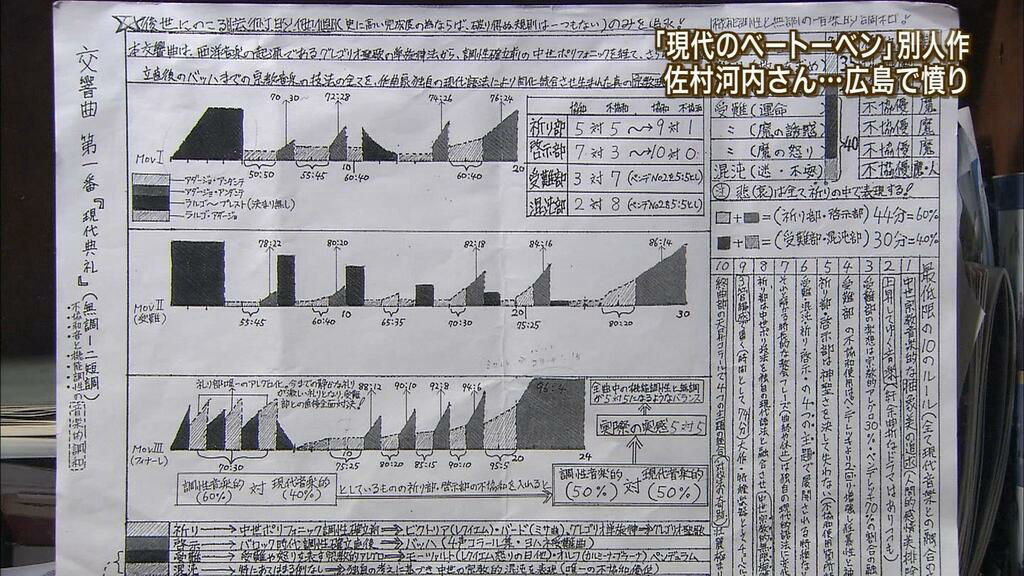
(Source) Buzzap Mamoru Samuragochi’s composition instructions attract attention as amazing after reports that another person composed his music → further suspicions that he can hear (2014-02-06)
There may be various opinions, but I simply cannot agree.
Another work under Mamoru Samuragochi’s name readily heard on YouTube is “Short Piece for Wind Band.” According to an interview, it had no such instructions. As music, I think it is far better. Could that be because no detailed order sheet from Mr. Samuragochi existed, giving the composer greater freedom?

4. The misconception that Beethoven had profound hearing loss
Now, this fake Beethoven was supposedly profoundly hearing-impaired. I say “supposedly” because it apparently was malingering. I exchanged various messages with Ken Ito, but I cannot believe he truly had profound hearing loss. His pronunciation is far too clear for someone supposedly in that condition for 18 years. I will not pursue that question further here. The topic here is Beethoven’s hearing, which made a “fake Beethoven” possible.
Many know the story that Beethoven was hard of hearing and completely deaf by about age 40. In fact, this information cannot possibly be correct. Understanding why requires learning a little about hearing loss.
Terms such as moderate and profound hearing loss are often used. They describe the degree of hearing, defined by WHO as follows.
【World Health Organization (WHO) classification of hearing loss by hearing level】
| Mild | 26–40 dB |
| Moderate | 41–55 dB |
| Moderately severe | 56–70 dB |
| Severe | 71–90 dB |
| Profound | 91 dB or more |
(Source) Types of Hearing Loss and Hearing Levels
Another classification is based on mechanism.
| Conductive hearing loss | Hearing loss caused by disorders of the outer or middle ear Because sound merely has difficulty being transmitted, amplifying it with a hearing aid can restore relatively good hearing. Treatment can sometimes improve symptoms. |
| Sensorineural hearing loss | Hearing loss caused by disorders of the inner ear, auditory nerve, or brain (age-related hearing loss is also sensorineural). Sound is distorted or resonates, reducing speech clarity. Merely amplifying sound through a hearing aid does not work well; its sound quality and output require detailed adjustment. |
| Mixed hearing loss | Hearing loss with causes of both conductive and sensorineural loss |
(Source) Basic Knowledge of Hearing Impairment
Conductive hearing loss is rarely worse than moderate; serious hearing loss is almost always sensorineural. Sensorineural loss does not merely make sounds harder to hear: it distorts them and causes many other effects. This is difficult for people with ordinary hearing to understand. By chance, today I found a blog that explains it well, so I introduce it here.
Visualizing How People with Hearing Impairment Hear
Hearing loss is also classified by when hearing was lost.
| Congenital | When the auditory system is damaged by malformed auditory structures or viral infection during pregnancy (especially rubella), among other causes |
| Acquired | When auditory structures are damaged by sudden illness, medication side effects, head trauma, noise, aging, or other causes |
(Source) Basic Knowledge of Hearing Impairment
When considering hearing loss, this 3-dimensional matrix is important. For example, someone with congenital hearing loss faces enormous difficulty acquiring spoken language and the concept of music. Understanding something never experienced is extremely difficult.
Now that we are prepared, consider Beethoven. He is said to have “become completely deaf around age 40.” Complete deafness did not appear above, but means hearing of 100 dB or worse in both ears (Enforcement Regulations of the Act on Welfare of Physically Disabled Persons, Appended Table No. Five). In the classifications above, that is acquired profound hearing loss. Yet various information suggests this is incorrect.
After losing his hearing, Beethoven reportedly composed by holding a wooden rod in his mouth against the piano. This uses bone conduction. He is also said to have heard Liszt perform late in life and instantly become a fan. With profound hearing loss, such things are basically impossible. Hearing through bone conduction, for example, means the nerves of the inner ear are intact while the path carrying sound to them is impaired, so bone vibration bypasses that path. It is difficult if the inner-ear nerves are damaged. Beethoven could do this because his hearing loss must have been conductive.
Indeed, sources say Beethoven’s ear disease was otosclerosis, a type of conductive hearing loss that today can be considerably improved by surgery. Hearing aids are also quite effective because it is conductive. Conductive loss rarely exceeds moderate severity. In other words, Beethoven was not completely deaf or even profoundly impaired. At most his hearing loss was moderate, perhaps even mild 4. In a sense, that may be precisely why he could continue composing.
As for Mr. Samuragochi himself, if he says he “hears about as little as Beethoven,” I might answer, “Perhaps.” At that level his pronunciation would not deteriorate, and noticing someone call to him would be entirely possible. If he says, “I did not use complete deafness as a formal term; Beethoven is said to have been completely deaf, so I used it as a ‘music-world term’ to match him,” then perhaps that is the story 56. Still, because such conduct creates misconceptions about hearing impairment, he absolutely should stop.
5. The misconception that contemporary music is incomprehensible
What can one even say…? As discussed in detail in columns by Ken Ito and Shoko Egawa below, the idea that contemporary music is meaningless to ordinary people is a grave misconception. Play Schoenberg to kindergarteners and they will happily say, “That’s a nice song.” Everyone hears contemporary music naturally on television and in films. It is merely the “adult ear” that considers it incomprehensible because it has been contaminated by tonal music.
Vi Hart’s YouTube video about 12-tone music (the atonal technique pioneered by Schoenberg) explains this background very clearly. It reached 1 million views almost immediately after release. It clearly explains how people become slaves to tonal music heard in the past and how they might be liberated. Both the music and illustrations and animation are wonderful. Although it is in English, please watch it.

Conclusion
I decided to write this rambling essay after exchanging messages on Twitter Thursday night with Ken Ito. Without that exchange, I would not have felt inclined to organize my thoughts this way. I thank him for providing the impetus.
Since then, he and other knowledgeable people have written highly suggestive columns about the fake Beethoven affair. I will close by introducing links to them.
- Ken Ito, “Commentary on the Fake Beethoven Affair Is Full of Errors,” JBPress (2014-02-08)
- Yui Morishita, “Music Given a More Accurate Story Is Happier: On the Mamoru Samuragochi (Takashi Niigaki) Uproar” (2014-02-07)
- Shoko Egawa, “To Avoid Bringing About ‘The Death of Classical Music’: Conductor Kazushi Ono’s Warning” (2014-02-09)
- Ken Ito, “Exploiting Musicians’ Goodwill: The Fake Beethoven Who Crossed the Line” (2014-02-12) (Added 2/12)
- Takashi Yoshimatsu, “Still More on the Mr. S Uproar: Performers” (2014-02-11) (Added 2/13)
- Takashi Yoshimatsu, “Persistently on the Mr. S Uproar: Symphonies” (2014-02-08) (Added 2/13)
- Takashi Yoshimatsu, “The Mr. S Uproar Again: Apologies for the Length” (2014-02-07) (Added 2/13)
- Takashi Yoshimatsu, “More on the Mr. S Uproar” (2014-02-06) (Added 2/13)
- Takashi Yoshimatsu, “The Mr. S Uproar” (2014-02-05) (Added 2/13)
(Revision History)
- 2014-02-12 Added 1 Ken Ito article to “Conclusion.”
- 2013-02-13 Added 5 Takashi Yoshimatsu articles to “Conclusion.”
- 2013-02-13 Added [5][6]. Expanded links within the article. Added “Takashi Niigaki” as a tag.
Footnotes
- I had only once heard one of his pieces at some concert and thought, “What an extraordinary name.”
- From The Times Standard, May 10, 1956 issue.
- In a tweet dated February 6, I also wrote, “Can we treat Mamoru Samuragochi as Takashi Niigaki’s stage name? Whether or not he is hearing-impaired does not change the value of the music.” Anyone changing their assessment now was judging not the music’s content but the “story” through which it was presented. That is unacceptable for a music critic. In fact, although works by Kreisler and Vavilov have no significance for music history or for opening new artistic horizons, they remain fine pieces and are performed exceptionally often for works of the 20th century. That is perfectly fine. I actually rather like the “Short Piece for Wind Band” mentioned below and think it deserves more performances. (Added 2/13)
- Even “mild” hearing is extremely limited compared with ordinary hearing. In normal terms it would seem serious, and it truly is difficult. Especially in Beethoven’s time, without hearing aids, describing him as unable to hear at all would not be surprising.
- Though that would not explain his grade 2 disability certificate (= official recognition of profound hearing loss).
- According to a Yomiuri Shimbun article dated 2/12, he says he began hearing again about 3 years ago. Amazing. Spontaneous nerve regeneration and recovery from the most profound hearing loss may be nearly unprecedented worldwide. I hope he will assist medical progress orz. Yet even now, by giving people the “dream” that profound hearing loss heals naturally, how far will Mr. Samuragochi compound his lies and spread misconceptions about hearing impairment? It is truly outrageous and unforgivable. (Added 2/13)
Related posts

On the Symphonic Suite Space Battleship Yamato
The NHK Symphony Orchestra conducted by Naoto Otomo Composed by Kentaro Haneda Symphonic Suite Space Battleship Yamato https://youtu.be/lkkYEexkYVw?list=PLF1C1000D34C4616D The work was created using the various themes…
It Is Wrong to Say, “The Idea That Different Emotions Arise Depending on the Initial Key (Major or Minor) Is Also Wrong”!
DIAMOND Online published an article titled "The Musical Secrets You Never Knew, Revealed by Dr. John Powell, Author of How Music Works". In it, as something…
On the 230th Anniversary of Kuhlau’s Birth
I seem to have an affinity for composers who remain in the historical record but are relatively obscure. While sorting through a pile of scores at…