
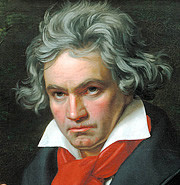
DIAMOND Online published an article titled “The Musical Secrets You Never Knew, Revealed by Dr. John Powell, Author of How Music Works”.
In it, as something “many composers misunderstand,” he argues that “the idea that different emotions arise depending on the initial key (major or minor) is also wrong.” He says:
Similarly, the idea that different emotions arise depending on the initial key (major or minor) is also wrong. For example, in Stevie Wonder’s song there is a repeated line, “I just called to say I love you.” Raising it by 1 tone partway through makes the mood brighter. But raising it by 1 tone partway through has the same effect regardless of the starting key. The initial key does not matter.
—So many composers may have misunderstood this?
Yes. Many composers, including Beethoven, believed that particular keys evoke distinctive emotions. They therefore used one particular key for a sad piece and another for a romantic piece. Others followed them.
What is he talking about? Dr. John Powell is the one who does not understand. He should stop disparaging the great composers. Beethoven and other composers were not so foolish. The doctor has been conditioned by equal-tempered pianos and speaks only from that conventional assumption, believing it correct. The arrogance is extraordinary.
There is essential background knowledge when discussing this subject: temperament and the characteristics of the instruments used. Although the doctor has even written a book, he apparently does not know even this much.
What Is Temperament?
You have probably heard the term “equal temperament,” since it appears in titles such as Bach’s “The Equal-Tempered Clavier.” (Incidentally, that title is an outrageous mistranslation, as discussed later.) Equal temperament is a relatively recent temperament that became common in the latter half of the 19th century, dividing 1 octave equally into 12 semitones. Temperament is precisely the question of how to divide 1 octave into 12 semitones.
Historically, many systems have been used, including Pythagorean tuning, just intonation, meantone, Werckmeister, and Kirnberger. Pythagorean tuning stacks perfect fifths and suits beautiful melodic singing, while just intonation emphasizes the sound of 3rds and produces beautiful harmony, although melodies can sound odd. Violins and cellos tune their strings in perfect fifths and are thus Pythagorean in a sense. But since their pitch can be adjusted freely during performance, harmony can be played in just intonation. That is why a string quartet has both beautiful melody and beautiful sonority. Choirs should in principle do likewise, but in a church with extremely long reverberation, the melody itself becomes harmony, so they may sing in just intonation. From this perspective, if only instruments capable of freely changing pitch are used, one can perform in Pythagorean plus just intonation, or in just intonation, according to the venue.
Temperament and Instruments: Keyboard Instruments
In both Pythagorean and just intonation, the semitones within 1 octave are not equally spaced. Thus the pitch of G in C major differs from G in E-flat major, and pitches change with the key. This is no problem when using only instruments whose pitch can be changed freely. But not every instrument can do so. Keyboard instruments such as the piano are representative examples of instruments whose pitch cannot be changed freely.
Keyboard instruments produce sound by striking pre-tuned strings or sounding pipes, so their pitches cannot be freely changed during performance [1]. Tuning them in Pythagorean or just intonation therefore creates serious problems. Suppose one tunes an instrument in just intonation for C major. Then:
- Modulating to any key other than C major sounds badly out of tune.
- Because it is just intonation, the melody sounds odd.
The ideal solution would require a keyboard dividing 1 octave extremely finely. The instrument would be enormous and extremely difficult to play. (Another solution is to alter pitch through key pressure, as on the clavichord. Bach loved the clavichord because it allowed this, but it cannot produce much volume.)
The question therefore becomes what compromise to make. Meantone, Bach’s well temperament, Werckmeister, and Kirnberger are all compromise temperaments with different advantages and disadvantages. In one key the sound may be exceptionally good, while another sounds cloudy, harsh, or strangely expansive. Some chords sound so bad that they are unusable, the “wolf.” One of the 1 skills of composers at the time was avoiding unusable harmonies under these temperaments and exploiting each harmony’s distinctive sound; even the same 5th differs in sonority depending on whether it is wide or narrow.
As noted above, equal temperament is relatively recent and began to be used at the end of the 19th century. Conversely, earlier music was written for other temperaments. The temperament of Bach’s Well-Tempered Clavier is indicated on its title page; Beethoven wrote for Kirnberger No. 2, and Chopin for Kirnberger Nos. 2 and 3. They fully exploited the inequalities of those temperaments. That is why some pieces have unusually many sharps or flats. In the quotation above, Dr. Powell says many composers including Beethoven merely believed that particular keys evoke distinctive emotions. They did not merely believe it: in the temperaments they used, particular keys do evoke distinctive emotions.
Temperament and Instruments: Orchestral Instruments
Unlike keyboard instruments, most orchestral instruments can adjust pitch in real time. A violinist can shift finger position slightly, and a flutist can alter pitch through air speed and angle. In principle, they can therefore always perform using Pythagorean plus just intonation. (Accurate intonation in rapid passages is extremely difficult, however, so performers tend toward the central pitches to which their instruments are tuned.) In such cases, as Dr. Powell says, does every key sound the same?
In short, no.
That is because each instrument resonates differently in different keys.
Consider the violin. Its 4 strings, from lowest to highest, G, D, A, and E, are tuned in pure perfect fifths. These strings are not always stopped by fingers; usually several remain open. Depending on the note being played, open strings may or may not resonate. Resonance in a high string creates brilliance, while resonance in a low string adds depth. Thus a piece in a key that does not make E resonate will sound muted. E major sounds brilliant because the tonic resonates at the octave, while E-flat major does not resonate and therefore sounds subdued.
Every instrument has such acoustic characteristics, and composers write with them in mind.
Thus Dr. Powell is wrong here as well. Particular keys do evoke distinctive emotions.
Why Did Dr. John Powell Reach Such an Absurd Conclusion?
Why, then, did Dr. Powell reach such an absurd conclusion?
Because it is correct under one condition, and that condition is pervasive today: playing a keyboard instrument tuned in equal temperament.
Most modern pianos are tuned in equal temperament [2]. Under this temperament, every key has the same sonority. That is the condition the doctor is describing. His mistake was extending it to other cases, including music conceived for other temperaments and instruments played outside equal temperament.
I have not read Dr. Powell’s How Music Works, but if it contains claims like those in this article and they spread as an urban legend, that would be deeply regrettable. I sincerely hope the doctor will reconsider.
[1] On a piano, striking strongly and softly makes the vibrating length of the string slightly different. When struck softly, the string does not vibrate all the way to its ends, producing a higher pitch than when struck strongly. Truly professional pianists reportedly exploit this to adjust the resonance of each note in a harmony and create a beautiful sound. I recall reading Argerich say something like, “A pianist’s job is deciding at what angle to drop a finger onto each key.” This may also explain why the same piano can sound astonishingly different under different players.
[2] A temperament that divides 1 octave equally into 12 semitones. Since the English is “Equal Tempered,” “equal division temperament” would probably be a more accurate Japanese translation….
Related posts
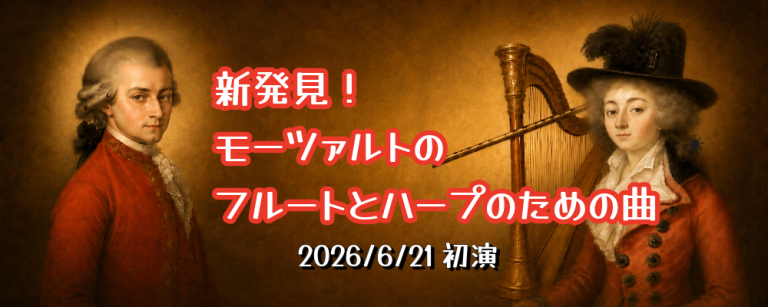
New Discovery: Mozart Works for Flute and Harp Premiered on 6/21 (6/23 Performance Recording Also Added)
Across 250 Years: Mozart’s “Unpublished Autograph” Found in Paris Reveals the Genius Behind the Legend An “Anonymous” Treasure Sleeping in a Corner of the Library On…
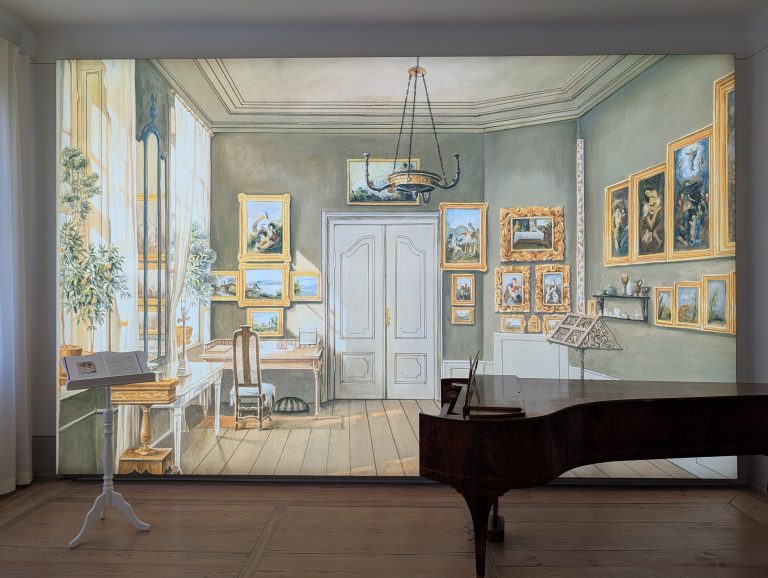
A Visit to the Mendelssohn House in Leipzig — The Difficulties Faced by the Mendelssohn Family and Women
Year-End Greetings: Fauré’s “In Paradisum” from Requiem, Op. 48—In Memory of Andrew Nash
Here are my customary year-end greetings. This year I had begun preparing to perform “Lilium”, but after learning of the death of my close friend and…