
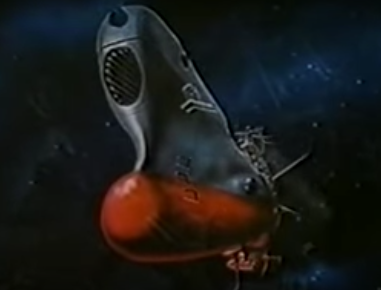
The NHK Symphony Orchestra conducted by Naoto Otomo
Composed by Kentaro Haneda1
Symphonic Suite Space Battleship Yamato

The work was created using the various themes from Hiroshi Miyagawa’s Space Battleship Yamato in every conceivable way.
Stylistically, it is Romantic. Perhaps it is a little reminiscent of Tchaikovsky.
There are 4 movements in all. The 3rd movement, Adagio, includes a vocalise partway through, and the 4th movement is a double concerto for violin and piano. The transition returning to the main theme in the coda of the finale feels slightly tacked on2, and the very end is a little repetitive, but overall I think it is well put together as a Romantic work.

Of course, it has no significance in music history, but I think performing more works like this would help bring classical music to a broader audience.
(*)3
(**)4
Footnotes
- This is an example of someone using themes composed by others and presenting the resulting work as his own composition. During 2009, in May, I received a complaint from the composer* of Katabami Kindergarten’s school song (represented by attorney Kito), alleging that labeling a piece I had composed using the school song as “composed by” me infringed the author’s moral rights. Because I did not want to waste time, I settled by paying several hundred thousand yen. But in such cases the theme is properly no more than a quotation**, and among musicians it is surely natural to label such a work a “composition.” If I had not been as busy as I am now, I would have wanted to litigate the matter properly and establish a precedent.
- There are several places where the “transitions” feel awkward overall, but this one is especially unfortunate. Apparently the piece was being revised until the last possible moment, so there was probably not enough time to resolve it.
- When I explicitly stated the composer’s name in another entry (the complaint had demanded that I state it), I was then asked not to state it, so I do not really understand. In any case, the most recent demand is not to state it, so I will not do so here.
- There appears to be a paper by Hiroshi Watanabe on determining quotation in music. (Hiroshi Watanabe, “Determining Quotation in Music,” Bulletin of Kunitachi College of Music, vol. 17, pp. 151-165, 1982.) I intend to read it sometime.
Related posts
On the 230th Anniversary of Kuhlau’s Birth
I seem to have an affinity for composers who remain in the historical record but are relatively obscure. While sorting through a pile of scores at…
Was “Yuki ya Konko” Composed by Rentarō Taki?
After a long interval, I received a comment on an earlier article, “So ‘Yuki ya Konko’ Was Composed by Dvořák...” The comment said, “Rather than having…