
After a long interval, I received a comment on an earlier article, “So ‘Yuki ya Konko’ Was Composed by Dvořák…”
The comment said, “Rather than having an unknown composer, wasn’t it composed by Rentarō Taki?” and “If Taki’s original dates from 1901, isn’t that earlier?”
“What?!”
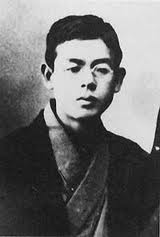
So I consulted the esteemed Wikipedia, and astonishingly, it listed Rentarō Taki as composer.
But I did not think, “Oh, I see.” This was not because I am contrary, but because the style is nothing like Rentarō Taki’s.
Rentarō Taki’s “Yuki ya Konkon” and the Famous “Yuki ya Konko” Are Different Songs
Rentarō Taki actually has a song called “Yuki ya Konkon.” It is “konkon,” not “konko.” While “Yuki ya Konko” (whose actual title is “Yuki”) belongs to the Elementary School Songbook 1, “Yuki ya Konkon” belongs to the Kindergarten Songbook 2. This collection contains 20 songs, including the famous New Year’s song beginning “How many nights until New Year’s Day?”
“Yuki ya Konkon” Lyrics: Kume Higashi; Music: Rentarō Taki
Snow, fall and fall; hail, fall and fall
Fall more and more, pile up without melting
With the fallen snow, a snowman and lantern
Let us make them, dear sister
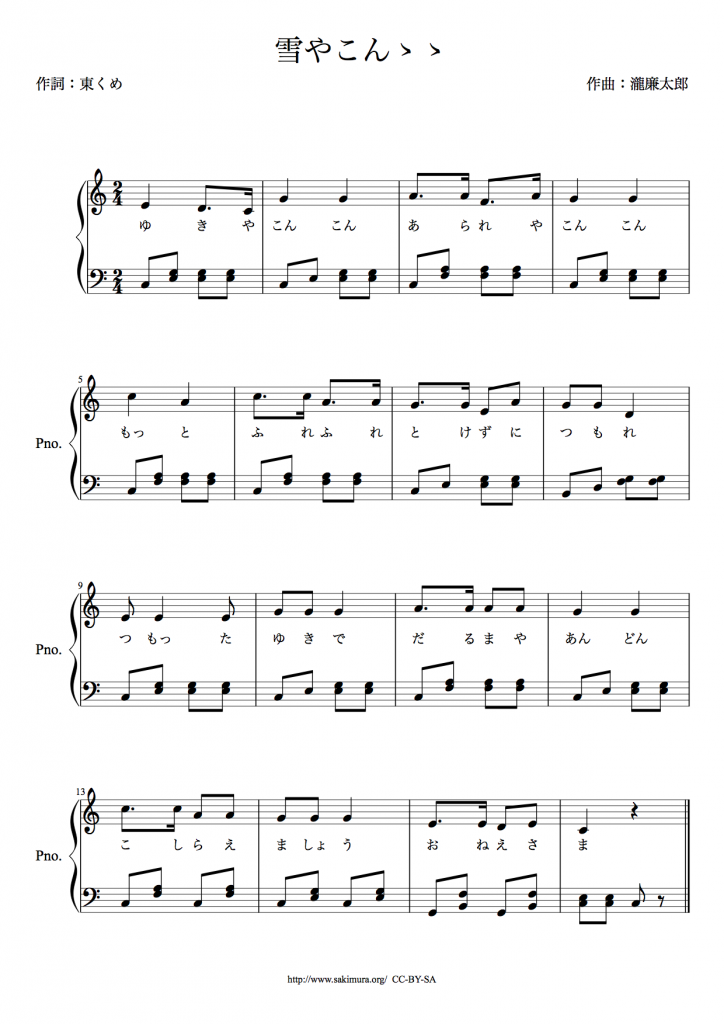
It is a completely different song, isn’t it? This one is unmistakably in Rentarō Taki’s style.
It shares something with “Hakone’s mountains….” It appears to have been confused with “Yuki” from the Elementary School Songbook.
So I corrected Wikipedia as well.
Rentarō Taki’s “Yuki” Is the 4th Piece in Japan’s First Song Suite, “Four Seasons”
To make matters confusing, Rentarō Taki also wrote an art song called “Yuki.” It is one piece in the song cycle “Four Seasons,” published in Meiji 33 (1900), when he was 21 years old.
Its structure is as follows.
- Hana (lyrics: Hagoromo Takeshima; soprano, alto, and piano accompaniment)
- Nōryō (lyrics: Kume Higashi; solo voice and piano accompaniment)
- Tsuki (lyrics: Rentarō Taki; soprano, alto, tenor, and bass)
- Yuki (lyrics: Shūka Nakamura; soprano, alto, tenor, bass, piano, and organ accompaniment)
“Hana” is the very famous song beginning “The Sumida River in the gentle spring.” The 4th piece is “Yuki.” I suspect you have rarely heard it.
“Yuki”
Lyrics: Shūka Nakamura
Music: Rentarō TakiIn a single night, fields and mountains alike
Palaces and thatched huts, all alike
Have been wrapped in silver
Have been adorned with white pearls
What dazzling light, what lovely scenery
Ah, it is the work of God
The work of God, wondrous indeed

“Four Seasons” is in fact a tremendously important work in the history of Western-style music in Japan: the first artistic Western music written by a Japanese composer. Until then, there had been little more than school songs 3. The sudden publication of such music by a completely unknown composer apparently caused great surprise. For details, the Society for Contemporary Psychological Research’s “On Rentarō Taki’s Art Song ‘Yuki’ (Song Cycle ‘Four Seasons’)” is informative, and I strongly recommend reading it. Music from this period shows extremely strong Western influence 4. To be honest, there are also places that make one think, “That is not right,” but considering the circumstances of the time, it remains an astonishing work.
Please enjoy the song cycle “Four Seasons.”

Footnotes
- A song textbook for ordinary elementary schools compiled by the Ministry of Education from 1911 to 1914, containing 120 songs in all.
- Kyōeki Shōsha, ed., “Kindergarten Songbook” (Kyōeki Shōsha Musical Instrument Store), published in Meiji thirty-four, seventh month.
- When publishing the song cycle “Four Seasons,” Taki himself wrote at the beginning: “Most songs are school songs, with Japanese lyrics fitted to foreign melodies. Many of those lyrics do not match the content of the original music. Therefore, on this occasion, I have composed music for Japanese lyrics….”
- “Araiso,” written after his return from studying in Germany and the year before his death, seems to blend the German Lied with Japanese jōruri and is fascinating. Unfortunately, it is an extremely short piece….
Related posts

On the Symphonic Suite Space Battleship Yamato
The NHK Symphony Orchestra conducted by Naoto Otomo Composed by Kentaro Haneda Symphonic Suite Space Battleship Yamato https://youtu.be/lkkYEexkYVw?list=PLF1C1000D34C4616D The work was created using the various themes…
“Divertimento for 2 Marimbas”—On the 1st Anniversary of Seiji Yokoyama’s Death
Today marks the 1st anniversary of the death of Seiji Yokoyama, known as the composer of works including Space Pirate Captain Harlock and Saint Seiya. Though…
You must be logged in to post a comment.