Yesterday, UK Prime Minister Starmer proposed banning social-media use by children under 16. I reposted the announcement about 1 and a half hours later, so those who follow me on X probably already know. (If you do not yet follow me, please consider doing so. I am at https://x.com/_nat.)
We are banning social media access for under 16s.
These days kids must find their feet in a world where technology intrudes into every area of their life.
I just can’t let that go on anymore. So we’re giving children their childhoods back. pic.twitter.com/jn7iQrcwk8
Let me say at the outset that I oppose this kind of regulation. The current surge of support stems from the tragic case of a 14-year-old British schoolgirl who died by suicide after viewing suicide-related posts on social media. Even so, I believe imposing such regulation now would be premature or contrary to the principle of proportionality.
The community note on Prime Minister Starmer’s post, though it may go somewhat too far, cites an evidence review commissioned by the UK government. The review found a small but consistent association between time spent by young people on social media and worse mental-health outcomes. It concluded, however, that current evidence provides little certainty about causality and is insufficient to confirm a causal relationship; stronger experimental or natural-experiment research is needed. The legislative facts are therefore insufficient to justify such a law. Regulating social media would not prevent people from searching for methods of suicide either, so it is unlikely to be very effective in this respect. Research increasingly associates short-video feeds and infinite scrolling with problematic or compulsive use, reduced self-control, and adverse effects on attention. Yet “short-video addiction” is not an established clinical diagnosis, and much of the evidence shows correlation rather than causation. Nor would banning social media necessarily prevent people from watching short videos. Even if a causal relationship were proven, it would apply to every age group, so age verification would not be an appropriate response.
The side effects of taking such measures, on the other hand, are serious.
Here I am not considering merely regulation that imposes a duty on platforms to protect minors, but specifically a regime like the following.
A regime that prohibits or restricts children below a specified age from using social-media accounts and, to make the restriction effective, broadly requires age verification, age estimation, identity verification, parental confirmation, or similar measures.
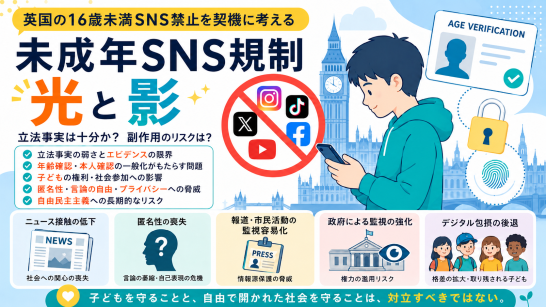
This type of regulation may have the legitimate aim of protecting children. If designed badly, however, it will have broad side effects on children’s rights, adults’ anonymous use, journalism and civic activity, democratic participation, and digital inclusion.
Coincidentally, from tomorrow, June 17, through July 8, Japan will also hold a public consultation on the Draft First Report of the Youth Protection Working Group of the Study Group on Addressing Issues Concerning Information Distribution in Digital Spaces. (See https://www.soumu.go.jp/menu_news/s-news/01ryutsu20_02000001_00034.html.) I would like everyone to use this opportunity to think about the issue, so below I am sharing an edited version of a summary that I asked Chatty to prepare from my concerns and references. I think it is relatively well organized, and I hope you find it worthwhile.
Key Points
The particularly important serious adverse effects are as follows.
| Adverse effect | Severity | State of evidence |
|---|---|---|
| Reduced exposure to news and civic participation among children | High | Initial evidence from an Australian survey |
| Children’s social isolation and loss of support networks | High | Warnings from UNICEF, LSE, and LGBTQ+ research |
| Impeded development of digital skills and media literacy | High | Explicitly identified by UNICEF Innocenti |
| Normalization of age and identity checks for all internet users, including adults | Very high | Warnings from EFF, ACLU, and Ofcom/ICO-related research |
| Chilling of anonymous speech | Very high | Supported by the UN Special Rapporteur, ACLU, and EFF |
| Easier surveillance of journalists, whistleblowers, activists, and vulnerable communities | Very high | Strong basis in the UN human-rights framework |
| Aggregation of browsing history, interests, and political inclinations by governments and companies | Very high | Structural risks of age-verification infrastructure |
| Migration to VPNs, alternative services, and unregulated spaces | High | UNICEF warning and empirical research showing increased interest in VPNs after the UK Online Safety Act |
| Pushing children into environments with even weaker protections | High | Explicitly identified by UNICEF and LSE |
| Shifting responsibility to parents, teachers, and children while delaying improvements to platform design | High | Explicitly identified by UNICEF and LSE |
| Widening socioeconomic and ID disparities | Medium to high | EFF and ACLU identify effects on people without ID |
| Discrimination and errors caused by age-estimation AI and biometric-data use | Medium to high | Ofcom/ICO research raises concerns about privacy, autonomy, and usability |
| Violation of children’s rights to participate and express their views | High | LSE/EU Kids Online identifies the relationship with Article 12 of the UNCRC |
| Expansion of censorship and access restrictions in the name of “safety” | Very high | Institutional risk of expanding age-gating |
The points are set out below.
1. Reduced Exposure to News and Interest in Social Issues among Children
There is already relatively concrete initial evidence of this. After the Australian social-media ban took effect in December 2025, a survey in February 2026 covered young people aged 10 to 17, with 1,027 respondents. Among children under 16 who had previously used the prohibited platforms, 61% said that their use had changed “little or not at all,” while 26% said they had been affected. Among those whose social-media use was substantially impeded, 51% said they received less news “as a direct result of the ban.”
The same article says that affected young people “are losing access to news about issues they care about, and have fewer opportunities to discuss news, share opinions, and take action.” This is a serious effect on civic participation and political socialization among young people.
Assessment: The evidence is still an initial Australian survey and has limitations for causal inference, but the policy side effect is quite important. In particular, it suggests a structure in which the more effective the regulation is, the less exposure children have to news.
2. Children’s Social Isolation and Loss of Support, Especially for Isolated and Marginalized Children
UNICEF clearly warns that social-media bans carry risks and may be counterproductive. It says that social media is a “lifeline” that provides many children, especially isolated and marginalized children, access to learning, connection, play, and self-expression.
LSE/EU Kids Online likewise says that social media and digital technology give children opportunities for learning, connection, and self-expression, and that blanket bans fail to address root causes and may push children into less protected spaces.
Those at particular risk include LGBTQ+ children, children with disabilities, children isolated at home or school, children in rural areas, and children in immigrant or minority communities. For them, online peer communities may be more than entertainment: they can provide places for advice, self-understanding, and avoiding crises.
Assessment: The strength of quantitative causal evidence differs by area, but major institutions studying children’s rights and digital environments, such as UNICEF and LSE, consistently issue warnings. This provides a strong basis for treating it as a policy risk.
3. Impeding the Development of Digital Skills and Media Literacy
A 2025 UNICEF Innocenti report says that the time children spend online and their online activities contribute substantially to developing digital skills. Children who use social media regularly are more likely to have skills such as changing privacy settings, choosing search terms, and deleting contacts.
The report also says that children whose parents restrict their internet use tend to have lower skill levels and that access to and use of digital technology are important for skill formation.
It further states that keeping children offline may harm skill development while providing only limited protection against the mental-health problems covered by the report.
Assessment: This is quite important. Social-media regulation seeks to keep children away from harmful content, but it may also deprive them of opportunities to learn about digital environments by making mistakes safely.
4. Age Verification Turning into Identity Verification for Every User, Including Adults
To exclude minors, a service must determine whether a person is a minor. In practice, this tends to lead toward requiring every user to verify their age, not only minors.
EFF says that age-verification laws affect every user, not just young people, because excluding a particular age group requires checking the age of every visitor. It also says that systems requiring government-issued ID or similar documentation may eliminate anonymous access.
The ACLU likewise says that age verification removes individuals’ ability to browse the internet anonymously and burdens the speech rights of adults and minors alike.
Assessment: This is a core design risk. It is very difficult in implementation to “verify only children,” and the result may be a permanent authentication layer for adults’ internet use as well.
5. Chilling Anonymous Speech
When age and identity verification become widespread, speaking anonymously or pseudonymously becomes more difficult. This is especially serious for sensitive topics such as political opinions, religion, sexual orientation, health, labor issues, whistleblowing, domestic violence, and immigration status.
The UN Special Rapporteur on freedom of expression treats encryption and anonymity as matters concerning the rights to privacy and to freedom of opinion and expression, and considers within the human-rights framework the extent to which governments may restrict them.
EFF calls age-verification systems “surveillance systems” and says that age verification involving identity checks is an inappropriate means of protecting young people.
The ACLU likewise notes that age verification impairs the right to speak and browse anonymously and may deter people from using online platforms because of concerns about data privacy and security.
Assessment: This is one of the most important issues for liberal democracy. Age verification introduced to protect children may chill political and social discourse among adults generally.
6. Easier Surveillance of Journalists, Whistleblowers, Activists, and Sources
When age-verification infrastructure becomes widespread, companies, third-party verification providers, and in some cases governments can more easily track who accessed which services, which topics interested them, and which communities they joined.
This is serious not only for journalists themselves, but also for sources, whistleblowers, victims, and human-rights defenders. As anonymity weakens, sources will avoid making contact in the first place.
Under the UN Special Rapporteur’s framework, anonymity and encryption are treated as means supporting freedom of expression, opinion formation, and privacy.
Assessment: There is still limited empirical evidence of restrictions on minors’ social-media use being employed directly to surveil journalists. The structural risk is clear, however: widespread age- and identity-verification infrastructure lowers the cost of surveillance.
7. Making Government Surveillance and Access Control Easier
Once age-verification mechanisms become commonplace, their scope may expand beyond protecting minors.
For example, they may be extended to:
- Adult content
- Gambling
- Information related to self-harm and eating disorders
- Political advertising
- Election-related information
- Information related to “extremism”
- Health and medical information
- Cryptocurrency and financial information
- Anonymous forums and messaging services
The problem is that, while some of these may legitimately be regulated, once age-verification and identity-verification infrastructure becomes commonplace, it becomes institutionally easier to establish a model in which governments control in advance “who may read what.”
The ACLU points out that age-verification laws introduce government authority over what speech young people may access.
Assessment: This currently depends on the country and its institutions, but it is a very serious long-term threat to liberal democracy.
8. Secondary privacy and security harms
Age verification may use government-issued IDs, facial images, biometric information, credit cards, mobile phone numbers, parental information, behavioral profiles, and other data. A leak of such data can cause serious harm, and even the metadata showing “who verified their age on which site” is itself sensitive.
The EFF points out that there is no guarantee that information shared for age verification will not be retained, used, shared, or sold; that users have no choice but to trust third-party verification services and site operators; and that there are risks of employee misuse or theft, data breaches, and disclosure under subpoena.
Research on families associated with Ofcom and the ICO also found support among parents and children for age assurance, while noting concerns—depending on the method—about privacy, parental control, children’s autonomy, and ease of use.
Assessment: High risk. Age-estimation methods based on facial recognition, ID scanning, or behavioral profiling pose particular risks of excessive collection and secondary use.
9. Migration to VPNs, circumvention tools, and unregulated platforms
When bans become stricter, children do not necessarily go offline. They may move to VPNs, lie about their age, use a parent’s or friend’s device, use overseas services or encrypted messaging, or migrate to smaller services with weaker moderation.
UNICEF warns that children and young people may continue to access social media through workarounds, shared devices, and less-regulated platforms, making them harder to protect as a result.
A 2026 study analyzing the implementation of the UK Online Safety Act reported stepwise increases in VPN-related discussions on Reddit and interest in VPN searches on Google after each regulatory milestone. In particular, at the age-verification deadline, UK interest in VPN searches reached +89%, and users cited not merely bypassing access restrictions but concerns about privacy and surveillance and distrust of age-verification intermediaries.
Assessment: Quite important. Regulation may drive children away from “visible major social networks” and into less visible spaces with weaker support and moderation.
10. Shifting responsibility for protecting children from platforms to families, schools, and children themselves
A blanket ban is politically easy to understand, but it can become an excuse to leave fundamental problems unaddressed, including platform recommendation algorithms, advertising design, addictive design, responses to reports, age-appropriate design, and content moderation.
UNICEF states that age restrictions are not a substitute for improving platform design or investing in content moderation, and that companies should have a duty to identify and address adverse impacts on children.
LSE/EU Kids Online likewise says that governments, regulators, and industry should bear responsibility and should not place an excessive burden on children, parents, and caregivers.
Assessment: This creates a major perverse incentive in policy. A ban may be treated as having “solved the problem,” while improvements to harmful design are in fact delayed.
11. Violating children’s rights, especially their rights to participate and express their views
Children are not merely objects of protection; they are rights-holders. Social media is also a place for self-expression, interaction with peers, participation in political and social issues, creativity, and learning.
LSE/EU Kids Online points out that implementing bans on social media, screen time, or smartphones without listening to children about decisions that affect them is contrary to UNCRC Article 12, which establishes children’s right to express their views.
Assessment: This is important not only from the standpoint of liberal democracy but also under the Convention on the Rights of the Child. In particular, legitimacy becomes an issue when consultation with children during policymaking is merely perfunctory.
12. Chilling effects on adults’ access to information
Age verification not only excludes children; it also adds friction to adults’ reading and speech. If people must present ID or undergo facial recognition, some will avoid even lawful content.
The ACLU states that age verification burdens the speech rights of adults and minors alike, and that users concerned about data privacy and security may refrain from using online platforms.
This is particularly serious in the following areas.
- Sex education
- LGBTQ+ information
- Mental health
- Support for drug addiction
- Domestic violence and abuse counseling
- Labor unions and workplace advice
- Speech by political minorities
- Religion and ideology
- Whistleblowing
- Journalism
Assessment: There is serious cause for concern. Even if age verification appears to create only “minor friction,” it amounts to a substantial access restriction for sensitive information.
13. Widening socioeconomic and ID divides
Identity-based age verification may require a government-issued ID, a stable address, a bank account, a credit card, a smartphone, or a device suitable for facial recognition. People without these may be excluded even if they are not minors.
The EFF points out that many people without government-issued ID could lose access to large portions of the internet, and says that many such people are already marginalized, including those on low incomes.
Assessment: The degree varies by country, but even in Japan, if the system presupposes a My Number Card, mobile phone number, credit card, facial recognition, or similar means, inclusion becomes an issue not only for children but also for adults.
14. Errors and discrimination from age-estimation AI and biometric use
When age checks use “age estimation” rather than “identity verification,” they may use facial images, voice, behavioral history, usage patterns, and other data. This leads to excessive use of biometric and behavioral data.
Research associated with Ofcom and the ICO distinguishes between age verification and age estimation within age assurance, and explains that age estimation may include algorithmic analysis of service-use behavior and interactions. It also identifies concerns, depending on the method, about privacy, children’s autonomy, and ease of use.
Assessment: “Privacy-preserving proof of age” may be technically possible, but a crude implementation could normalize the use of biometric information and behavioral profiling.
15. Depriving children in dangerous home situations of a means of escape
For some children, a parent is not always a protector. Where there is abuse, excessive control, or repression within the home over religion, sexual orientation, gender, or political views, social media and online communities can provide a connection to the outside world.
Age verification based on parental consent may appear moderate, but in a dangerous home environment it can become a barrier to a child seeking outside support.
UNICEF’s observation that social media is a lifeline for isolated and marginalized children is directly connected to this problem.
Assessment: Evidence must be examined separately for each area, but this is a serious risk that cannot be ignored in child-protection policy.
16. Fewer opportunities for learning, creativity, and career exploration outside school and the local community
Social media is a gateway not only to news but also to learning, creativity, career paths, technology, music, sports, research, and civic activity. A ban may cause children whose schools and families lack sufficient resources to lose informal learning opportunities in particular.
UNICEF Innocenti states that online activities contribute to the development of digital skills and that common activities such as social media use, watching videos, and gaming also make a measurable contribution to skill development.
Assessment: The impact may be particularly large for children in rural or low-income settings and those who have difficulty accessing specialist communities.
17. Reducing children’s visibility instead of making them safer
If children remain online after a ban, they may lie about their age, hide their use from parents, use VPNs, create other accounts, or move into more closed spaces. This makes it harder for parents, teachers, and support workers to identify problems.
UNICEF says that migration to workarounds, shared devices, and less-regulated platforms makes children harder to protect.
An initial Australian survey also reported that, among existing users under the age of 16, 61% had experienced almost no change.
Assessment: The less effective the regulation, the greater this side effect. If the number of children who “officially are not there” increases, both safety design and support become more difficult.
18. Reinforcing the norm that “young people are immature and may therefore be excluded from the public sphere”
Social media is part of the modern public sphere. Excluding young people from it across the board reinforces the norm that “young people are objects of protection, not participants in public debate.”
LSE/EU Kids Online states that children are diverse and that their right to participate in and benefit from the digital world should be balanced with protective measures, not erased by blanket restrictions.
Assessment: This is difficult to quantify, but it concerns the cultural foundations of liberal democracy. People do not suddenly become mature citizens the moment they turn 18; citizenship develops through the experience of participation.
19. Creating an institutional template for censorship and content control
Technically, age verification is a mechanism for controlling “what is shown to whom.” Once introduced, it becomes easy to expand the ages and content covered.
It may begin with “social media for those under 16,” but later expand to “political advertising for those under 18,” “minors’ comments on news,” “adult-oriented but lawful information,” or “information deemed problematic for national security.”
As the ACLU points out, age verification can directly or indirectly restrict access to protected speech online.
Assessment: Institutions with high potential for abuse should not be evaluated on the assumption that governments will always act in good faith. In a liberal democracy, the potential for future misuse should also be part of the institutional assessment.
20. Making policy evaluation more difficult and producing “apparent success”
A social media ban may appear successful if it reduces the number of accounts or time spent using them. But the indicators that really matter include bullying, sexual exploitation, sleep, academic performance, mental health, isolation, exposure to news, digital skills, access to counseling, and circumvention.
UNICEF Innocenti says that protecting children’s mental health should focus on preventing online sexual abuse, online bullying, and exposure to harmful content rather than merely limiting screen time.
Assessment: A ban can readily treat the easily measured “reduction in use” as an outcome, while tending to underestimate less measurable side effects.
The most serious threats to liberal democracy
From the standpoint of their impact on liberal democracy, I would rank the priorities as follows.
A. Normalizing identity-verification infrastructure for everyone, including adults
This is the most important concern. Measures intended to protect minors could produce a society in which virtually every adult must present their age, identity, biometric information, or device information whenever they use the internet.
B. Chilling anonymous speech and anonymous reading
Anonymity is a condition of safety for political minorities, whistleblowers, journalistic sources, survivors of domestic violence, sexual minorities, religious minorities, and others.
C. Making access control by governments and companies into basic infrastructure
Age verification is infrastructure that controls “who can see what.” Once introduced, it risks being expanded to other purposes.
D. Excluding young people from the public sphere
It may reduce young people’s exposure to news, interest in social issues, expression of views, and opportunities to participate in public debate.
E. Loss of support for marginalized children
For isolated children, social media can be more than entertainment: it can provide a connection to the outside world, a place for self-understanding, and a way to seek support.
More realistic measures
To be fair, regulating minors’ use of social media has legitimate aims. Online bullying, sexual exploitation, harmful content, addictive design, excessive data collection, and advertising targeting are real problems. UNICEF Innocenti also finds that online sexual abuse and online bullying have moderate-to-strong associations with anxiety, suicidal ideation, and self-harm among children.
The question, therefore, is not “whether to regulate,” but whether the means—a blanket ban and broad age verification—are proportionate and effective, and whether their side effects are acceptable.
Current evidence suggests that the following approaches would have fewer side effects.
- A duty on platforms to design for safety, instead of age-based bans
- Restrictions on recommendation algorithms, infinite scrolling, notifications, and advertising targeting
- Disabling high-risk features by default for children
- Data minimization and advertising restrictions
- Privacy-preserving, decentralized age assurance
- Independent audits and transparency reports
- News literacy and digital safety education in schools
- Involving children themselves in policymaking
- Regulation tailored to risk, stage of development, and functionality rather than a blanket ban
Summary and conclusion
The serious side effects of regulating minors’ use of social media are not simply that “children will be unable to use social media.” The larger problem is that age verification may move the entire internet toward an identity-verification regime, undermining anonymity, journalism, civic activity, and young people’s participation in public life. In this respect, serious questions remain about the hasty introduction of regulation of the kind now proposed.
In the UK, it is reported that 90% of parents who responded to the consultation supported a ban on use by those under the age of 16. This is a global trend, gathering enough momentum to drown out scientific objections. We must remember, however, that many people once supported witch hunts. To avoid repeating such tragic history, we today must firmly resist emotional reactions unsupported by scientific evidence.
References
1. Warnings concerning children’s rights and social media bans in general
- UNICEF. “Age restrictions alone won’t keep children safe online.”
UNICEF press release, 10 Dec 2025.
Key points cited: Social media bans do not necessarily make children safer; online connection can be a “lifeline” for isolated and marginalized children; and there is a risk of migration to workarounds and less-regulated spaces. (UNICEF) - UNICEF Innocenti. “Childhood in a Digital World.”
UNICEF Innocenti Global Office of Research and Foresight, 12 Jun 2025.
Key points cited: Children’s development of digital skills; inequalities in digital access; online activities and skill development; and the inadequacy of screen-time restrictions alone to protect mental health. (UNICEF) - EU Kids Online / London School of Economics. “Protecting, not excluding: why banning children from social media undermines their rights.”
LSE, EU Kids Online statement.
Key points cited: Blanket bans may undermine children’s rights, right to participate, self-expression, and opportunities to learn and connect. (LSE) - Council of Europe Commissioner for Human Rights. “Regulate platforms, not children: Commissioner urges caution over social media bans.”
Council of Europe, 23 Feb 2026.
Key point cited: The position that platforms should be regulated rather than excluding children across the board. (COE) - German Ethics Council. “No blanket social media ban for children and teenagers – Ethics Council recommends risk-based safety concept instead.”
Deutscher Ethikrat / German Ethics Council, Press Release 06/2026.
Key point cited: The position that, instead of a blanket social media ban, a risk-based safety design should reconcile protection, participation, and capability development. (Deutscher Ethikrat)
2. Effects on age verification, identity verification, anonymity, and privacy
- Electronic Frontier Foundation. “Age Verification Mandates Would Undermine Anonymity Online.”
EFF, 10 Mar 2023.
Key points cited: Age verification may effectively become identity verification; loss of anonymity; its development into surveillance infrastructure; and problems with requiring government-issued ID. (Electronic Frontier Foundation) - Electronic Frontier Foundation. “Age Verification Is Coming For the Internet. We Built You a Resource Hub to Fight Back.”
EFF, 10 Dec 2025.
Key points cited: A warning that age-verification mandates will spread across the internet, and the risks of surveillance, censorship, and exclusion. (Electronic Frontier Foundation) - American Civil Liberties Union. “Age Verification and Restricting Online Content.”
ACLU, 7 Dec 2023; PDF hosted by ACLU Pennsylvania.
Key points cited: Age verification may make anonymous browsing difficult and chill adults’ access to lawful content and online speech. (ACLU of Pennsylvania) - ACLU. “ACLU Comment on Supreme Court Decision in Free Speech Coalition v. Paxton.”
ACLU, 27 Jun 2025.
Key points cited: Concerns about age-verification mandates, freedom of expression, and privacy, albeit in the US context of sexual-content regulation. (American Civil Liberties Union) - Ofcom / ICO / DRCF. “Families’ attitudes towards age assurance.”
Research commissioned by ICO and Ofcom, published 11 Oct 2022.
Key points cited: Parents and children support age assurance, but have concerns about privacy, parental control, children’s autonomy, and ease of use. (www.ofcom.org.uk) - ICO. “Age Assurance research.”
Information Commissioner’s Office.
Key points cited: Age-assurance methods and tradeoffs among privacy, safety, and convenience. (ICO) - Lueks, Wouter; Dreyer, Stephan; Federrath, Hannes; Simon, Judith. “Assessing Age Assurance Technologies: Effectiveness, Side-Effects, and Acceptance.”
arXiv, 2026.
Key points cited: The effectiveness, side effects, and acceptability of age-assurance technologies; risks to privacy and anonymity; bias, discrimination, exclusion, and censorship. (arXiv) - Lavermicocca, Simone; Carminati, Michekle; Longari, Stefano. “X-rated Compliance Theater: An Empirical Evaluation of European Age Verification Systems in Adult Websites.”
arXiv, 2026.
Key points cited: Security and privacy vulnerabilities in European age-verification implementations, and the risks of dependence on third-party verification providers. (arXiv) - Wodo, Wojciech; Gorski, Maksymilian; Hanzlik, Lucjan. “Age Verification in the Web — Holy Grail to Control Access to Restricted Content.”
arXiv, 2026.
Key points cited: Privacy-preserving design of age-verification technologies, concerns about government-based solutions, and alternatives using Privacy Pass and similar technologies. (arXiv) - Liu, Shuang; Scheffler, Sarah. “Adequately Tailoring Age Verification Regulations.”
arXiv, 2026.
Key points cited: US age-verification legislation, technical means, fit with regulatory objectives, and tradeoffs in technical implementation. (arXiv)
3. Anonymity, encryption, and the human-rights framework
- OHCHR / UN Special Rapporteur context on encryption, anonymity and human rights.
Office of the United Nations High Commissioner for Human Rights.
Key points cited: The human-rights framework in which anonymity and encryption relate to the right to privacy, freedom of opinion and expression, journalism, activists, and protection of sources. OHCHR is the United Nations’ human-rights body. (Office of the United Nations High Commissioner for Human Rights)
4. Australia’s social media ban for minors and reduced exposure to news
- The Conversation. “Australian teens impacted by the social media ban are getting less news — new research.”
The Conversation, 2026.
Key point cited: Research finding that young people affected by Australia’s social media ban had less exposure to news. (The Conversation) - The Guardian. “Australia’s social media ban preventing teenagers from accessing the news, research finds.”
The Guardian, 19 May 2026.
Key points cited: A survey of people ages 10 through 17 with 1,027 respondents; 51% of the group affected by the social media ban reported reduced exposure to news; and social media is an important source of news for young people. (The Guardian) - Women’s Agenda. “Australian teens impacted by the social media ban are getting less news — new research.”
Women’s Agenda, 2026.
Key points cited: A republication and introduction of the research published by The Conversation. Many of those under 16 experienced no impact, while the affected group had less exposure to news. (The Guardian) - The Guardian. “Most Australians under 25 have never used newspapers or radio as a source of news, survey finds.”
The Guardian, 16 Jun 2026.
Key point cited: Social media, TikTok, and similar services have become important channels through which young people encounter news. (The Guardian)
5. VPN use, circumvention, and regulatory side effects
- Mehta, Dhyey; Jalilzade, Eldar; Kalameyets, Maksim; Owens, Rebecca; Juarez, Marc; Aidinlis, Stergios; Shi, Lei; Elmas, Tuğrulcan. “Online Safety Regulation Increases Privacy Risk: Evidence from the UK Online Safety Act.”
arXiv, 2026.
Key points cited: Following the phased implementation of the UK Online Safety Act, VPN-related discussions on Reddit and interest in Google searches increased, and users cited privacy, surveillance, and distrust of age-verification intermediaries. (arXiv) - Malwarebytes. “VPN use rises following Online Safety Act’s age verification controls.”
Malwarebytes, 30 Jul 2025.
Key point cited: Reporting and observations that VPN use and interest increased after the UK Online Safety Act introduced age verification. (Malwarebytes) - Mishcon de Reya. “Online Safety Act: VPNs and age verification — what the House of Lords debate reveals.”
Mishcon de Reya, 14 Nov 2025.
Key points cited: Age verification and VPN circumvention under the UK Online Safety Act, and Ofcom’s assessment of the risk of evasion. (Mishcon de Reya LLP)
6. Trends in national regulation of minors’ social media use
- Reuters. “From Australia to Europe, countries move to curb children’s social media access.”
Reuters, 15 Jun 2026.
Key points cited: International trends in restrictions on minors’ social media use in Australia, the UK, France, Denmark, and elsewhere. (Reuters) - Reuters. “Macron wants to ban under-15s from social media from September 2026, Le Monde reports.”
Reuters, 31 Dec 2025.
Key points cited: France’s proposed social media ban for those under 15, President Macron’s promotion of EU-level regulation, and difficulties enforcing the existing parental-consent system. (Reuters) - Reuters. “France’s National Assembly debates banning under-15s from social media.”
Reuters, 26 Jan 2026.
Key points cited: A bill before France’s National Assembly to ban social media for those under 15, a requirement for EU-compliant age verification, and domestic support in France. (Reuters) - Reuters. “Britain announces sweeping social media ban for under-16s.”
Reuters, 14 Jun 2026.
Key points cited: The UK’s proposed social media ban for those under 16, covered services, regulation and age verification by Ofcom, and criticism concerning circumvention and effectiveness. (Reuters) - The Guardian. “Social media firms hit back as Starmer announces ban for under-16s in UK.”
The Guardian, 15 Jun 2026.
Key points cited: Platforms’ responses to the UK’s proposed social media ban for those under 16, and concern that children may migrate to less safe services. (The Guardian) - Tech Policy Press. “Tracking Efforts To Restrict Or Ban Teens from Social Media Across the Globe.”
Tech Policy Press, 23 Feb 2026; updated 1 Jun 2026.
Key point cited: A comparative list of countries’ proposed restrictions and bans on minors’ social media use. (Tech Policy Press) - TechCrunch. “These are the countries moving to ban social media for children.”
TechCrunch, 2026.
Key point cited: An overview of social media age restrictions and proposed bans in different countries. (TechCrunch)
7. Effectiveness, modes for children, and platform design
- Figueira, Olivia; Chamarthi, Pranathi; Le, Tu; Markopoulou, Athina. “When Kids Mode Isn’t For Kids: Investigating TikTok’s ‘Under 13 Experience.’”
arXiv, 2025.
Key points cited: Problems with transparency, safety, and the suitability of content in TikTok’s Kids Mode / Under 13 Experience, and the possibility that children are steered toward the standard mode. (arXiv) - Verfassungsblog. “Just the Illusion of Protection.”
Verfassungsblog, 20 Feb 2026.
Key points cited: Social media age bans may create an illusion of protection, and their relationship to addictive design, harmful content, and legal constraints. (Verfassungsblog) - European Science-Media Hub. “Is banning children from social media ‘the’ answer?”
European Parliamentary Research Service / ESMH, 13 May 2026.
Key point cited: Expert views that a social media ban alone cannot address the full range of online risks that children face. (European Science-Media Hub)
Related posts
Age Verification: The UK Online Safety Act Is Being Toyed With in All Kinds of Ways—Bypassing It With VPNs and Evading Biometrics With Death Stranding
What Is the UK's Online Safety Act? The UK's Online Safety Act formally became law after receiving Royal Assent on October 26, 2023, and came into…
UK Treasury Launches Consultation on Improving the Effectiveness of the Money Laundering Regulations (MLRs)
On March 11 London time, HM Treasury launched a consultation aimed at improving the effectiveness of the Money Laundering Regulations (MLRs), titled “Improving the effectiveness of…