
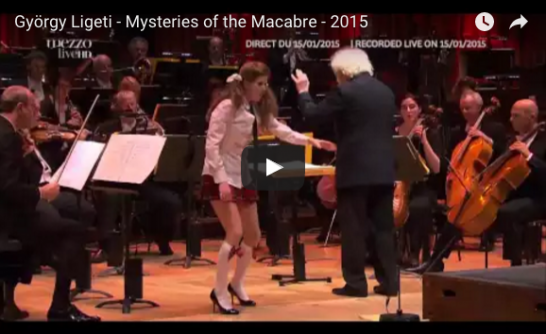
The article named in the title appeared in my SmartNews feed. It said: “A performance by the London Symphony Orchestra conducted by Barbara Hannigan. A schoolgirl is welcomed with great applause, but she is chewing gum and seems to have a bad attitude. But once she starts singing…”
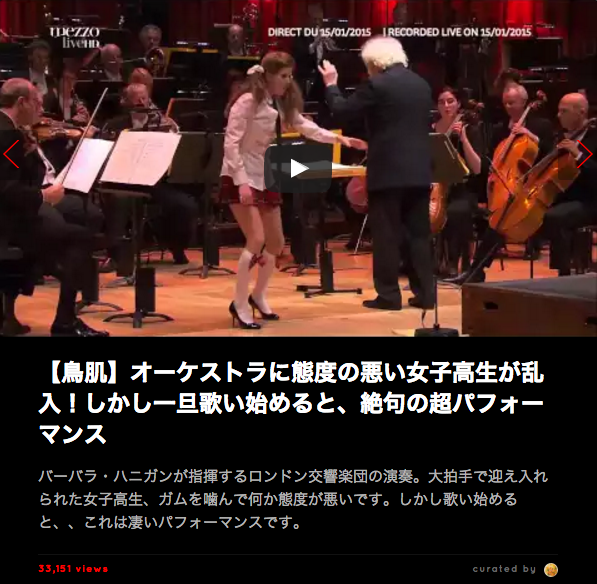
Come on. The conductor is Sir Simon Rattle1, one of today’s foremost conductors. It is not Barbara Hannigan2. And the “schoolgirl” is Barbara Hannigan, a Canadian leading exponent of contemporary opera, aged 44. The piece is by the great 20th-century composer György Ligeti3. From his opera Le Grand Macable (1974-77, revised in 96), it is the concert aria extraction “Mysteries of the Macabre” (1992)4. This was a London Symphony Orchestra concert on January 15, 2015.
Still, this is an amazing performance—a truly great one. Indeed, critics everywhere have praised it highly5. If you have not heard it yet, please do.


Incidentally, Barbara Hannigan also conducts. There is also a video of her conducting while singing the same piece.

I have liked Ligeti since 1981, when, as a high school student, I heard “Lontano” performed by the Orchestre de Paris at the Salle Pleyel in Paris. Among recordings that are readily available today, I recommend the Berlin Philharmonic performance conducted by Jonathan Nott.


European orchestras often perform this kind of “contemporary music.” I wish it were performed a little more often in Japan too.
Footnotes
- Sir Simon Rattle (1955-), a British conductor. He has served as principal conductor and artistic director of the Berlin Philharmonic since 2002.
- Barbara Hannigan (1971-) http://www.barbarahannigan.com/
- György Ligeti (1923-2006), born in Romania, raised in Hungary, and later naturalized as an Austrian citizen.
- The Japanese title is “The Secret Ritual of the Macabre.” But what do we make of that Japanese title? Will “macabre” convey anything when simply written in katakana? Macabre means an eeriness that evokes death. The dance of death is called Dance Macabre in French, and the shortened form entered English as a word.
- http://www.barbarahannigan.com/press/ligeti-mysteries-of-the-macabre-le-grand-macabre/
Related posts
Yomiuri Symphony: Stravinsky’s Renard and Others
At a subscription concert by the Yomiuri Nippon Symphony Orchestra, I heard Stravinsky's Renard. The previous time was in 91, in August, again at Suntory Hall,…
“Doppler: Andante and Rondo, Op. 25” in the Mirror
About Franz Doppler Franz Doppler (1821-1883) was a Hungarian-Austrian composer, conductor, and flutist. As the composer of the famous “Hungarian Pastoral Fantasy,” he is known to…

Suor Angelica
I went to see Puccini's opera Suor Angelica. An acquaintance of mine, conductor Hirofumi Yoshida (principal permanent conductor of the Teatro del Giglio in Lucca, Italy),…
You must be logged in to post a comment.