
The subject of this New Year’s installment 3 is, as promised in the previous article, a “visionary” [1] growth strategy.
Japan’s greatest current problem is said to be its low birthrate and aging population. The fundamental issue is that the consuming population becomes too large relative to the productive population. When consumption exceeds production, national wealth flows overseas and citizens grow poorer. And because demand exceeds supply, inflation will advance in industries where imports are difficult.
The orthodox solutions are:
- Encourage people to have more children
- Immigration
France pursued option 1 with some success. The United States sustains its economy through option 2. Japan is considering both, but option 1 takes at least 20 years and is rather late, though it should begin immediately. Option 2 will predictably create friction in Japan, unlike the United States, whose very identity is that of an immigrant nation, and experts are surely right that it presents many difficulties.
What, then, should we do?
There is a Cool Japan solution.
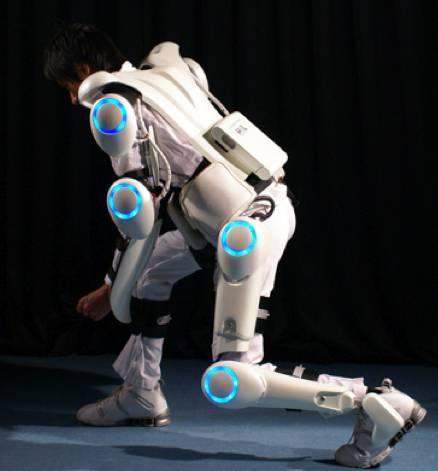
Yes: robot suits, or powered suits. Something like this:
As people age, growth-hormone and sex-hormone secretion declines and muscles weaken, restricting movement. The eyes also lose elasticity, turning the naturally excellent autofocus mechanism into a fixed-focus lens: presbyopia. These changes ultimately force people to retire.
Retirement creates still more undesirable consequences. Muscle contraction plays an important role in maintaining blood flow. Weakened muscles make walking troublesome, reduced walking worsens circulation, and this accelerates dementia. Dementia is said to remove not only the person’s own labor but the labor of roughly 2 family members. Thus, when 1 person develops dementia, the net loss of labor is -3 people.
Wearing a robot suit compensates for lost strength and encourages movement, helping prevent dementia while allowing the wearer to remain productive.
As noted initially, the essence of population aging is that people who only consume outnumber producers, making consumption exceed production. Abolishing mandatory retirement and making older people producers would solve this. Robot suits provide the means.
Where should we begin?
The Tokyo Olympics will take place in 2020, bringing many overseas tourists with very heavy luggage. Meanwhile, taxi drivers average 57.9 years of age; half are at least 60, and among those at least 50, the proportion exceeds 77%, according to fiscal 2012 data [2]. They grow older each year. At this rate, back injuries will abound. We should first provide them with robot suits. When a foreign tourist with huge bags approaches an airport taxi, a gray-haired driver in a robot suit gets out, effortlessly lifts the heavy bags with a mechanical whirr, puts them in the trunk, and invites the passenger aboard.
“Wow, it’s Cool Japan! ♡”
That reaction is guaranteed.
There are slightly more than 65,000 taxi drivers. If suits were supplied to drivers aged 50 or older, numbering 50,000, and Panasonic’s mass-production model, at annual production of 1000 units, costs ¥500,000 [3], the maximum budget would be ¥25 billion. At annual output of 20,000 units it would be much cheaper, and the price is modest if it creates a new industry.
In fact, the 3rd arrow of Abenomics includes “realizing a new industrial revolution through robots” [4][5]. It cites robots that reduce lower-back strain when lifting in medical and care settings. Although aimed there at younger people, the proposal is to apply them to older people. This may not be merely a fantasy—what do you think?!
[1] Also known as a tall tale
[2] Tokyo Hire-Taxi Association, “Tokyo Taxis 2013”, p. 25
[4] Prime Minister’s Office, “Revision of the Japan Revitalization Strategy” (Cabinet decision, June 24, Heisei 26)
[5] Prime Minister’s Office, “Key Points of the Revised Japan Revitalization Strategy (10 Challenges toward Reform)” (Cabinet decision, June 24, Heisei 26), p. 4
Related posts

Anyone Who Thinks Identity Is Given by the State or Government Should Sit Up and Read This: Utah Digital ID Bill SB260 and the Transformation Brought by a User-Centric Digital ID System
As digital technology evolves, our dependence on personal information and data continues to grow. Yet many government-provided ID systems do not always give sufficient consideration to…

The Provider Liability Limitation Act Has Become the Information Distribution Platform Act (May 10)
Following deliberations by the Ministry of Internal Affairs and Communications’ Study Group on Platforms, of which I was also a member, the amended “Provider Liability Limitation…

MyData Japan submitted comments in response to the public consultation on the “Order Partially Amending the Regulation for Enforcement of the Act on Certification Business of the Japan Agency for Local Authority Information Systems Pertaining to Electronic Signatures, etc.”
In response to the public consultation announced on January 26 regarding the "Draft Order Partially Amending the Regulation for Enforcement of the Act on Certification Business…
You must be logged in to post a comment.