

 What is social security?
To me, social security means a society in which people without a disadvantage support those who have acquired one. That is the fundamental idea behind insurance.
Japan is now approaching an unprecedentedly aging society, and we are told that pensions and social security will be in serious trouble. According to the Cabinet Office, we will see “the arrival of a society in which 1.3 working-age people support 1 older person”[1], prompting cries that this is a terrible crisis.
But “older people” here means those aged 65 or above. People aged 65 in the past may have been frail, but today’s 70-year-olds are vigorous. They travel frequently and surely can work. Preventing older people who can work from doing so and making young people support them could aptly be called a “policy of turning the elderly into an aristocracy.” That is plainly wrong.
Perceptive readers have probably already noticed: I think the supposed crisis results from wrongly replacing “healthy people” with “young people” and “people who are not healthy” with “older people” in the proper principle that healthy people support those who are not healthy. Put starkly, “older people who are not healthy” can be supported by “healthy older people.” Seen this way, materials such as Table 1-1-6[2] must be fundamentally reconsidered. We need a table calculating the proportion of people who are not healthy in each age group.
If so, what we must do is:
- Create an environment in which older people can work easily and realize a society where people remain active throughout life.
- Thoroughly manage health so that as many people as possible remain vigorous until a quick death.
An environment where older people can work easily means, for example, a society where cashiers sit while working. There is no reason at all to stand for that job. In Europe and elsewhere, cashiers routinely sit. Another point is using IT. Eyesight and hearing inevitably deteriorate with age, honestly making paper harder to read, but IT can compensate for that. In this sense, I think gerontechnology deserves much more attention. Professor Umemuro[3], this is your moment.
As for thoroughly managing health, people are calling for the use of big data. Whenever big data comes up, the discussion immediately turns to marketing, but that is merely CRM. One wonders how many examples truly require big data[4]. Yet big data is highly anticipated for applications such as controlling Alzheimer’s disease[5]. An OECD symposium on this topic should be held in Tokyo on September, so it merits attention.
Thus, my conclusion:
Japan should aim for
“a society where healthy older people support older people who are not healthy.”
That is what I think!
[1] Cabinet Office, Annual Report on the Aging Society, Heisei 25 (full edition)
[2] Cabinet Office, Annual Report on the Aging Society, Heisei 23 (full edition)
[3] Representative Coordinator, Japanese Chapter of the International Society for Gerontechnology: Associate Professor Hiroyuki Umemuro, Tokyo Institute of Technology
[4] Examples enthusiastically sought
[5] Alzheimer’s disease cannot currently be cured, but it is believed that its progression can be delayed through changes in lifestyle and other measures. Identifying high-risk groups from lifelog data and providing lifestyle guidance is therefore considered extremely important for preventing future social losses, such as the person becoming unable to work and family members leaving productive activity to provide care.
(Illustration source) Free illustration of a senior citizens’ association
Related posts
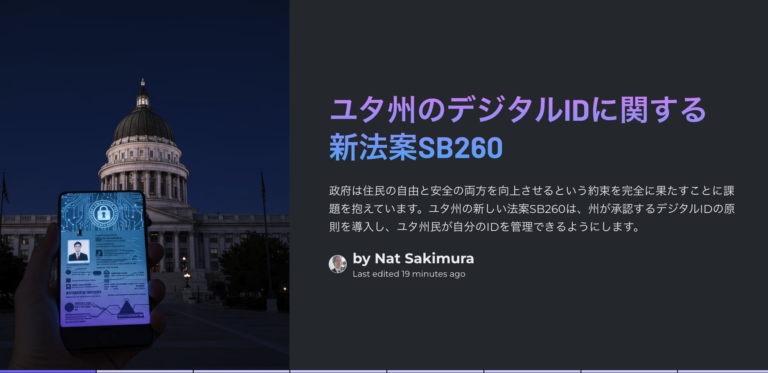
Anyone Who Thinks Identity Is Given by the State or Government Should Sit Up and Read This: Utah Digital ID Bill SB260 and the Transformation Brought by a User-Centric Digital ID System
As digital technology evolves, our dependence on personal information and data continues to grow. Yet many government-provided ID systems do not always give sufficient consideration to…
The Provider Liability Limitation Act Has Become the Information Distribution Platform Act (May 10)
Following deliberations by the Ministry of Internal Affairs and Communications’ Study Group on Platforms, of which I was also a member, the amended “Provider Liability Limitation…
MyData Japan submitted comments in response to the public consultation on the “Order Partially Amending the Regulation for Enforcement of the Act on Certification Business of the Japan Agency for Local Authority Information Systems Pertaining to Electronic Signatures, etc.”
In response to the public consultation announced on January 26 regarding the "Draft Order Partially Amending the Regulation for Enforcement of the Act on Certification Business…
You must be logged in to post a comment.