

Recently, it seems that My Number has been receiving increasing coverage in various media[1]. Leaving aside the fact that this is long overdue, I think it is better than receiving no coverage at all.
Ideally, I should point out any issues with each provision, but unfortunately I am extremely busy and do not have the time. So I will write down a few general points that I would like those discussing these matters to keep in mind.
Definition of an Identifier
A combination of attributes that can uniquely distinguish (identify) an individual (or object) from others within a group is called an “identifier.”
The so-called My Number is also a type of identifier.
The names “My Number” and “Individual Number” seem to assume that a sequence of digits is used to identify an individual, but an identifier does not have to be numeric, nor does it have to be a single string.
For example, a typical identifier is the so-called basic 4 information: address + name + date of birth + sex. With some exceptions, this functions adequately as an identifier. (However, using it as an identifier is undesirable from a privacy standpoint because it unnecessarily discloses other information.)
Basic 4 information is often thought of as contact information and, in most cases, is probably not consciously regarded as an identifier. But when using it, one really needs to be aware of whether it is currently being used as contact information or as an identifier.
It is also important to recognize that My Number will not function as an identifier unless it is used together with the information that the number is a My Number, and unless the population is limited to those to whom My Numbers have been issued at that point in time.
Desirable Properties of Identifiers
Different properties are desirable for identifiers depending on their purpose.
For example, identifiers used by people should:
- be strings that are easy to remember
- be capable of being read aloud
- Requirement 1: Be stable over a certain period of time
- Requirement 2: Be stable among handlers sharing a particular purpose of use
- Requirement 3: Not cause unwanted extraction of personal information through such use
The Privacy Perspective: The Principle of Data Minimization
Requirements for Various “Numbers”
Bank Account Numbers
Basic Pension Numbers
Taxpayer Identification Numbers
A Common Number for Tax and Social Security (Including Pensions) Is a Bad Idea
So What About My Number?
| Bill on the Use of Numbers to Identify a Specific Individual in Administrative Procedures (My Number Bill) |
H24.02.14
|
Office for Social Security Reform | Overview Summary Bill and Reasons Referenced Provisions |
| Bill on the Arrangement and Other Matters of Related Acts Accompanying the Enforcement of the Act on the Use of Numbers to Identify a Specific Individual in Administrative Procedures |
H24.02.14
|
Office for Social Security Reform | Overview Summary Bill and Reasons Old-and-New Comparison Table Referenced Provisions |
[1] Example: The Expanding My Number System: The “Folly” of Adding Unnecessary Functions — Norio Murakami’s Global Compass (44) 2012/7/31 7:00Nikkei
[2] Me? I do not have the time. Besides, it appears that many experts are addressing this issue, so I would like to focus on more fundamental areas (for example, international standards for identity proofing and the development of technical international standard protocols). Incidentally, if a common number is introduced, and if permitted, I would like to change my number roughly every 5 years. I will recommend that my acquaintances do the same. That is the minimum needed for self-protection. The national and local governments will also need to estimate the costs on the assumption that such behavior becomes widespread.
Related posts
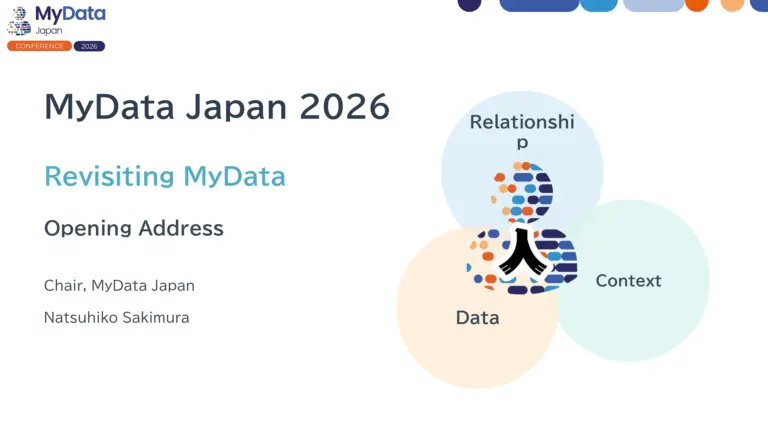
Data Sustains Lives—MyDataConference 2026 Opening Address
The following is the opening address for the MyData Japan Conference 2026, delivered by Nat Sakimura in his capacity as Chair of the General Incorporated Association…
The MyData Conference 2026 Is This Wednesday. See You at Hitotsubashi Hall!
I have been posting announcements on X every few days, and the MyDataJapan Conference 2026 is this Wednesday. There are many highlights: Naohiro Fujie, Representative Director…
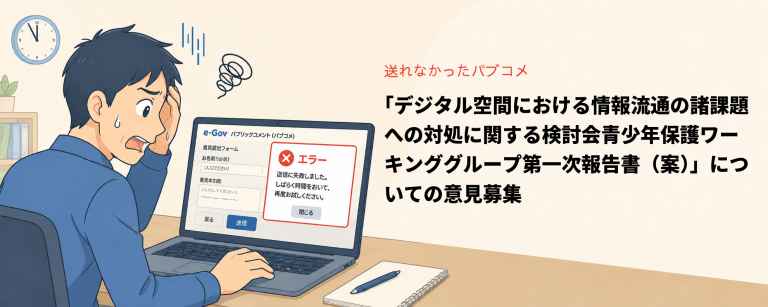
Unsubmitted Public Comment on the Call for Comments on the Draft First Report of the Youth Protection Working Group on Information Distribution in the Digital Space
July 823:59 was the deadline for the call for comments on the draft first report. I ended the FAPI WG early and23:40 began the submission process…