
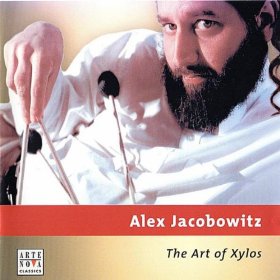
Alex Jacobowitz, Marimba, ARTE NOVA Classics, BMG Entertainment
The low resonator pipes roar, the high notes sob, and individual sounds dissolve into silence. Alex Jacobowitz’s latest recording, “The Art of Xylos,” reveals the true capabilities of this often-forgotten instrument.
Whenever an instrument becomes established as a solo instrument, a performer invariably emerges who makes it seem necessary to perform particular music on that instrument. Alex Jacobowitz can be said to have taken the first step toward becoming such a performer for the marimba.
Perhaps because of his deep emotional investment, Jacobowitz makes extensive use of rubato, and this sometimes disrupts the musical flow. In terms of safe choices among arrangements, Safri Duo’s Gold Rush and Leigh Howard Stevens’s Marimba When are far safer. For me, however, those performances would be better heard on piano or harpsichord; I find no compelling reason to hear them on marimba. Their technique is impressive, but there is no purely musical necessity.
By contrast, Jacobowitz’s “The Art of Xylos” draws out the marimba’s sonic appeal to the fullest and presents it as music. Through his wide dynamic range, variety of tone colors, and attention even to the process by which each sound fades, Bach and Beethoven become genuine marimba music.
Before hearing this recording, I could never even have imagined playing Beethoven’s “Moonlight” on marimba. That masterpiece, an ultimate expression of pianism, seemed impossible on any instrument other than the piano. Yet this performance almost makes me think Beethoven composed it with performance on the marimba exactly 200 years later in mind. The handling of the final 2 notes is just a little disappointing, though!
The same applies to Schumann’s Träumerei. For me, this was always a piece to hear from Horowitz, but Jacobowitz comes quite close. Mozart’s Fantasia makes you think, “So that is how he handles it,” although a few passages remain unsatisfying, and Bach’s Chaconne is compelling. The Chromatic Fantasia is also good, though it is regrettable that the flow of the scales occasionally stops. Pictures at an Exhibition has real character, and if someone heard Recuerdos de la Alhambra for the first time here, might they not think it was written for marimba?
As an incidental point, the recording is also superb. Apparently no artificial reverberation was added, yet it brings out the sound of the Adams 5-octave instrument Jacobowitz plays, a Van Sice model made in 1994, and the hall to their fullest. The bass and the sensation of sound dissolving into space are especially remarkable, so please listen on a stereo that can reproduce solid bass, not a portable radio-cassette player. This recording feels better through speakers than headphones, so please try it. With headphones, the impact sound of the mallets striking the bars becomes slightly distracting.
If you love marimba, this is a CD that should definitely be added as 1 disc in your collection. I also strongly recommend it to those who have not previously had much interest in marimba.
2002-04-20
(Natsuhiko Sakimura)
The Art of Xylos
Alex Jacobowitz, Marimba
Recording time: 67:40
ARTE NOVA CLASSICS (BMG)
AN 74321 91300 2
Instrument: Marimba = Adams Robert Van Sice Model (5 Octave), made in 1994
[Note: Although the CD jacket and liner notes describe the instrument as a xylophone, the performance is actually on marimba.]
Falla, from The Three-Cornered Hat
“Miller’s Dance”Tárrega
“Recuerdos de la Alhambra”Mussorgsky, from Pictures at an Exhibition
“Samuel Goldenberg & Shmuyle”
“The Old Castle”J. S. Bach
“Chromatic Fantasia”
“Chaconne (from Partita for Solo Violin No. 2)”Couperin
“Les Baricades Misterieuses”Debussy, from Preludes, Book 1
“The Girl with the Flaxen Hair”Satie
“Gymnopédie No. 1”Smadbeck
“Rhythm Song”Traditional Jewish Melody
“Firm di Mechatonim Aheim”Beethoven, from Sonata “Moonlight” (1801), Op.27 No.2
“Movement 1: Adagio sostenuto”Mozart
“Fantasia in D Minor, KV 397”Schumann, from Kinderszenen, Op.15
“Träumerei”
Related posts
New Discovery: Mozart Works for Flute and Harp Premiered on 6/21 (6/23 Performance Recording Also Added)
Across 250 Years: Mozart’s “Unpublished Autograph” Found in Paris Reveals the Genius Behind the Legend An “Anonymous” Treasure Sleeping in a Corner of the Library On…
A Visit to the Mendelssohn House in Leipzig — The Difficulties Faced by the Mendelssohn Family and Women
Year-End Greetings: Fauré’s “In Paradisum” from Requiem, Op. 48—In Memory of Andrew Nash
Here are my customary year-end greetings. This year I had begun preparing to perform “Lilium”, but after learning of the death of my close friend and…
You must be logged in to post a comment.