
The Strange Absence of Reporting on This Severe Consequence of a Privacy Violation
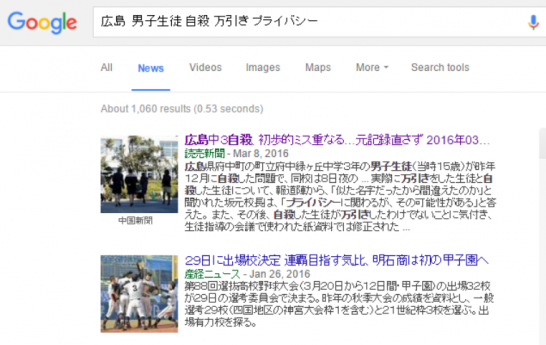
This was a truly tragic incident. A male student in junior high school year 3 was falsely accused of shoplifting, denied a recommendation letter for high school, and took his own life. The details are covered in “Teacher, You Wouldn’t Listen Anyway”: Report on the Suicide of a Hiroshima Junior High School Year 3 Student1. What particularly caught my attention was that a document incorrectly stating that the student had shoplifted in October 2013 was not corrected even after the error was pointed out at a school student-guidance meeting, and “career guidance” was subsequently conducted in which the school refused to write a recommendation letter on the basis of that document2. This is especially noteworthy because it is a severe consequence of a “typical privacy violation.” Yet few Japanese news reports appear to treat it as a privacy violation. Indeed, entering “Hiroshima male student suicide shoplifting privacy ” in Google News search produces little more than this Yomiuri Shimbun article, and even that article is not about the privacy violation suffered by the student.
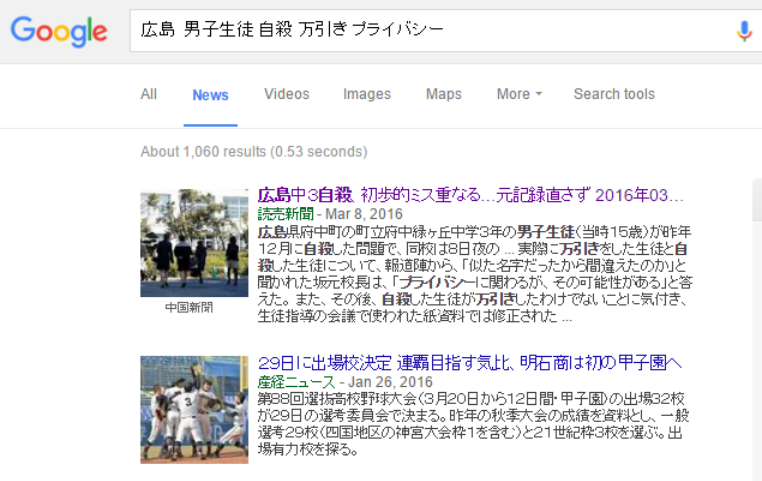
The reason for this phenomenon is unclear. One hypothesis is that Japanese news organizations may mistakenly believe that a privacy violation means the leakage of personal information.
Why Is This a Privacy Violation?
Privacy is said to be multifaceted and difficult to define3. For that reason, documents such as the ISO/IEC 29100 Privacy Framework do not define privacy directly, but instead present the actions required to respect privacy as “privacy principles.” The ISO/IEC 29100 privacy principles set out the following 11 points.
1. Consent and choice
2. Purpose legitimacy and specification
3. Collection limitation
4. Data minimization
5. Use, retention, and disclosure limitation
6. Accuracy and quality
7. Openness, transparency, and notice
8. Individual participation and access
9. Accountability
10. Information security
11. Privacy compliance(Source) Prepared by the author from ISO/IEC 29100
A privacy violation can occur if even one of these 11 principles is not ensured. Many of them were not observed in this case4. The point I particularly want to address here is principle 6, “accuracy and quality.”
It is widely known that failure to observe the principle of accuracy and quality often constitutes an extremely serious privacy violation. A common problem in the United States concerns what is known as “identity theft.” For some reason, it is widely and mistakenly believed in the United States that a Social Security number (SSN) has an authentication function, and providing an SSN may allow someone to obtain a credit card in the corresponding name. A typical pattern of identity theft is to use a credit card obtained in this way to commit fraud and then disappear. As a result, the “real person” associated with the SSN is falsely blamed for a crime they know nothing about, their credit score collapses, and ordinary social life becomes difficult5. Linking incorrect data to a person causes a serious privacy violation.
The principle of “accuracy and quality” is a norm intended to prevent privacy violations of this kind.
In this case, another person’s criminal history was linked to the student, seriously affecting his future path. This drove him into severe emotional distress and ultimately to suicide. It was therefore a grave consequence of a privacy violation caused by failure to observe the principle of “accuracy and quality.” It is truly tragic.
To Prevent This from Happening Again
A privacy violation shakes the very foundation of a person’s pursuit of happiness6, and may produce consequences so severe that they lead directly to death.
Everyone involved, particularly educational institutions, should recognize this and conduct a comprehensive review of whether the 11 principles above are being observed.
News organizations should likewise make it a standard practice to analyze such stories from the perspective of privacy.
Footnotes
- “Teacher, You Wouldn’t Listen Anyway”: Report on the Suicide of a Hiroshima Junior High School Year 3 Student: The Asahi Shimbun Digital http://www.asahi.com/articles/ASJ3B5RS3J3BPITB00X.html
- “Shoplifting” Document Submitted to Meetings 6 Times Even After Error Was Identified; Junior High School Year 3 Student Dies by Suicide (The Asahi Shimbun Digital March 11, 2016) http://www.asahi.com/articles/ASJ3B5SVYJ3BPTIL029.html ; “Hiroshima Junior High School Year 3 Student’s Suicide Shoplifting by Another Student Erroneously Recorded; School Refused Recommendation” (The Mainichi Shimbun)http://mainichi.jp/articles/20160309/k00/00m/040/081000c
- Personally, I do not think it is that difficult, but that is a subject for another occasion.
- On close examination, almost none of them appear to have been observed…
- This can, of course, be corrected afterward, but doing so apparently requires considerable time and financial expense.
- According to a Harvard University longitudinal study spanning 75 years (see, for example, Robert Waldinger, “What Makes a Good Life? Lessons from the Longest Study on Happiness”), good interpersonal relationships are fundamental to human happiness. In this case, the student was falsely branded a “shoplifter,” deprived of the hope of entering his desired school, and the resulting destruction of his relationships can be said to have caused his death.
Related posts
Data Sustains Lives—MyDataConference 2026 Opening Address
The following is the opening address for the MyData Japan Conference 2026, delivered by Nat Sakimura in his capacity as Chair of the General Incorporated Association…

The MyData Conference 2026 Is This Wednesday. See You at Hitotsubashi Hall!
I have been posting announcements on X every few days, and the MyDataJapan Conference 2026 is this Wednesday. There are many highlights: Naohiro Fujie, Representative Director…
Unsubmitted Public Comment on the Call for Comments on the Draft First Report of the Youth Protection Working Group on Information Distribution in the Digital Space
July 823:59 was the deadline for the call for comments on the draft first report. I ended the FAPI WG early and23:40 began the submission process…
You must be logged in to post a comment.