

After February 19, 1998, shortly after 12 p.m., Representative Masataka Arai, who was due to be arrested that day over improper transactions with Nikko Securities, “committed suicide.” I put “suicide” in quotation marks because there are several highly puzzling points.
Newspaper reports say that the person who discovered Arai’s suicide was his wife. After going out, she returned to the hotel room at 1:5 p.m. and found that he had hanged himself from an air vent using the sash of a yukata. It is somewhat strange that he was in a hotel on the day he was to be arrested, but leave that aside. The problem is that the police were not notified for 2 hours and 15 minutes after the discovery—the notification came at 3:20—and the scene was not preserved. Given that a man who was so talkative left no suicide note, the blank period raises questions.
Why was so much time necessary?
Since his death was neither from illness nor accident, the possibilities are murder or suicide. In a murder case, time would be needed to destroy evidence, so the blank 2 hours and 15 minutes would make sense. In a suicide case, on the other hand, the police would ordinarily be contacted immediately. If time was needed, it is natural to think either that there was something at the scene that should not be seen by the police, or that there was some possibility to conceal. What might that “something that should not be seen” be? It would be documents accusing other legislators of wrongdoing.
If a man so talkative chose a deliberate death by suicide—he repeatedly said “the last” at the previous day’s press conference—it is almost unimaginable that he would leave no note at all. If so, it seems entirely natural to think either that the note was disposed of, or that he was eliminated despite not intending to die.
Masataka Arai died before completing his work. It is said that the investigation into this matter will now largely end. But that would make his death meaningless. A thorough investigation is needed.
Related posts
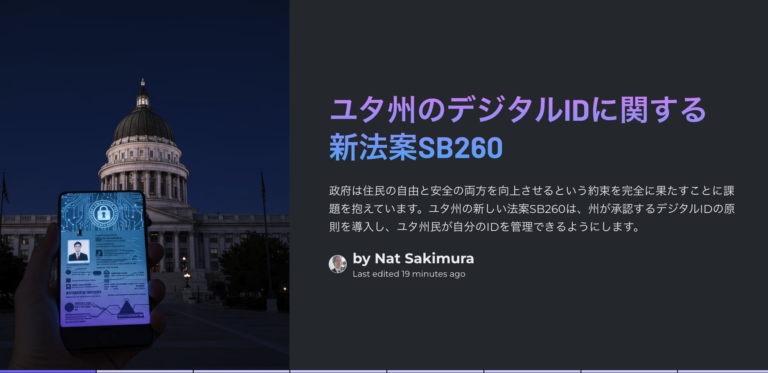
Anyone Who Thinks Identity Is Given by the State or Government Should Sit Up and Read This: Utah Digital ID Bill SB260 and the Transformation Brought by a User-Centric Digital ID System
As digital technology evolves, our dependence on personal information and data continues to grow. Yet many government-provided ID systems do not always give sufficient consideration to…

The Provider Liability Limitation Act Has Become the Information Distribution Platform Act (May 10)
Following deliberations by the Ministry of Internal Affairs and Communications’ Study Group on Platforms, of which I was also a member, the amended “Provider Liability Limitation…

MyData Japan submitted comments in response to the public consultation on the “Order Partially Amending the Regulation for Enforcement of the Act on Certification Business of the Japan Agency for Local Authority Information Systems Pertaining to Electronic Signatures, etc.”
In response to the public consultation announced on January 26 regarding the "Draft Order Partially Amending the Regulation for Enforcement of the Act on Certification Business…