
The Karuizawa Bus Accident
1was an extremely tragic incident.
In this case, many news organizations reported the victims’ photographs, personal relationships, and other details. Quite a few people appear to have had privacy concerns about this coverage. One example is this article by the Asahi Shimbun:
2and this article by Toshinao Sasaki in response:
3These are probably representative examples.

For many people, this accident seems to have prompted a reconsideration of privacy, for better or worse.
Privacy of the deceased is a useful subject for highlighting the difference between compliance with the Act on the Protection of Personal Information and the protection of privacy, as well as the gap between human rights and privacy. At the same time, a situation like this one, in which episodes from victims’ lives are reported one after another, also offers a good opportunity to reconsider the relationship between what the mass media call “freedom of speech” and “privacy.”
The tension between “freedom of speech” and “privacy”
When an incident like this occurs, news organizations all rush to gather information from everywhere and compete to “report” it. This may be because it is content that attracts viewers. But to what extent do news organizations consider the possibility that their reporting may violate privacy? They may invoke freedom of speech or the right to know, but are those not rights asserted against the three branches of government? In this case, the victims were basically private individuals. What public interest could justify the mass media’s invasion of their privacy? Did the media consider that question? I would like to hear their position.
Different rights often interfere with one another, so a balance must be struck after considering many factors. Surely not everything is permissible simply because it is done for news reporting. Yet freedom of the press is often reported as though it were an “absolute right,” and I believe care is needed on this point. According to this document from the Japan Newspaper Publishers & Editors Association,
4Attorney Mimura says that “even when permission cannot be obtained from the person who posted a video or image on a video-sharing site or social media, its use is fully permitted if it is for news reporting,” and that “similarly, photographs of faces posted on social media may be used without permission if the purpose is news reporting.” The divide is therefore unexpectedly deep. This point requires serious discussion. From the view that rights should be structured to protect those in weaker positions, it would seem that “the privacy rights of private individuals” should take precedence over “freedom of the press.” Yet no one wants to make an enemy of the fourth estate, and the fact that few people confront it with a principled argument seems to be a major problem.
「私は昨日殺された。でもその後の辱めの方がひどかった」 https://t.co/TuxhJQvUnH #死者のプライバシー
Privacy of the deceased and human rights
The Act on the Protection of Personal Information protects information concerning living individuals. Consequently, data concerning the deceased is not protected. That does not mean that data concerning the deceased need not be protected. “Privacy of the deceased” is an issue that has received increasing attention in recent years.
Privacy of the deceased is difficult because the discussion first has to return to the question, “For whose sake is it protected?”
5Since the deceased also possess dignity, the answer must primarily be the deceased themselves. But this also suggests that deriving privacy solely from human rights is surprisingly difficult, since the deceased do not possess human rights. Perhaps we must “define an existence deserving a certain fundamental ‘respect,’ rather than relying on the framework of ‘rights.’”
6That may be what is required.
Another approach would be to avoid the problem and resolve it indirectly. The legal interests underlying the offense of damaging a corpse apparently include the rights of the bereaved and preserving the ability of the police and others to conduct verification. A similar model could therefore seek a solution through the rights of the bereaved. But infringement by the bereaved themselves is also possible, and this approach cannot be used when there are no surviving relatives.
I understand the right to privacy as “the right to enjoy happiness by building relationships in the desired form through having oneself seen by others (the external view) as one wishes to see oneself (the internal view)” (see Figure 2). A person naturally has wishes about “how they want to be seen” even after death. If everything is disclosed on the ground that personal information is no longer protected after death, the relationships the person intended during life will collapse.
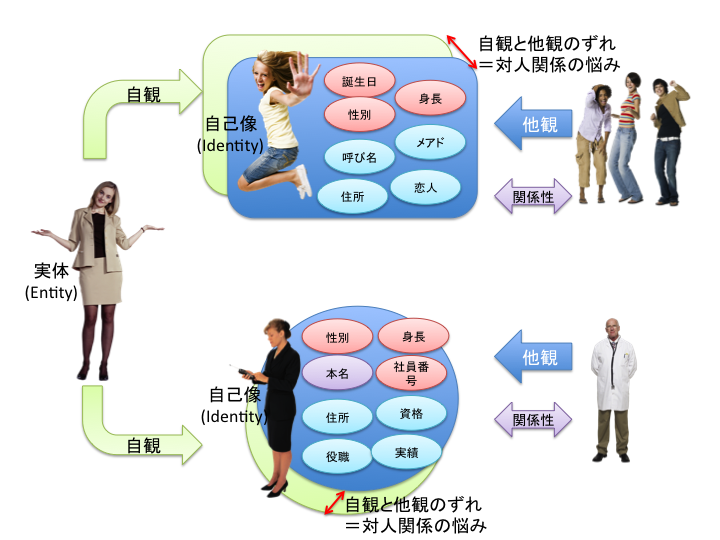
Third parties who witnessed those relationships may realize after the person’s death that relationships built during life have collapsed, leaving them anxious and potentially unhappy. One possible challenge is to treat the protection of those relationships as a legal interest and ask whether #privacy of the deceased can be derived from human-rights provisions.
Another possibility may be to derive it by analogy from the reasons why wills are recognized. I hope legal scholars will give some thought to the issue of #privacy of the deceased, including the perspectives described above.
Psychology and privacy
Regarding privacy generally, not only that of the deceased, I would very much like psychologists to explain the effect that maintaining “relationships” has on human “happiness.” As stated above, my understanding of privacy is closely related to “maintaining relationships.” To derive its protection from human-rights provisions, we need to establish the correlation between building and maintaining relationships and happiness.
In Japan, discussions of privacy usually become discussions of law. But law is one of the 1 technologies for achieving “something.” We must first clarify what it is that we seek to protect. If we are to derive the protection of personal information or privacy from the right to pursue happiness under Article 13 of the Constitution, we must clarify why protecting personal information relates to the pursuit of happiness and why maintaining desired relationships relates to the pursuit of happiness. This belongs to the field of psychology. I feel that developing privacy theory further will require a considerably more interdisciplinary approach than it does today.
(Postscript)
I subsequently found a Harvard University longitudinal study spanning more than 80 years.
Welcome to the Harvard Study of Adult Development
Robert Waldinger’s TED Talk on the study: Robert Waldinger: What makes a good life? Lessons from the longest study on happiness
Harvard Gazette article: Liz Mineo, Good genes are nice, but joy is better
Footnotes
- Karuizawa ski bus crash
- Jobs, further education, friends… What the university students dreamed of before the bus accident http://www.asahi.com/articles/ASJ1J43P4J1JUTIL00N.html
- Toshinao Sasaki https://www.facebook.com/sasaki.toshinao/posts/10154029823812044
- Attorney Mimura explains issues concerning news reporting and portrait rights, News Materials Study Group http://www.pressnet.or.jp/news/headline/141127_4510.html
- Akihira Yoshimoto https://twitter.com/AKHYSH/status/688728385523027968
- Akihira Yoshimoto https://twitter.com/AKHYSH/status/688739394535034880
Related posts
Data Sustains Lives—MyDataConference 2026 Opening Address
The following is the opening address for the MyData Japan Conference 2026, delivered by Nat Sakimura in his capacity as Chair of the General Incorporated Association…

The MyData Conference 2026 Is This Wednesday. See You at Hitotsubashi Hall!
I have been posting announcements on X every few days, and the MyDataJapan Conference 2026 is this Wednesday. There are many highlights: Naohiro Fujie, Representative Director…
Unsubmitted Public Comment on the Call for Comments on the Draft First Report of the Youth Protection Working Group on Information Distribution in the Digital Space
July 823:59 was the deadline for the call for comments on the draft first report. I ended the FAPI WG early and23:40 began the submission process…
You must be logged in to post a comment.