
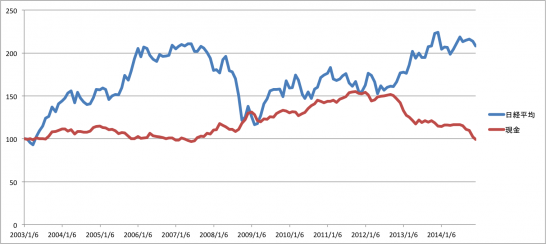
In “At the New Year, Looking Back at the Value of Cash in 2014”, I reviewed how the value of cash changed over the course of 2014. I then received criticism that “you need to extend it back about 8 years to include the periods before and after the Lehman shock,” so I created a graph extending back to 2003, the earliest year for which exchange-rate data was readily available. Here it is.
Equities certainly have high volatility. That is why one must consider long-term investment. You must avoid being forced to cash out at the bottom, so investing funds that will be needed in the short term in equities is not advisable. Since volatility ranks equities > bonds > cash, assets must be allocated appropriately according to plans for funding needs. With pensions and similar funds, those needs are somewhat foreseeable, so I think it is quite important to set a portfolio balance accordingly and maintain it. As with an inflation target, maintaining the indicator is essential; there should be no such thing as opportunistic rebalancing through political intervention.
Incidentally, when I viewed the site after writing “At the New Year, Looking Back at the Value of Cash in 2014”, an article titled “Print Money and Improve the Economy” from 1998 appeared as a related article. Its proposals were:
- Increase the money supply by issuing government currency, or having the Bank of Japan underwrite government bonds
- Use the resulting revenue for public investment
These became the 1 and 2 arrows of Abenomics. It is deeply moving to think that I said this before Abenomics began in 2013, by 15 years.
Incidentally, the 3 arrows of Abenomics are said to be the following 3:
- Bold monetary policy
- Flexible fiscal policy
- A growth strategy that stimulates private investment
Unfortunately, the 1998 article says nothing about growth strategy 3. Tomorrow, in keeping with the New Year, I intend to write something about this that includes a few dreams.
Well then, Good Night!
You must be logged in to post a comment.