
Happy New Year.
I look forward to your continued support in this year marking 70 years since the end of the war.
There has been a great deal of public clamor claiming that the GPIF is insane to raise the proportion of equities it purchases. To show that this is not so, I would like to begin the new year by looking back using data from 2014.
People often say, “Stocks are dangerous. Cash is safe.” This is an illusion caused by being misled by nominal values. Long ago, I traveled around interviewing pension funds in various countries, and I vividly remember a fund in a certain European country telling me that “equities are the safest asset.” The reasoning was that although their nominal value may fluctuate, equities are linked to the real economy and therefore make it easier to preserve real value, whereas cash invariably loses over the long term, as long as the inflation rate is positive.
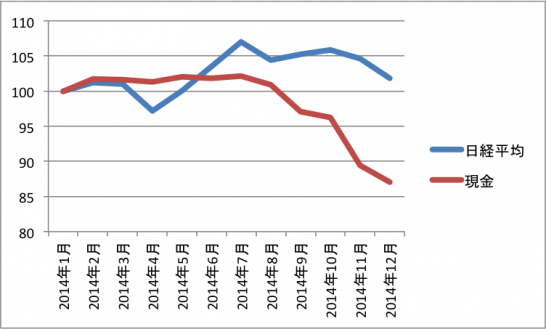
It seems to me that Japan in 2014 demonstrated this perfectly in just one year. Figure 1 shows Japanese equities (the Nikkei average) and cash (the Japanese yen) in U.S. dollar terms, using their prices at the end of January as an index value of 100.

What do you think? I expect you can now see just how dangerous an asset cash can be. Equities are stable, aren’t they? Personally, I regret not reducing the cash exposure in my portfolio further and not tilting it more toward overseas assets.
And so, this New Year has made me think that perhaps I should consider asset management a little more seriously this year.
May the coming year be a good one for everyone.
Related posts
At the New Year, Looking Back at the Value of Cash from 2003 to 2014
In “At the New Year, Looking Back at the Value of Cash in 2014”, I reviewed how the value of cash changed over the course of…

Is a Weak Yen Something to Celebrate?
The Strong Yen and Income At the beginning of 1995, when the yen suddenly strengthened, business leaders spoke of “hollowing out” and the like as if…
You must be logged in to post a comment.