
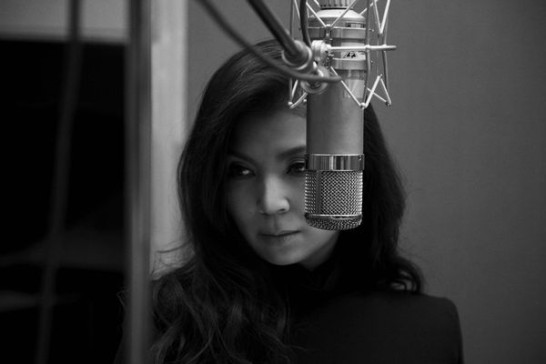
At the end of 2023, the great singer of yesteryear, Aki Yashiro, passed away at the age of 73. What a terrible loss at such a young age. I had hoped she would show us the musical beauty of maturing and fading, so I am deeply saddened.
In tribute, I am reposting an article I wrote 10 years ago. Through “Songs Around Midnight,” it explores “Fly Me to the Moon” from various angles. I have embedded YouTube videos as well, so I hope you enjoy it.
And now, a toast in her memory.
(2012-10-17 21:39)
Aki Yashiro’s new album, “Songs Around Midnight”, is attracting attention. The impact probably comes from the queen of enka, 41 years after her debut, singing jazz, and from the album being released in 75 countries worldwide. It appeared in my Twitter feed, so I promptly listened on iTunes and found it unexpectedly good1. Then I learned that she had originally aspired to become a club singer after hearing Julie London when she was in grade 5 of elementary school, so she was a jazz singer from the beginning. That makes sense.

Track 1 is the title song, “Fly Me to the Moon.” Its tasteful opening on double bass resembles Natsuki Morikawa’s “Lullaby of Birdland” on &JAZZ, and is exactly the sort of opening I like2. But it differs considerably from the Julie London version that influenced Yashiro.

“Fly Me to the Moon” Was Originally a Waltz
“Fly Me to the Moon” is a popular song written by Bart Howard in 1954. Its original title was “In Other Words,” and Johnny Mathis (1957) was the first to use the title “Fly Me to the Moon.” Many versions have since been recorded. Most people have probably heard somewhere either the Ernie Freeman version, with the distinctive jazz pizzicato of Julie London, who inspired Yashiro to pursue jazz, or Frank Sinatra’s version on It Might as Well Be Swing (1964). Sinatra’s is an extraordinarily luxurious version, arranged by Quincy Jones and accompanied by Count Basie; stylish and tremendously cool. The transition into the interlude is electrifying, and I strongly recommend it if you have never heard it. Like Yashiro’s version, both are in four beats. Surprisingly, however, the song was originally written as a waltz. Its first recording was Kaye Ballard’s recording from 1954.

It is exceedingly sweet, in some sense the opposite of the cool Julie London and Frank Sinatra versions. It is a very good song in its own way, but today this waltz version seems almost never to be performed. So where did the conversion to four beats occur?
Quincy Jones
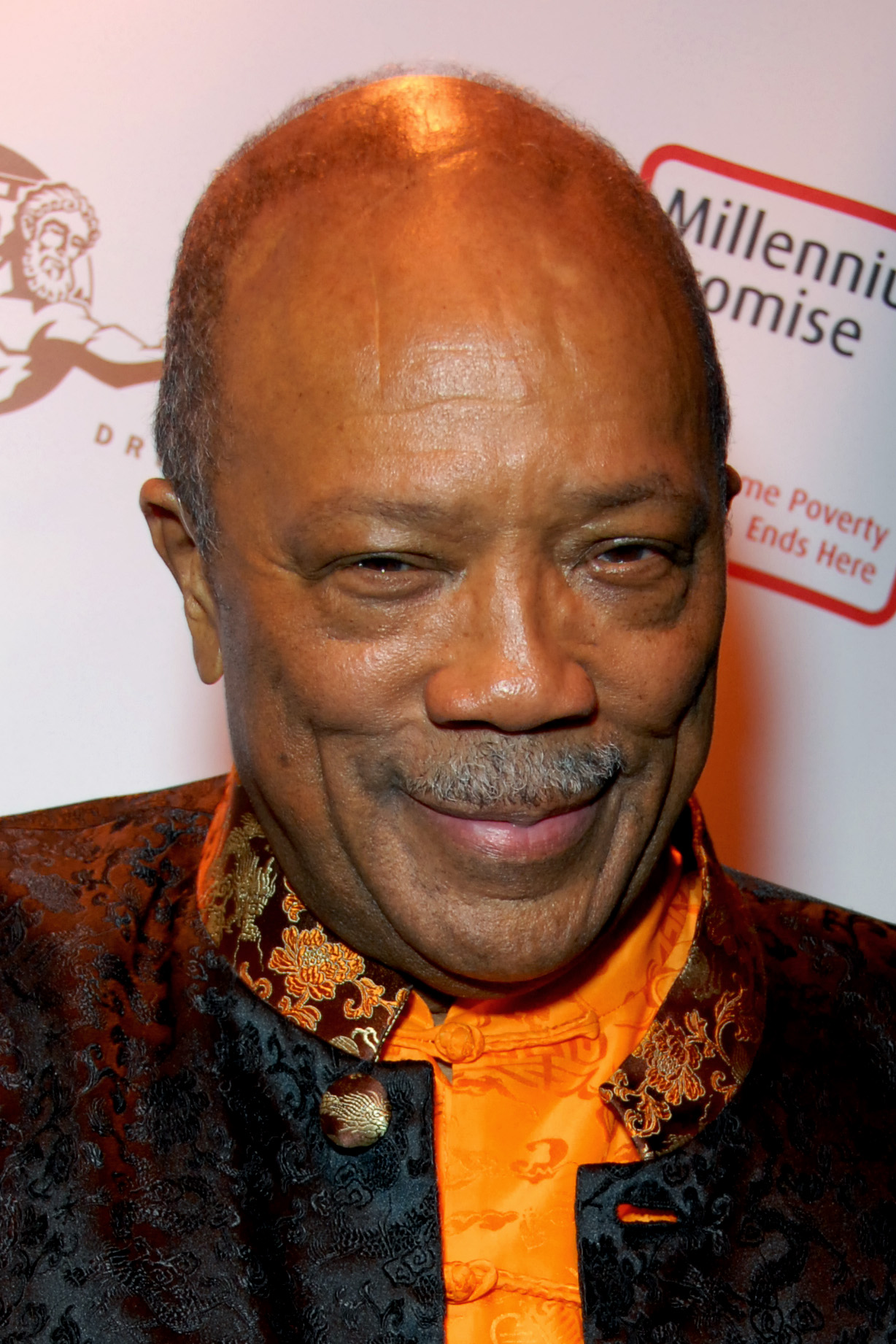
With this question in mind, I investigated using YouTube and Wikipedia. According to Wikipedia, the meter was changed in Sarah Vaughan’s 1962 version3. Quincy Jones arranged this version, and he also arranged the Frank Sinatra version. In that sense, much of the credit for this song’s survival may belong to him.
As everyone knows, Quincy Jones, born in 1933, was a producer, composer, arranger, and trumpeter. He was not only the first African American to win the Academy Award for Best Original Song, but also produced Michael Jackson’s “Thriller” and “We Are the World.”
I had always thought of Quincy Jones as purely a jazz musician, but he was also a student who studied composition and theory under Nadia Boulanger 4 and Olivier Messiaen 5. This surprised me a little. It shows that fundamentals matter to originality. Without foundations, even what one thinks is original ends up being merely derivative.
Finally, please listen to the Frank Sinatra version. When it comes to “Fly Me to the Moon,” it really has to be Sinatra.

Bonus
Among younger performers, Halie Loren’s performance at Cotton Club Tokyo is charming. It matches her age and the lyrics extremely well. The CD is cooler, but this charming performance is also quite good. Why can’t Japanese performers make music sound like this, whether jazz or classical…?

Footnotes
- perhaps my expectations had been low. It still has the weakness common to Japanese singers: the pronunciation of the lyrics bothers me. And the Japanese lyrics are… well. The backing and voice are too separate to create the live feeling of jazz, and the arrangements seem somewhat half-finished. For example, the opening of “Fly Me to the Moon” is wonderful when it begins with double bass alone, but adding finger snaps instantly makes it sound cheap…
- although &JAZZ is still much better—overwhelmingly more sophisticated. Perhaps I am biased, since I also went to hear her live…
- you can hear an excerpt on amazon.com. In the sense of departing from triple meter, however, Nancy Wilson (1959) and Nat King Cole (1961) came earlier, although their sweetness remained unchanged. I also like Sarah Vaughan’s live Copenhagen version
- Nadia Boulanger was a French composer and teacher. Aaron Copland, John Eliot Gardiner, Dinu Lipatti, Igor Markevitch, Philip Glass, and Ástor Piazzolla were all her students.
- Olivier Messiaen was a major French composer representing the 20th century, famous for works such as the Turangalîla-Symphonie. Personally, I like works such as Le Merle Noir (The Blackbird) (performed by Patrick Gallois, with score) .
Related posts
As Expected of Kyoko Shimbun: The Abnormality of Today’s Privacy Violations, as Seen in “Edited Yearbooks, Anonymous Essay Collections… The Privacy Wave Reaches Graduation Keepsakes”
As expected of Kyoko Shimbun. Published on March 11, 2016, the article “Edited Yearbooks, Anonymous Essay Collections… The Privacy Wave Reaches Graduation Keepsakes” uses humor while…
How to Download Photos from Flickr in Bulk
Flickr was acquired by Verizon in 2017. It was subsequently resold to SmugMug, and the service is about to change. Free accounts will be able to…

noon@Cotton Club Tokyo
I went to see noon perform live at Cotton Club Tokyo. I had not gone there specifically for her; I simply went to Cotton Club and…