
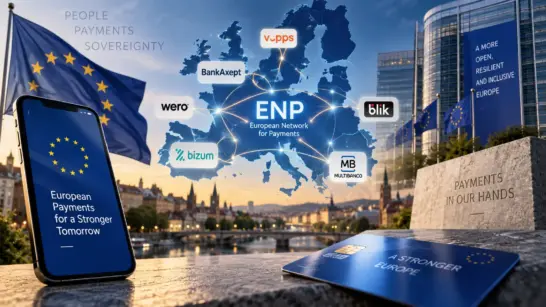
On September 30, 2026, leading European payment providers announced the establishment of a new company, European Network for Payments (ENP). Its participants are Italy’s BANCOMAT, Spain’s Bizum, the European Payments Initiative (EPI) with Wero, Portugal’s SIBS–MB WAY, and the Nordic region’s Vipps MobilePay. Based in Madrid, the company will operate a shared infrastructure connecting these payment services. Together, the participating services have approximately 130 million users. Their coverage spans 13 countries, whose population represents at least 70% of the combined population of the EU and Norway.
ENP plans to begin with cross-border person-to-person transfers, before expanding into e-commerce and in-store payments. 1
At first glance, this is a joint venture among European fintech companies. Looking into the background, however, reveals a somewhat bigger story.
That story is payments sovereignty.
In Europe, dependence on US companies such as Visa and Mastercard for payment infrastructure is increasingly seen as a security issue as well. US sanctions against judges and staff of the International Criminal Court (ICC) provided a concrete illustration of the danger.
What about Japan? Japan has JCB. Its presence may be more important to Japan’s payments sovereignty than we generally realize.
What will ENP do?
Let us first clarify what ENP is intended to do.
ENP is not about building a new Visa or Mastercard from scratch.
Europe already has payment services widely used within individual countries: Bizum in Spain, BANCOMAT in Italy, and MB WAY in Portugal, for example.
These services, however, have largely developed for domestic use.
Even if sending money with Bizum is easy in Spain, it is not necessarily just as easy to send money to a Wero user in France. Once a border is crossed, users ultimately rely on international payment networks such as Visa and Mastercard.
ENP seeks to solve this problem by interconnecting national services rather than replacing them.
Users will continue to use the same apps. The idea is that ENP will provide interoperability when transfers or payments need to move between different apps.
According to the official announcement, it will build a common technical and operational layer based on European standards, using mechanisms such as instant account-to-account payments.
Conceptually, the structure looks like this.
flowchart TB
    U["Users and merchants"]

    subgraph APPS["Existing European payment services"]
        BIZ["Bizum"]
        BAN["BANCOMAT"]
        MBW["MB WAY"]
        VIP["Vipps MobilePay"]
        WERO["Wero / EPI"]
    end

    ENP["ENP<br/>Interoperability layer"]

    PSP["Banks and PSPs"]

    RAIL["Existing European payment infrastructure<br/>SEPA Instant, etc."]

    U --> BIZ
    U --> BAN
    U --> MBW
    U --> VIP
    U --> WERO

    BIZ -.-> ENP
    BAN -.-> ENP
    MBW -.-> ENP
    VIP -.-> ENP
    WERO -.-> ENP

    ENP --> PSP
    PSP --> RAIL
Figure 1: ENP’s conceptual role. Dotted lines indicate interoperability among the services, not actual payment messages or flows of funds.
What ENP provides here is a layer for interoperability.
ENP itself will neither issue a new currency nor create a new settlement system between central banks.
It is a mechanism for making existing services usable across Europe while retaining what they already offer.
This approach is also interesting from a standardization perspective. It seeks to achieve the necessary interoperability through a common layer, without necessarily requiring every participant to adopt the same implementation.
ENP’s detailed technical specifications have not yet been published, however. Which functions will be shared and which will remain the responsibility of each service still need to be clarified.
From EuroPA to Wero, and then ENP
This initiative did not emerge out of nowhere.
Europe has long been pursuing plans to interconnect national payment services.
One such initiative is the European Payments Alliance (EuroPA).
Led by BANCOMAT, Bizum, SIBS–MB WAY, and others, it demonstrated cross-border transfers using SEPA Instant in 2024. BLIK, IRIS, Vipps MobilePay, and others subsequently joined. 2
Meanwhile, EPI has been rolling out Wero as a payment service for use across Europe.
Wero is also based on instant account-to-account payments, but aims to expand across Europe as a distinct service in its own right.
Then, on February 2, 2026, 4 companies from the EuroPA side and EPI signed a memorandum of understanding (MoU) to connect these services through a common hub. 3 ENP, announced on September 30, is the joint company established to operate that hub.
In other words, EuroPA is the alliance that has promoted interoperability among existing services; Wero is the payment service offered by EPI; and ENP is the operator of the shared infrastructure connecting them.
Why has Europe begun emphasizing payments sovereignty?
According to the comprehensive payments strategy published by the European Central Bank (ECB) in March 2026, for every 3 card transactions in the euro area, at least 2 are processed under rules set by companies outside Europe.
Moreover, across the euro area’s 21 countries, 13 lack a domestic card scheme and depend on international card schemes. 4
Previously, I think this would mainly have been seen as a matter of industrial competitiveness.
But as geopolitical tensions have risen, its significance has changed.
Payments are essential infrastructure, just like electricity and communications. If they stop, the impact extends across economic activity, from everyday shopping to business-to-business transactions.
When this essential infrastructure depends on particular foreign companies, policy decisions by a foreign government can leave a country’s citizens and businesses unable to make payments.
In its 2026 payments strategy, the ECB likewise identifies excessive dependence on non-European providers as a vulnerability and notes the risk of payment services being used as instruments of economic or political pressure.
An incident has now brought this risk sharply into focus: yes, the case in which ICC judges lost access to card payments.
ICC judges lost access to card payments
On February 6, 2025, US President Trump signed Executive Order 14203, introducing a sanctions regime targeting individuals associated with the International Criminal Court (ICC).
The backdrop was the ICC’s issuance of arrest warrants for Israeli Prime Minister Netanyahu and others. The US government argues that the ICC has acted beyond its authority against US and Israeli individuals.
The sanctions were subsequently extended to ICC judges and prosecutors.
On August 19, 2026, the ICC’s President, Japanese judge Tomoko Akane, was also designated for sanctions. Of the ICC’s 18 judges, 9 were under US sanctions at that point. 5
On April 8, 2026, French ICC judge Nicolas Guillou testified before the French National Assembly about the sanctions’ impact on everyday life.
His account was striking.
The sanctions led to the cancellation of Guillou’s Visa card, and he was unable to obtain a replacement card from French banks.
France has a domestic card network called Cartes Bancaires (CB).
However, he explained that cards issued by French banks were co-badged with Visa or Mastercard, and that he had been unable to obtain a CB-only card.
According to Guillou, there is no technical obstacle to issuing a CB-only card. He said that the obstacle lay in the contractual relationships between banks and international card brands. 6 Although he had retained his bank account itself, at least as of his testimony he had not obtained a replacement card for everyday use. 7
I find this a very revealing case.
A French citizen living in France, with an account at a French bank, could no longer use card payments because of sanctions imposed by the US government.
The problem goes beyond payment networks
There are two issues here.
One is that Visa and Mastercard are US companies and must comply with US sanctions laws and regulations.
Even a card issued by a European bank is affected if it uses a US company’s payment network.
The other is the response of European companies themselves.
Banks and payment providers with business ties to the US may suspend even transactions that are not directly subject to restrictions, in order to avoid the risk of violating sanctions.
This is known as overcompliance.
Guillou testified that similar problems had arisen with health insurance and other services.
Creating a European card network would not solve this entire problem. If participating banks or payment providers refuse service because of their business ties to the US, a payment still cannot go through.
Even so, having an independent payment network can at least reduce the risk that the payment route itself becomes unavailable because of a US company’s decision.
I think that is a significant difference.
ECB President Lagarde’s “march to independence”
Against this backdrop, the ECB has also come to emphasize the independence of Europe’s payment infrastructure.
In March 2025, ECB President Christine Lagarde spoke of the need for Europe to pursue a “march to independence.”
In her speech to the European Parliament on February 9, 2026, she explained the policy of building the digital euro on infrastructure controlled by Europe itself, avoiding excessive reliance on foreign payment providers. 8
Also on February 9, the Financial Times reported comments calling for urgent development of European alternatives to Visa and Mastercard.
The speaker in that case, however, was EPI CEO Martina Weimert, not President Lagarde.
Weimert pointed out that Europe has excellent national payment services but lacks options that work across borders. She argued that if independence matters, action is needed urgently. 9
What Lagarde is calling for from a central bank’s perspective and what Weimert is calling for as a private payment provider can be seen as different sides of the same issue.
And progress has indeed followed, from the MoU of February to the establishment of ENP in September.
What about Japan? The significance of JCB
Let us now consider Japan’s situation.
Japan is actually in a somewhat different position from Europe.
That is because Japan has its own international card brand, JCB.
JCB was established in Japan in 1961 and began its own international expansion in 1981.
JCB is well known as an international brand originating in Japan.
From the perspective of payments sovereignty, however, its significance goes beyond the fact that a Japanese company owns an international brand.
JCB is an independent card scheme, operating rules and a network distinct from those of Visa and Mastercard.
Consequently, within Japan, JCB payments may remain available even when Visa or Mastercard acceptance is suspended.
And such cases have already occurred.
Visa and Mastercard restrictions on content sales
Since 2024, a series of Japanese digital content retailers have suspended Visa and Mastercard payments.
Services selling independently produced works, manga, games, and similar content have been particularly affected.
DLsite, for example, temporarily suspended Visa and Mastercard payments on April 3, 2024.
JCB was among the alternative card brands it recommended at the time. 10
FANZA’s current official help pages likewise state that available card brands vary by service, and that FANZA Books and FANZA Doujin accept only JCB and Diners Club. 11 In other words, there are cases where content sales have continued because JCB remained available after Visa and Mastercard acceptance was suspended.
Structurally, this closely resembles the payments sovereignty issue facing Europe.
Its nature differs from the ICC case, however.
In the ICC case, US government economic sanctions were the direct cause. In Japanese content sales, the issue concerns card brands’ acceptance policies and decisions by payment service providers.
Nor can every change in content offerings accompanying the suspension of card payments automatically be confirmed as a direct requirement imposed by a card brand.
Nevertheless, there is a common feature.
Rules set by one country or company can restrict payments for goods or services legally offered in another country.
I think this illustrates the enormous power held by payment infrastructure.
What has JCB’s presence actually changed?
Let us look at a more concrete example.
On December 19, 2025, viviON, the parent company of DLsite operator EISYS, announced the “viviON JCB Card.”
This is a JCB-branded credit card issued in partnership with Nudge Inc., announced as becoming available for use from January 26, 2026. 12
It is an interesting example of an effort to secure a payment method that allows customers to continue using the group’s services.
viviON has also offered “Minna Bank Payments” since October 6, 2025.
This does not use a credit card. Instead, users link their Minna Bank account to their viviON ID and pay directly from their bank account.
Approximately 3 weeks after launch, the service had surpassed 10,000 users, according to the announcement. 13
This is an even more interesting development.
JCB is an alternative card scheme to Visa and Mastercard, whereas payments directly linked to bank accounts bypass card schemes altogether. viviON is therefore diversifying its payment methods in two directions.
One is to use JCB, which is independent of US card brands.
The other is to offer payments directly linked to bank accounts, without going through card networks.
Technically, the latter has something in common with the A2A payments that Europe’s Wero and ENP aim to enable.
Of course, geographical coverage, interoperability, and business models differ. But the direction—reducing reliance on international card schemes—is shared.
Does having JCB mean Japan has nothing to worry about?
This requires a little more careful consideration.
JCB’s existence is a major asset for Japan’s payments sovereignty, but it does not solve every problem on its own.
JCB also has its own merchant terms
First, JCB also screens merchants according to its own rules.
JCB’s mail-order merchant terms contain provisions prohibiting card acceptance for transactions that violate public order and morals, or that JCB deems inappropriate, among others. 14.
Using JCB therefore does not mean that any type of content can be sold.
What matters here, however, is that JCB can make decisions independently of Visa and Mastercard.
If Visa, Mastercard, and JCB each have independent rules, an alternative may remain available when acceptance under one brand is suspended.
Conversely, if all brands operate according to the same criteria, having multiple brands does not increase the options available in practice.
In this sense, simply having a large number of payment methods is not enough.
JCB’s international network also has dependencies
Another issue is JCB’s international merchant network.
To expand acceptance overseas, JCB partners with companies including American Express and Discover.
In the US, for example, it uses Discover’s merchant network to increase the number of locations where JCB cards can be used.
JCB and Discover Network have maintained a reciprocal acceptance partnership since 2006. In May 2026, they announced its 20th anniversary. 15
This is a sensible arrangement for improving international convenience.
From a sovereignty perspective, however, it also means that some international payment routes depend on US companies.
The dependencies of domestic JCB payments in Japan therefore differ from those of overseas payments using partner networks such as Discover.
It would thus be too strong to say that JCB is unaffected by US sanctions simply because it is a Japanese company.
In particular, the possibility of an impact remains where banks, acquirers, payment intermediaries, or other parties involved in a payment have business ties to the US.
A card brand alone does not complete a payment
Card payments involve many different businesses.
These include the issuer that provides the card to the user, the acquirer that contracts with the merchant, the scheme that operates the card network, and PSPs that facilitate payments.
There is also supporting infrastructure, including authentication, fraud detection, and cloud services.
If any one of these parties refuses a transaction, the payment may become impossible.
It matters that JCB has its own scheme, but an independent scheme alone cannot guarantee independence across the entire payment process.
ENP faces this issue as well.
The relationship between ENP and the digital euro
Alongside ENP, Europe is also preparing for the digital euro.
The two may appear similar, but they have different roles.
The digital euro is central bank money to be issued by the Eurosystem.
By contrast, Wero, Bizum, and the other services that ENP connects are private payment services primarily using bank deposits.
A simplified picture of the relationship looks like this.
flowchart TB
    USER["European users and merchants"]

    subgraph PRIVATE["Private payment services"]
        ENP["ENP<br/>Interoperability"]
        WERO["Wero"]
        BIZ["Bizum"]
        MB["MB WAY"]
        VIP["Vipps MobilePay"]
        BAN["BANCOMAT"]

        WERO --- ENP
        BIZ --- ENP
        MB --- ENP
        VIP --- ENP
        BAN --- ENP
    end

    BANK["Commercial Bank Money<br/>Bank deposits"]

    DE["Digital Euro<br/>Central Bank Money"]

    EURO["European Payment Sovereignty"]

    GLOBAL["Visa / Mastercard, etc.<br/>International payment networks"]

    USER --> PRIVATE
    PRIVATE --> BANK

    USER --> DE

    PRIVATE --> EURO
    DE --> EURO

    USER -.-> GLOBAL
Figure 2: Private payment services and the digital euro supporting Europe’s payments sovereignty. ENP and the digital euro are separate arrangements; this diagram does not imply that the digital euro will become ENP’s underlying payment network.
The ECB also positions the digital euro and private pan-European payment services as complementary.
On the private side, ENP and Wero would make payment services available throughout Europe.
On the public side, the digital euro would preserve access to central bank money in the digital age.
Developing both in parallel is intended to expand the range of payment options that Europe itself can control. 16
I think this approach is also instructive for Japan.
What is payments sovereignty?
The examples so far show that payments sovereignty has several distinct dimensions.
First, there is monetary sovereignty.
This means maintaining a country’s monetary system and ensuring that central bank money continues to serve as the foundation of its payment system. The digital euro is closely connected to this dimension.
Next comes operational sovereignty.
This means being able to sustain basic domestic economic activity even if decisions by foreign companies or governments suspend payment functions.
The ICC sanctions case illustrates precisely this issue.
There is also technology and governance sovereignty.
This means having options that a country or region can control for payment standards, rules, technologies, data processing, and related functions.
Another question worth considering is who can authorize payments, and who can refuse them.
The independence of payment infrastructure alone cannot answer this question.
In the US sanctions against the ICC, a foreign government’s sanctions restricted payment methods available to people living in Europe.
In Japanese content sales, payment providers’ acceptance policies affected sales of products legally offered domestically.
The two cases differ in their legal nature, but share an issue concerning the power held by payment infrastructure operators.
Payment providers need to combat fraud, money laundering, and other abuses. They also have a responsibility to prevent illegal transactions.
But the criteria for exercising that power, who oversees those decisions, and the remedies available when a transaction is refused all require separate consideration.
Domestic ownership of a payment network is not the same as ensuring that the network operates under appropriate governance.
I think this point is essential when considering sovereignty.
What should Japan consider?
Japan has its own international card brand in JCB.
Given Europe’s current efforts to build independent payment networks, this is a substantial asset.
For domestic interbank payments, Japan also has infrastructure under its own control, including the Zengin System and BOJ-NET.
Payments directly linked to bank accounts and various code-based payment services have also become widespread.
Japan therefore does not face exactly the same problems as Europe.
Dependence on foreign payment providers remains, however, in areas such as digital content sales and international e-commerce.
And when app stores, digital wallets, payment intermediaries, cloud services, and other components are considered, many payment functions depend on overseas platforms.
I do not think the objective should be to stop using overseas services.
Using overseas services is itself important for competition and innovation.
The problem is when they become the only option.
For example, JCB could remain available when Visa or Mastercard payments become unavailable. Even if card payments themselves become difficult, payments directly linked to bank accounts could remain an option.
And those services would operate under independent rules and infrastructure.
Having such alternatives increases the resilience of the payment system as a whole.
viviON’s introduction of both a JCB-branded card and direct bank-account payments can be viewed as a concrete example.
Merely adding more payment methods, however, may not be enough.
If each service depends on the same payment intermediary or cloud provider, a common point of failure remains. Likewise, if banks and payment providers rely on the same external sanctions lists or risk assessments, multiple technical routes may all become unavailable at once.
When considering payments sovereignty, it is therefore necessary to examine dependencies across schemes, issuers, acquirers, PSPs, clearing and settlement infrastructure, and even the legal framework.
ENP’s technical specifications also deserve attention
Much about ENP remains unclear from a technical perspective.
The official announcement refers to a common technical and operational layer based on European standards, but no detailed technical specification has been published.
For example, how will routing between different schemes be implemented?
When an alias such as a telephone number is used to identify a transfer recipient, who will resolve it?
Will authentication, fraud management, and dispute handling be shared, or will each scheme remain responsible for them?
What conformance testing or certification will a new scheme need to undergo to join ENP?
These are questions of governance as well as interoperability.
Will all information and authority be centralized? Or will existing schemes retain their independence and exchange only the information they need?
Once the technical specifications are published, I would like to examine them from these perspectives as well.
Having alternatives, rather than eliminating dependence
Europe’s emphasis on payments sovereignty stems from its dependence on US companies.
US sanctions against ICC judges provided a concrete illustration of the risk that a foreign government’s decisions could make everyday payments unavailable.
In Japan, meanwhile, Visa and Mastercard acceptance policies have affected content sales.
These cases show that payment infrastructure is more than technology for commercial transactions. It is also a mechanism that shapes who can participate in economic activity.
Europe is advancing initiatives including EuroPA, Wero, ENP, and the digital euro.
Japan has JCB, as well as alternatives such as payments directly linked to bank accounts.
In neither case is excluding foreign payment services likely to be the answer.
What matters is ensuring that payments can continue through routes that do not depend on a particular company or country.
In that sense, sovereignty does not necessarily mean self-sufficiency.
I think having an alternative when a dependency becomes a problem matters more than eliminating dependencies altogether.
The establishment of ENP is one of Europe’s efforts to achieve that.
Japan already has an important foundation in JCB. How should it be positioned, how should it be combined with non-card payment methods, and under what governance should it operate?
Developments in Europe may also offer an opportunity to reconsider Japan’s payment infrastructure.
Footnotes
- BANCOMAT, Bizum, EPI, SIBS-MB WAY and Vipps MobilePay launch European Network for Payments (2026-09-30)
- The European Payments Alliance reaches over 100 million users across 10 European countries (2025-11-12)
- EPI Company: Bancomat, Bizum, EPI, SIBS and Vipps MobilePay sign MoU (2026-02-02)
- ECB: The Eurosystem’s comprehensive payments strategy (2026-03)
- ICC: The ICC strongly rejects new US sanctions designations (2026-08-19)
- This was, however, Guillou’s explanation based on his exchanges with the parties concerned, not a legally verified fact applying to every bank.
- Assemblée nationale: Audition de Nicolas Guillou, juge à la Cour pénale internationale (2026-04-08)
- ECB: European Parliament plenary debate on the ECB Annual Report — Christine Lagarde (2026-02-09)
- Financial Times: European alternatives to Visa and Mastercard urgently needed (2026-02-09)
- Siliconera: DLsite Credit Card Usage Temporarily Suspended (2024-04)
- DMM Help Center: Which credit cards can I use on FANZA?
- viviON: Launch of the “viviON JCB Card” in partnership with Nudge (2025-12-19)
- viviON: Within 3 weeks of launch, “Minna Bank Payments” surpasses 10,000 users (2025-10-28)
- JCB Mail-Order Merchant Terms and Special Provisions (revised April 1, 2026)
- JCB: JCB and Discover Network mark the 20th anniversary of their partnership (2026-05-14)
- ECB: The Eurosystem’s comprehensive payments strategy — Section 5, Retail Payments (2026-03)
Related posts
Executive Order Issued to Improve the Security of Consumer Financial Transactions — Including the Adoption of Chip Cards for Credit Cards and Multi-Factor Authentication for Government Websites
On October 17, 2014, an Executive Order [1] was issued to improve the security of consumer financial transactions. Its 3 main provisions are as follows. Section…
Digital Identity: Latest Global Developments – November 12 Edition
Digital Identity Verification Partnership in Portugal iProov and Biometrid Collaborate to Strengthen Digital Identity Verification Solutions Combining iProov's facial authentication technology with Biometrid's identity orchestration platform…

Latest Trends in Digital Identity and Authentication Technology: Combined November 19 and 25 Edition
Europe: IDnow Establishes a Qualified Trust Service Provider IDnow has established “IDnow Trust Services AB” as a qualified trust service provider (QTSP) under EU Regulation 910/2014…