

How to Obtain a Digital Address
To obtain a digital address, first visit the post office’s Digital Address website.
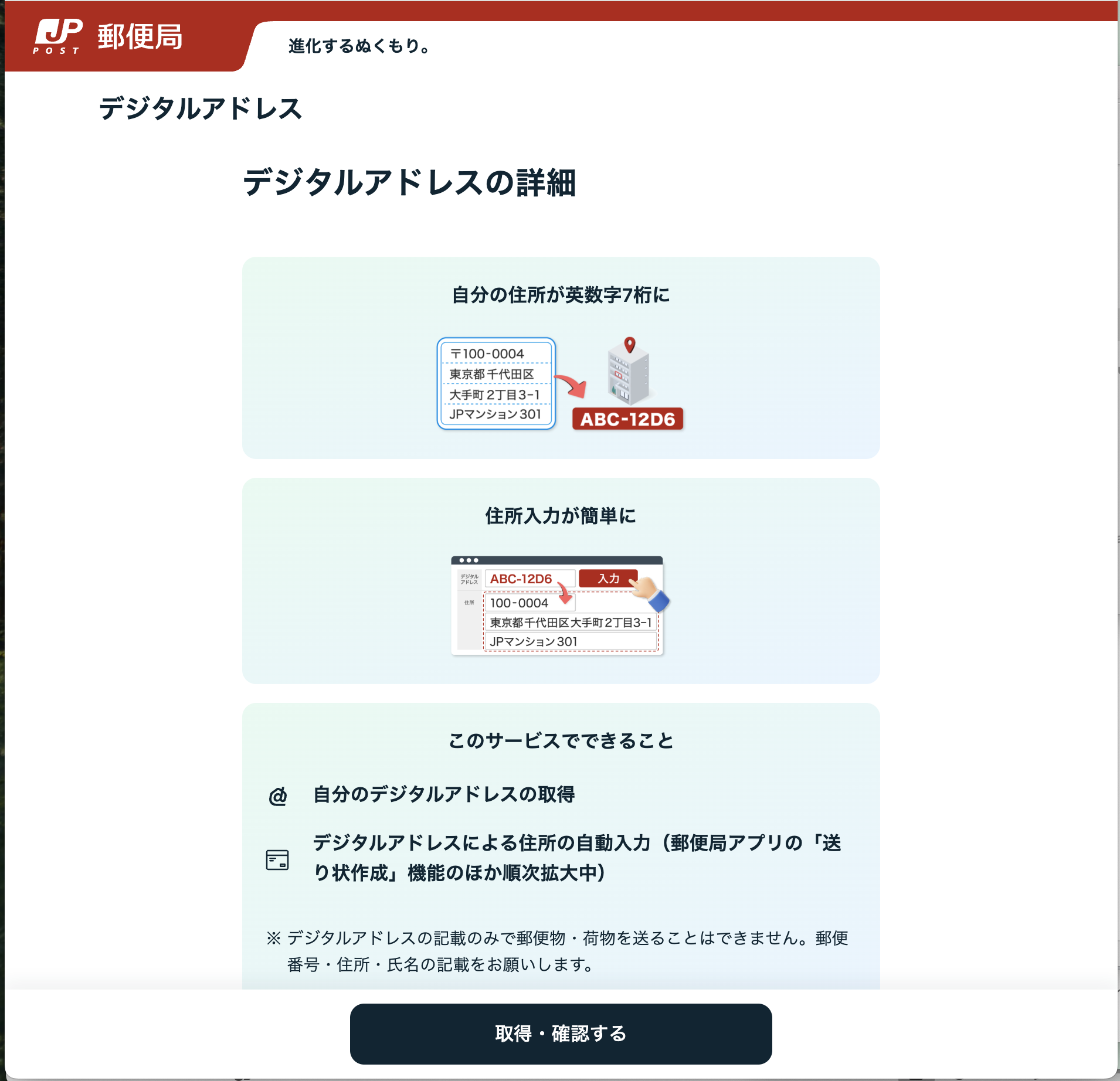
Judging from this, it does not seem possible to send mail using only a digital address. That is a little inconvenient.
To obtain one, press the [Obtain/Check] button. A message then says, “Registration for a Yucho ID is required to use a digital address.”
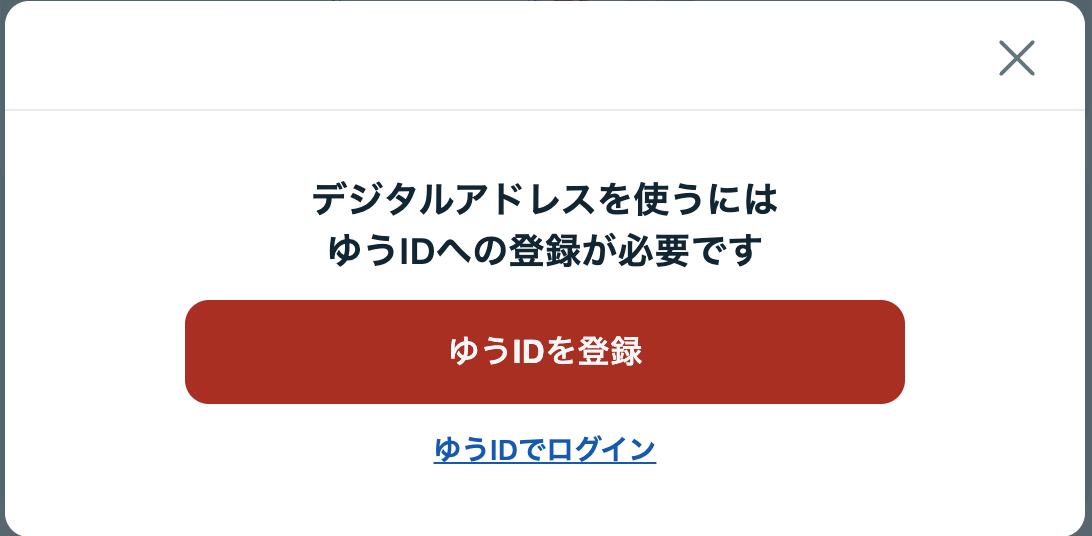
What is a Yucho ID? I already have a username and password for logging in to the postal portal. I will try those first.
Oh! I got in—with the account I created in January 2019.
What Is a Yucho ID in the First Place?—From the Yucho ID Terms
Apparently, although I can log in with the postal portal username and password, it had not previously been a “Yucho ID,” and the Yucho ID Terms of Use now appear.
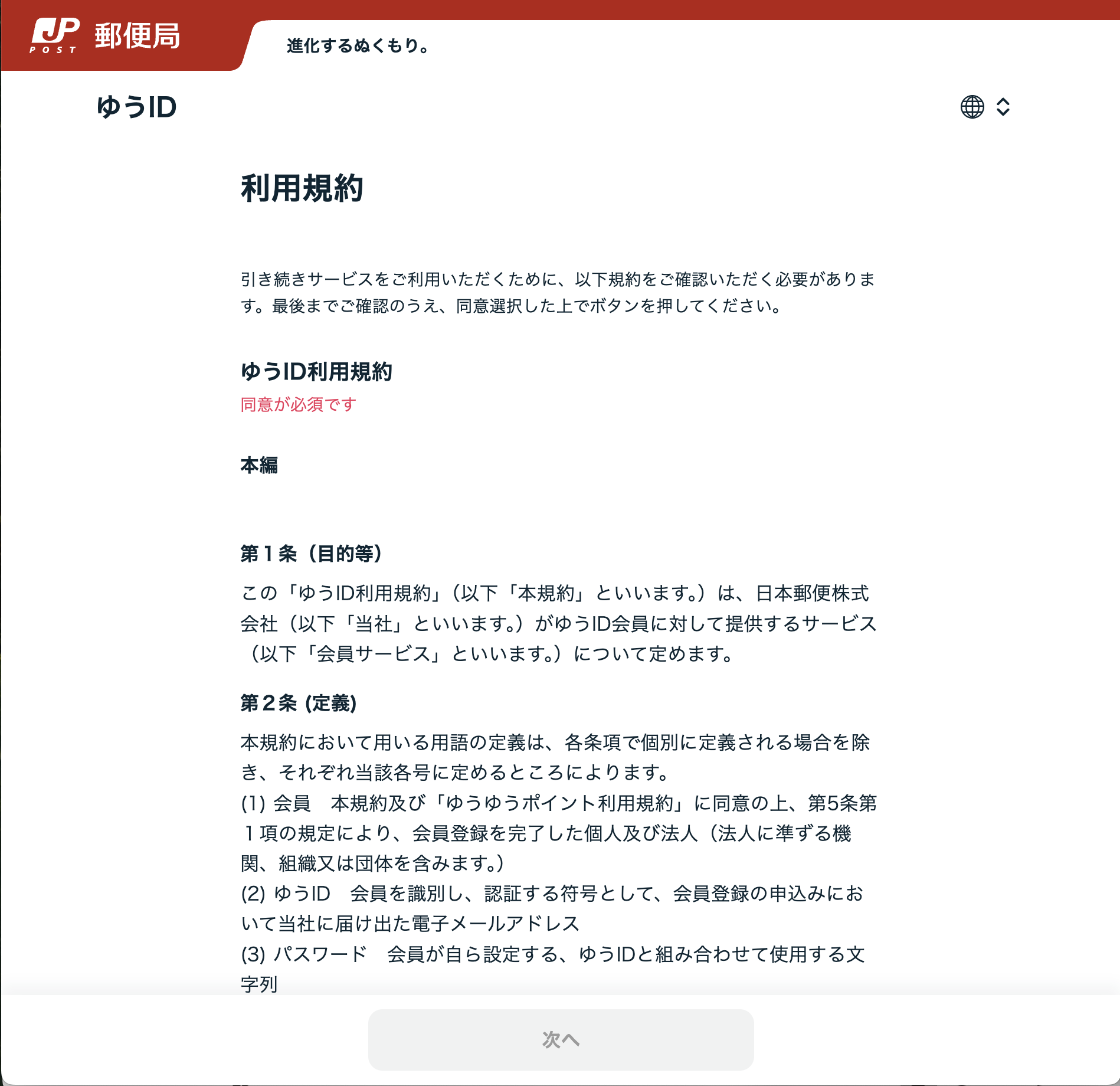
As usual, they are extremely long: on A4 paper, they run to 28 pages. There is no way I can read all that. I will have Gemini read them and tell me what to watch out for.
The following points should be noted when agreeing to the attached Yucho ID Terms of Use.
1. Definition and Use of a Yucho ID
- A Yucho ID is an email address used to identify and authenticate a member.
- => Oh, so a Yucho ID means an email address. In that case, “ID” probably means identifier.
- Members can use services and products that adopt this authentication method by using a Yucho ID and password (collectively, Yucho ID credentials).
- Members may not allow a third party to use their Yucho ID credentials, or lend, sell, transfer, or pledge them as collateral.
- Members themselves are responsible for managing their Yucho ID credentials, and in principle the company is not liable for damage caused by inadequate management or unauthorized use by a third party.
2. Handling of Personal Information
- Information concerning members, including registered information and information about use of member services, is handled in accordance with the company’s Privacy Policy, Japan Post Group’s Group Privacy Policy, and the personal-information-protection section of these terms.
- The purposes for using personal information are wide-ranging and include proper management of Yucho ID credentials, smooth provision of member services, information about services and products of the company, group companies, and partner companies, quality improvement, and market research.
- Members must agree in advance that, when using member services, member information may be provided or transmitted to the provider to the extent necessary.
- Technologies such as cookies, JavaScript, and Web Beacons collect various information not categorized as personal information, including browsing history, device information, and location information, and use it for advertising delivery, content delivery, statistical-data creation, and other purposes.
- In principle, personal information is not provided to third parties, with exceptions including cases where the member consents and where information needed to send benefits is provided.
- Some or all operations may be outsourced to third parties.
3. Yuyu Point Service
- The Yuyu Point service is provided as a benefit to Yucho ID members, and using it requires authentication with a valid Yucho ID.
- Points are awarded when a “points-eligible event,” such as use of a designated service or purchase of a product, occurs.
- Points expire 1 year after the most recent date on which the point balance changed. However, separately designated validity periods apply to limited-time and transferred points.
- Points held can be exchanged for goods or services and used to enter drawings.
- Prohibited actions include converting points to cash, entering false information, obstructing operation of the points service, improperly using Yucho ID credentials, harassing third parties, infringing intellectual-property rights, and violating public order and morals.
- Lending, selling, transferring, pledging, sharing, or providing points as collateral is generally prohibited, although points may sometimes be transferred to another member using a method designated by the company.
4. Responsibilities and Limitations Regarding Service Use
- Members use member services at their own discretion and responsibility and must resolve, at their own responsibility and expense, any damage or disputes with third parties arising from use.
- Membership may be canceled or use suspended if the terms are violated or misconduct occurs.
- The company may suspend or restrict all or part of the member services because of communications-equipment failures, force majeure, system maintenance, or similar circumstances.
- Member services are provided only within Japan.
- The company makes no warranty regarding member services, including fitness for purpose, completeness, or absence of bugs.
- Using services that require online identity verification requires agreement to the “Individual Provisions Concerning Online Identity Verification” and completion of prescribed procedures.
5. Joint Use of Personal Data Within Japan Post Group
- Japan Post Group companies (Japan Post Holdings, Japan Post, Japan Post Bank, and Japan Post Insurance) jointly use customers’ personal data to provide information on products and services suited to customers’ life events and needs.
- The jointly used personal data includes names, dates of birth, addresses, telephone numbers, email addresses, family composition, occupations, and information on individual transactions, excluding information concerning mail and its delivery and sensitive information.
- The purposes of joint use include providing information about various services and conducting research and development.
- Consent is also required for information obtained through use of Japan Post Bank products and services, such as savings balances and transaction information for investment trusts and government bonds, to be used by group companies for information and proposals.
- Consent is likewise required for information on insurance contracts obtained through use of insurance products from Japan Post Insurance or other underwriting insurers to be used in the same way.
- Consent is required for information obtained by Japan Post through its proprietary operations, such as postal and logistics services, product sales, and real-estate operations, to be used in commissioned operations such as banking agency services, financial-product intermediation, and insurance-sales agency services.
- Consent is required for information obtained by Japan Post through commissioned operations to be used in its proprietary operations.
- The status of consent to joint use can be checked and changed from “Customer Information” – “Handling of Information Concerning Customers” on the Yucho ID home page.
It is important to note these points, understand how your information will be used, and then decide whether to consent.
What Is the Scope of Joint Use of Personal Information?
I see. There are many things here, but I was concerned about the scope of joint use, so I will ask Gemini again.

The scope of joint use of personal information within Japan Post Group is as follows:
Personal Data Subject to Joint Use:
- Contact information such as name, date of birth, address, telephone number, and email address
- Family and occupation
- Information on individual transactions
- However, information concerning mail and its delivery and sensitive information are excluded.
Companies Engaged in Joint Use:
- Japan Post Holdings Co., Ltd.
- Japan Post Co., Ltd.
- Japan Post Bank Co., Ltd.
- Japan Post Insurance Co., Ltd.
Purposes of Joint Use:
- Providing information on various products and services of group companies, including products and services of partner companies
- Making proposals suited to customers’ life events and needs
- Among the purposes of use published on the Japan Post Holdings website, “(1) To provide information about, research, and develop various services”
Additional Information Subject to Joint Use Where Consent Is Required:
- Information on use of Japan Post Bank products and services:
- Savings balances, including postal savings from before privatization; deposits and withdrawals; maturities; foreign exchange; credit cards; Yucho Pay and other payment services
- Information on the content and management or consideration status of assets under custody, such as investment-trust and government-bond transactions, excluding sensitive information
- Information on use of insurance products from Japan Post Insurance or other underwriting insurers:
- Information used when proposing insurance products and information concerning customers’ insurance contracts
- Other information concerning family composition and similar matters, excluding sensitive information
This information is used by group companies to provide information and proposals in person, by telephone, post, email, and other means.
What Happens If You Do Not Consent?
I see. They use quite a lot of information.
I hesitate a little, but what restrictions would apply if I did not consent?

Based on the attached terms, there is no direct statement of what happens if you do not consent to joint use of personal information.
However, Article 4, paragraph 3 of the Yucho ID Terms of Use states: “When using member services, members shall agree to the content of these terms and faithfully perform all obligations prescribed herein. Members who do not agree to the content of these terms may not use member services.”.
Because consent to joint use of personal information can therefore be interpreted as part of the terms for using Yucho ID member services, the following outcomes are possible if you do not consent.
- Inability to use Yucho ID member services: Consent to joint use may be a prerequisite for using Yucho ID member services as a whole.
- Inability to receive information or proposals concerning Japan Post Group products and services: Because the purpose of joint use is to provide information about products and services from group companies, you may not receive such information if you do not consent.
However, because there is no direct description of the specific effects of not consenting, we recommend asking Japan Post Group directly.
Is It Possible Not to Consent?
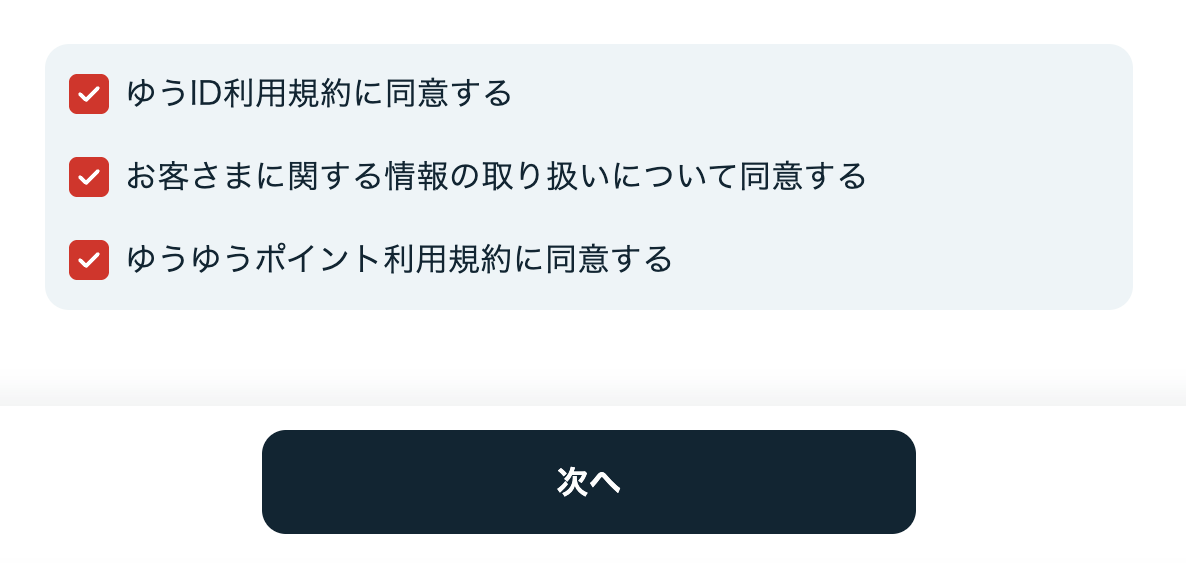
Well, making an inquiry is a little troublesome, so perhaps I will continue. But then I found that clearing even one checkbox prevented me from proceeding to “Next.”
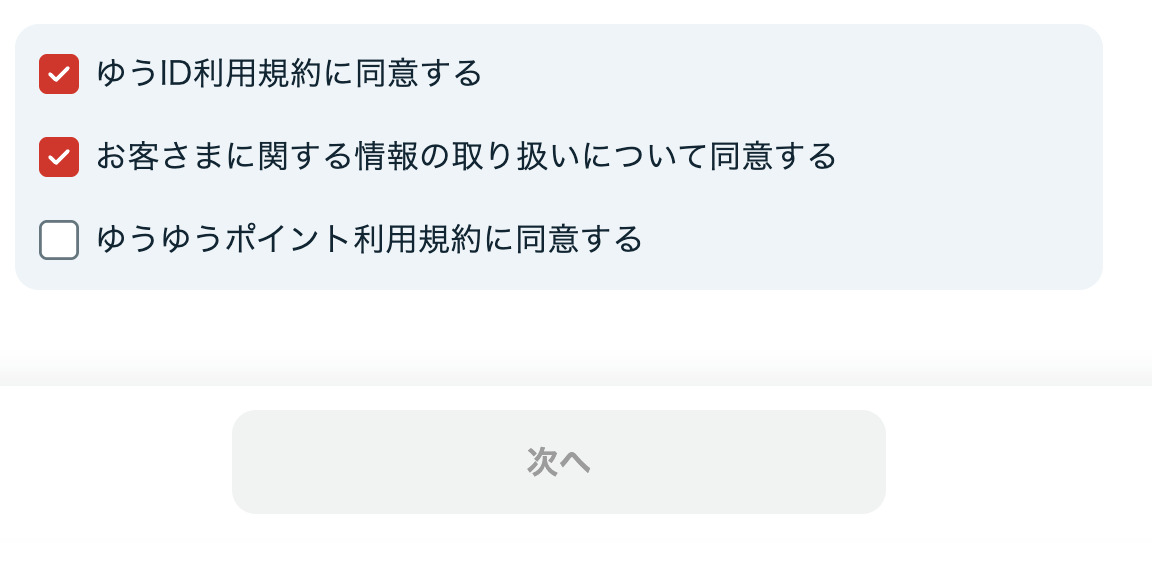
No choice, then. Click.
Oh, another pop-up appears and asks me. (It is checked from the outset—an opt-out model.)
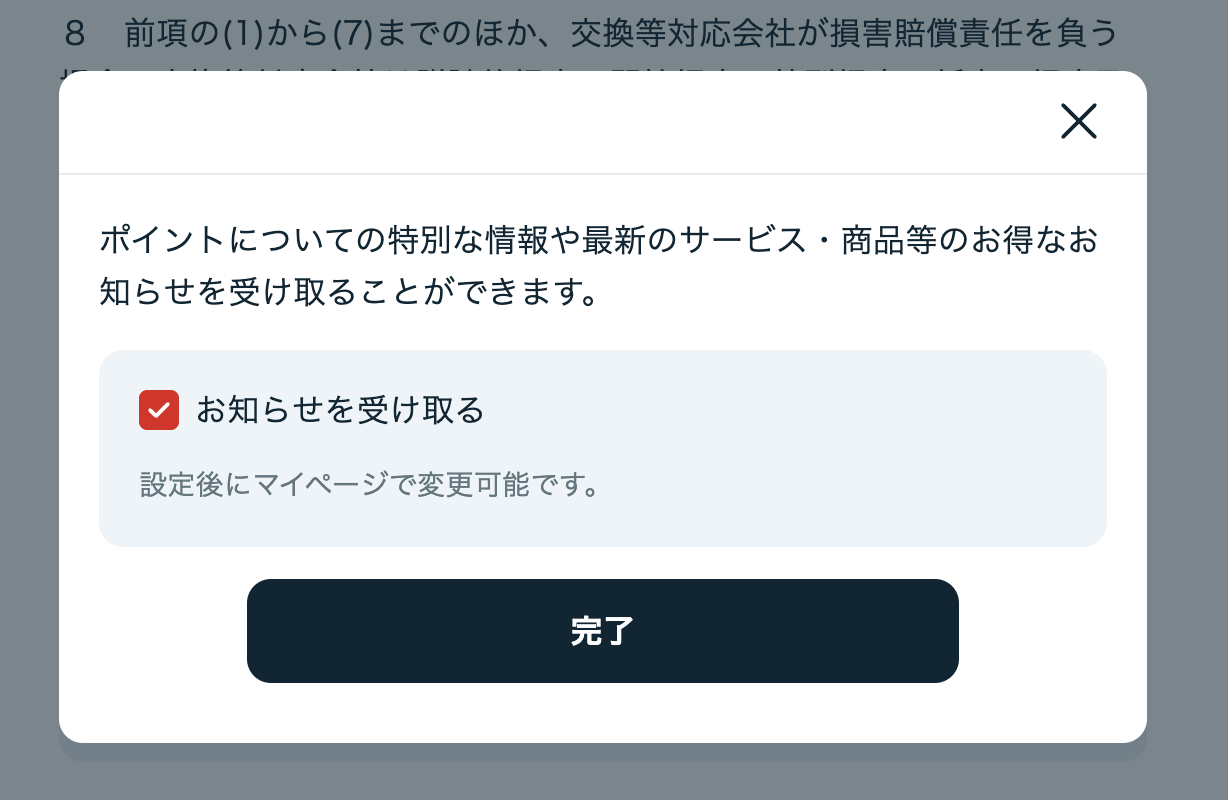
Address Confirmation Screen and Subsequent Consent Checkboxes
Pressing the Complete button displays the address confirmation screen.
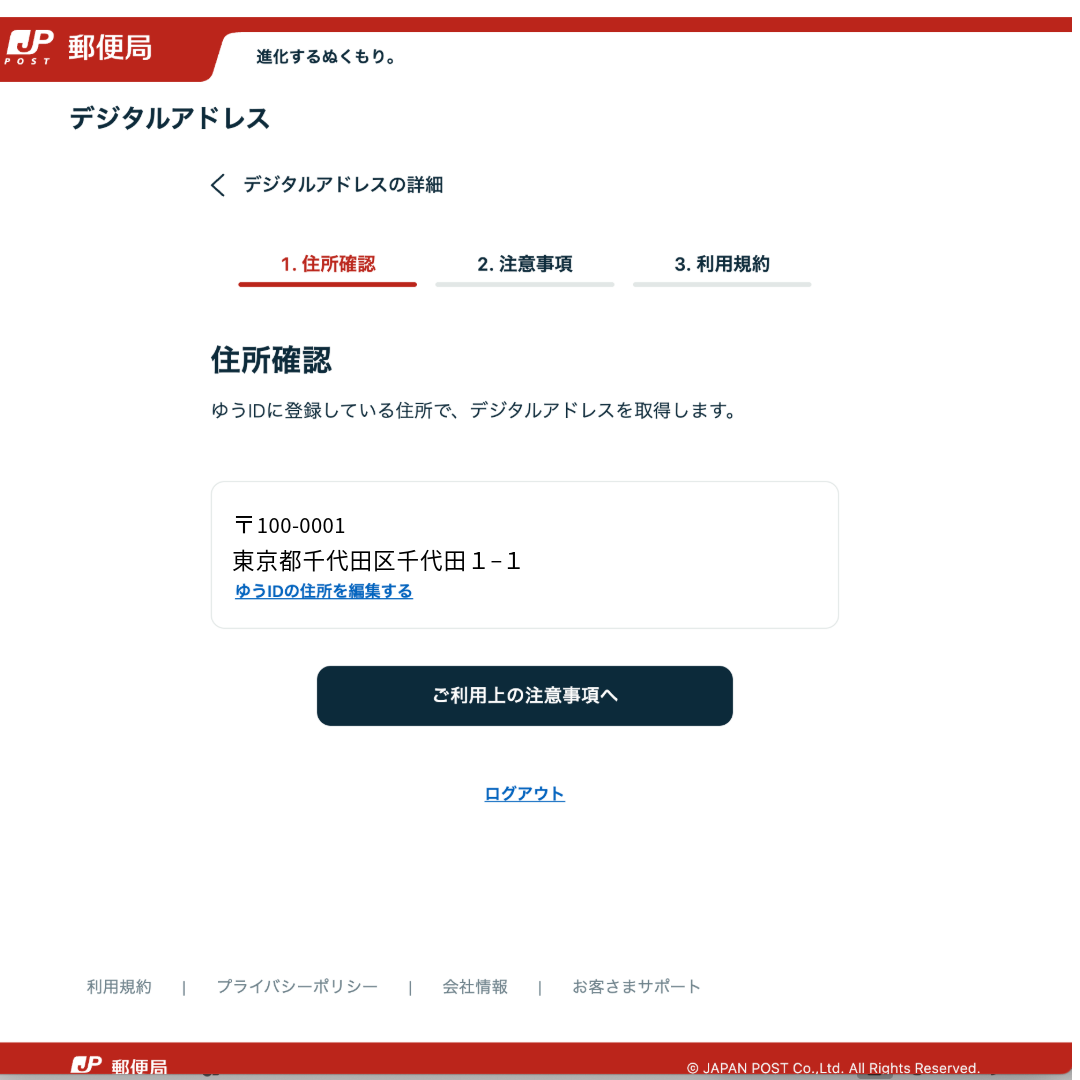
Pressing “Proceed to Usage Notes” brings up still more consent boxes.
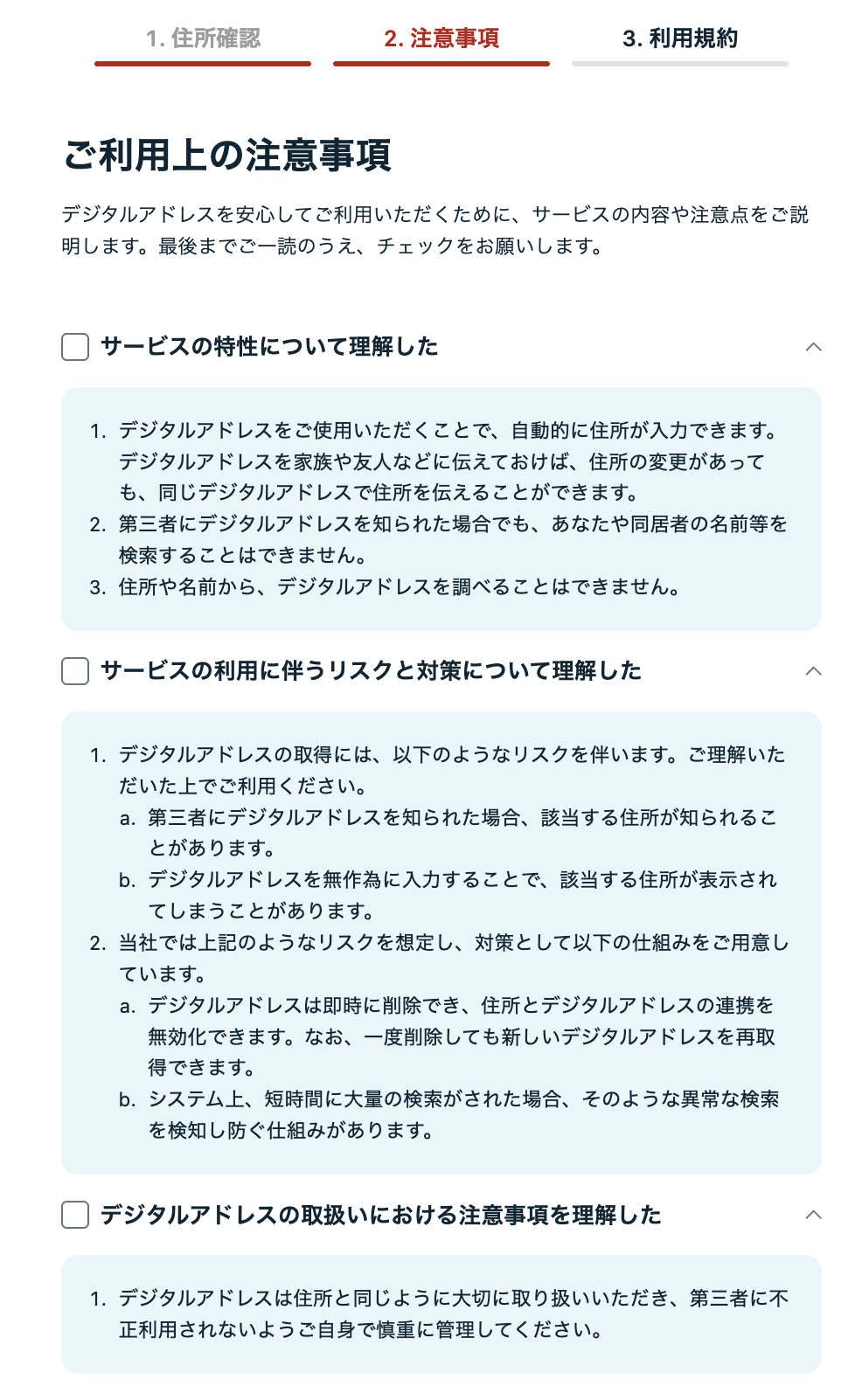
I see. If someone learns your digital address, they can determine your address but not your name. It is also impossible to perform a reverse lookup from an address or similar information.
Because learning the digital address reveals the physical address, a risk-mitigation measure allows the digital address to be deleted immediately, disabling its link to the physical address. A digital address can also be obtained again.
The Terms of Use Appear Again
After checking all 3 boxes, you proceed to the display of the terms of use.
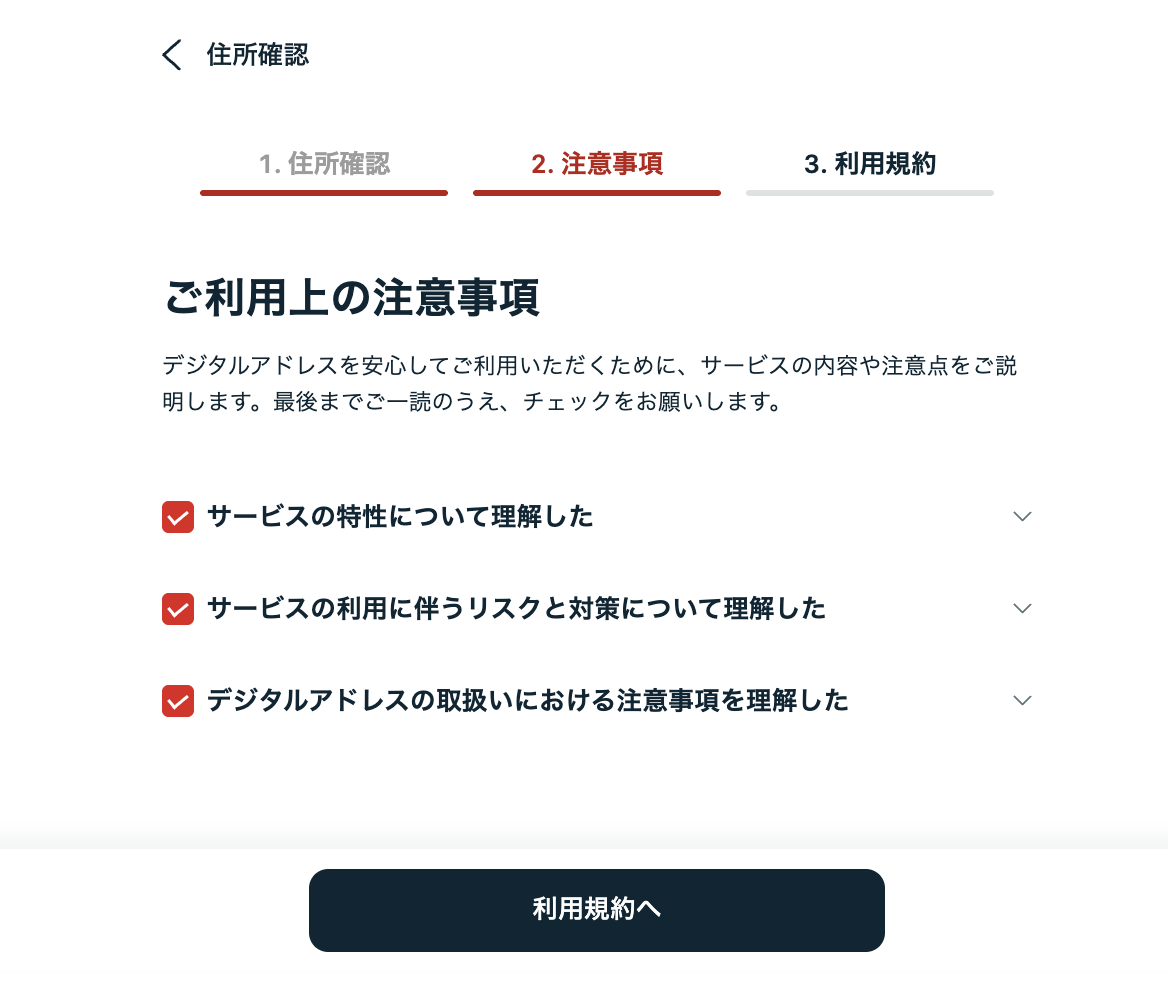
What? For a moment I thought I had just agreed to the Yucho ID Terms of Use, but this time these are the Digital Address Service Terms of Use, and agreement is again mandatory. This time, on A4 paper, it is around 13 pages. Can everyone really read all this…? On A4 paper, we have already exceeded 50 pages…
Good children should read them properly and, if they can agree, check the checkmark. That enables the “Obtain” button.
Now I have obtained a digital address!
It is an address resembling “AB3-C45D.” Incidentally, it appears that the physical address linked to it can be changed at any time under “Manage Digital Address” > “Edit Yucho ID Address.”
Let’s Use It Right Away
The post office app appears to be one place where it can currently be used.
Yes. As you guessed, there is yet another long set of terms.
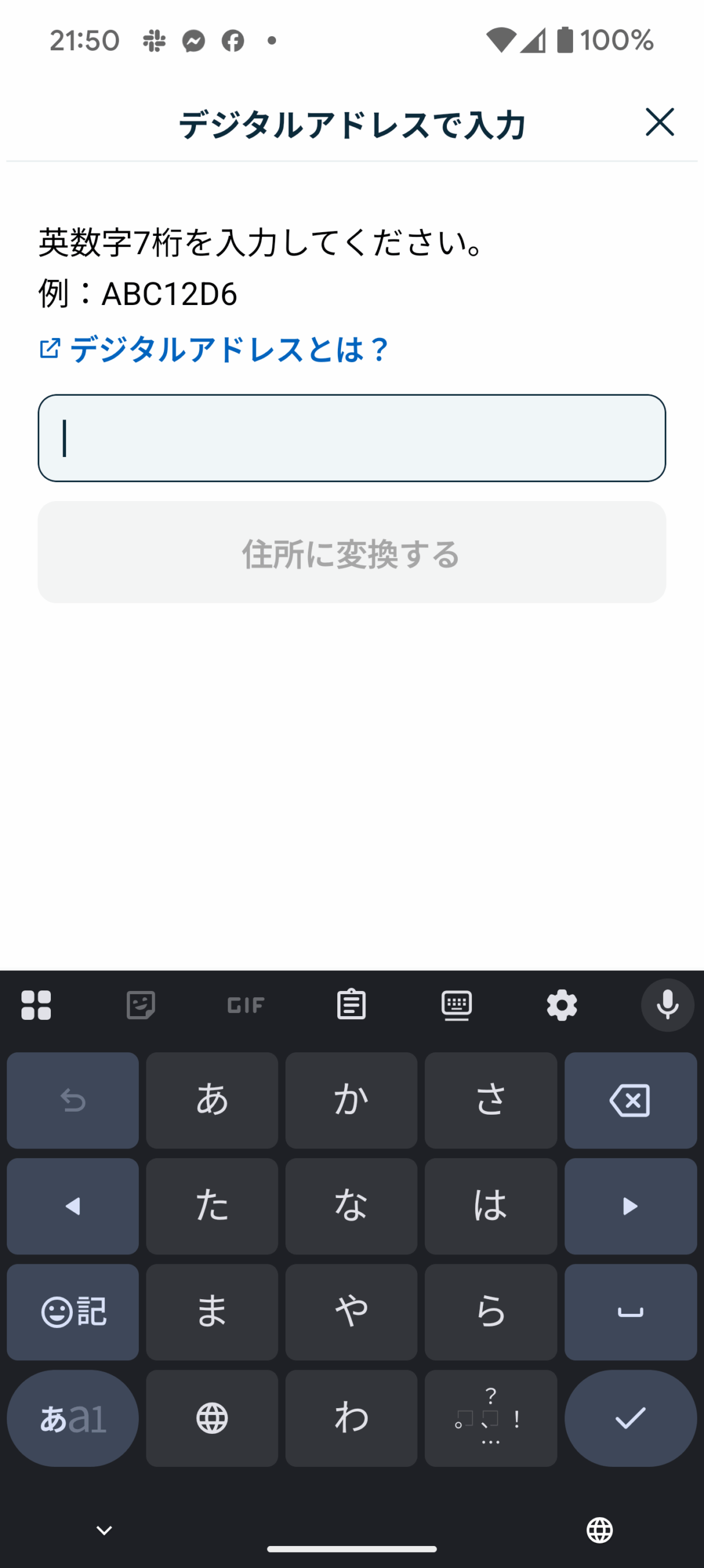
After working through them, agreeing, and going to the post office app’s shipping-label creation feature, there is a screen for entering a digital address. Entering the 7 characters from earlier converts it to a physical address and enters it on the shipping label. Only the address is entered, not the name.
So What Is a Digital Address, After All?
Ultimately, a digital address appears to be:
- A tool that makes entering addresses more convenient.
- A tool that, in exchange for providing that convenience, allows Japan Post Group to use addresses, savings balances, and other information to provide information and proposals concerning various services.
That is how it currently looks.
I am starting to feel a little unwell, so I will save the analysis for another day.
See you!
Related posts
Let’s Call Japan Post’s Digi-Ad API and Retrieve an “Address.” Is It Really OAuth?
Sorry for the long gap after I became unwell. In the previous article, I obtained a Japan Post Digital Address (Digi-Ad) and used it in Japan…
Japan Post Reportedly Considering a 7-Character Alphanumeric Address Identifier for Deliveries by Rakuten Group and Others, but…
The top story in the Nikkei on 5/26 was reportedly “Japan Post to Identify Addresses with 7-Character Alphanumeric Codes; Rakuten Group and Others Consider Adoption for…
Court of Justice of the EU Ruling: IP Addresses Are Personal Data, but Storing Them in Logs Is Lawful—Legitimate Interest
Yet another foolish article has been making the rounds. It claims: “EU: New ruling says IP addresses are also personal data; storing access logs without consent…
You must be logged in to post a comment.