
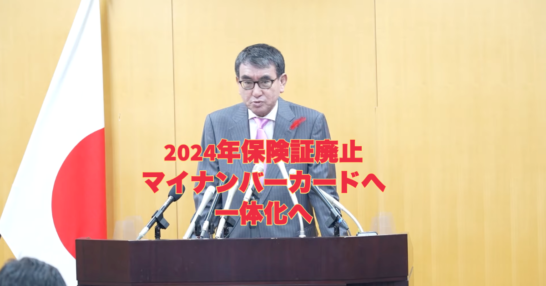
On October 13, at around 10 o’clock, Minister Kono held a press conference on efforts to promote adoption of the My Number Card. Several important announcements were made, so although this is a little late, I have summarized them here. The original press conference can be viewed on YouTube.

I. Minister Kono’s Report to the Prime Minister
The My Number Card serves as a passport for building a new digital society. To expand its adoption and use, under instructions from the Prime Minister, I have chaired liaison meetings among the relevant ministries and agencies since 9/29 and compiled the results of their deliberations. I reported to the Prime Minister on efforts to accelerate acquisition and use, as well as My Number Card-related measures in the economic package.
1. Integration of My Number Cards and Health Insurance Cards
- To accelerate the already Cabinet-approved integration of My Number Cards and health insurance cards, a supplementary budget request is planned to support My Number Cards in home medical visits, massage and acupuncture services, and similar settings.
- After thoroughly promoting acquisition of My Number Cards and reviewing card procedures, and following consideration of these matters, the current health insurance card is targeted for abolition in autumn 2024.
2. Integration with Driver’s Licenses
- We will work with the National Police Agency to consider whether the planned integration with driver’s licenses at the end of fiscal 2024 can be moved forward.
- From fiscal 2023, online training in some prefectures will be expanded from gold-license holders to ordinary license holders. (It will take a little longer to expand it to all 47 prefectures.)
3. Adding My Number Card Electronic Certificates to Smartphones
- This will make it possible to use a smartphone for online applications, logging in to the Mynaportal, issuing certificates at convenience stores, and other services.
- The system is currently under construction. Services using Android smartphones are to begin on 2023-05-11.
4. Service Providing the Basic 4 Information Items to Financial Institutions and Others
- Starting next year on 5/16, a service will begin providing the basic four information items, such as address, to financial institutions and other businesses that use the Public Personal Authentication Service, subject to the individual’s consent. This will enable financial institutions and other businesses to conduct ongoing customer due diligence efficiently and quickly.
5. Temporarily Making Electronic Certificate Usage Fees Free for Private Businesses
- When checking the validity of an electronic certificate, the current usage fee is ¥20 per signature certificate and ¥2 per user-authentication certificate. Both fees will be waived for the time being, for 3 years. This fee waiver will begin next year on January.
II. Instructions from the Prime Minister
Regarding the comprehensive economic package to be compiled this month:
- accelerating integration of driver’s licenses, health insurance cards, and other cards into the My Number Card; strategic public relations and support for local governments to promote card acquisition; temporarily waiving private businesses’ electronic certificate fees;
- supporting pilot projects for private-sector use of the card; supporting expansion of card use by local governments;
- and measures to expand these situations in which the card can be used.
Instructions were given to include these 3 points.
Regarding the integration of My Number Cards and health insurance cards:
- The environment must be prepared carefully, down to the finest details.
- The work must proceed carefully so that the public receiving medical care and the personnel of medical institutions providing it can understand and accept the change.
- Accordingly, until the comprehensive economic package is decided, I would like the Minister of Health, Labour and Welfare, the Digital Minister, and the Minister for Internal Affairs and Communications to work together on the final details, ensuring that nothing is overlooked and that the parties concerned understand the measures.
Those were the instructions given.
III. Personal Impressions
These are provisional impressions because I have not yet listened to the questions and answers…
- “5. Temporarily Making Electronic Certificate Usage Fees Free for Private Businesses” is quietly a major change. This will make the service easier to use.
- “4. Service Providing the Basic 4 Information Items to Financial Institutions and Others” should deliver substantial cost savings by making address changes trackable, while also improving convenience for users, so it is a positive development. I am interested in how it will be implemented. It should be provided through an API… Given the requirements for consent and restriction of the access source, might it use a mechanism like FAPI in Open Banking?
- With the “integration of My Number Cards and health insurance cards,” I am interested in how delegation use cases will be handled. A health insurance card is fundamentally an authorization token representing the right to access insurance services, not an identity document or authentication token. It is a token with a limited target scope. This characteristic has made it relatively easy to entrust the card to a helper or similar person. If it is consolidated into the all-purpose token that is the My Number Card and the limited-scope token is eliminated, problems may arise in these “entrusting” use cases. I am interested in how this will be handled operationally.
- Moreover, in situations where it is used as a health insurance card, the person will often be unable to use knowledge-based authentication, and it is reasonably foreseeable that facial biometrics could be unusable due to injury or other circumstances. There are also so-called verifier-offline cases where power for the card reader is unavailable. How will such cases be handled? Will it ultimately just be an insurance-card application installed on the IC card? But in that case, the printed face of the card could no longer be used… One reason for insisting on a card is the need to use its printed face, is it not? Might this issue be reflected in the “review of card procedures”?1
- “2. Integration with Driver’s Licenses” is especially welcome because I advocated it during the policy-design stage, although this means using it as an issuance platform.
- As for “3. Adding My Number Card Electronic Certificates to Smartphones,” I do not think it necessarily needs to use X.509 certificates. The card will still be issued, correct? If so, perhaps the design could be made lighter by storing purpose-specific tokens “blessed” by the Public Personal Authentication Service on the card.
Footnotes
- For verifier-online cases, it appears that the JPKI-AP uses a certificate for authentication of specified institutions to authenticate the insurance-eligibility verification service provider. If it is valid, the system bypasses PIN entry using the user-authentication certificate, signs a combination of the institution code and a random number, authenticates the user by verifying that signature, and then checks insurance eligibility using the serial number of the user-authentication certificate. (Reference: Why My Number Cards Can Be Used as Health Insurance Cards Without a PIN)
Related posts
Digital Agency: Expert Meeting on Organizing Issues Concerning Attribute Credentials (1st Meeting)
This is slightly old news, but on October 23 I participated remotely as a member in the Digital Agency's “Expert Meeting on Organizing Issues Concerning Attribute…
The “DS-511 Guidelines for Handling Digital Identity in Identity Verification for Administrative Procedures, etc.” Have Been Published
After 3 years of development, the Digital Identity Guidelines, to which I had the privilege of contributing as an expert (Expert Meeting on the Revision of…
Age Verification: The UK Online Safety Act Is Being Toyed With in All Kinds of Ways—Bypassing It With VPNs and Evading Biometrics With Death Stranding
What Is the UK's Online Safety Act? The UK's Online Safety Act formally became law after receiving Royal Assent on October 26, 2023, and came into…