
Following last week’s installment, the 3th article in the series “A Thorough Examination: Will Blockchain Make Humanity Happy?” has been published in Nikkei Cross Tech, presenting part 2 of the history of decentralized identity. It is titled “From Centralized IDs to Decentralized IDs, History Repeats Itself.” Last time, we compared W3C DIDs with XRI; this time, we finally turn to OpenID. There are few writings that explain the ideas underlying OpenID, so if you claim that OpenID is centralized, I suggest reading this material and thinking about it a little before making that argument.
The table of contents is roughly as follows.
- Introduction
- The OpenID Philosophy Embodying “Self-Sovereignty” and “Independence”
- Account URI: The Problem of Being Able to Type an Email Address but Not a URL
- Overview of the ‘acct’ URI
- Resolution of the ‘acct’ URI
- Relationship Between OpenID Connect and the ‘acct’ URI
- SIOP and Algorithmically Generated Metadata Documents
- Do DIDs Help Distribute Power?—History Repeats Itself
On page 1, the current text reads:
YADIS (Yet Another Distributed Identity Systemand 1 other decentralized identity system)
(Source) https://xtech.nikkei.com/atcl/nxt/column/18/02132/072900003/
The word “and” here is an error. The system is named “Yet Another Distributed Identity System,” so the correct notation should look like the following. I have requested a correction.
YADIS (Yet Another Distributed Identity System, “another 1 decentralized identity system”)
(Source) The author
Note: Correction confirmed on the 3th at 17:59.
Please have a read.

Related posts

OpenAI Launches Sign in with ChatGPT (Based on OpenID Connect)
(Work in progress; last updated 2026-10-02 12:39 JST) On September 29, at DevDay 2026, OpenAI officially announced Sign in with ChatGPT (SIWC). I would like to…
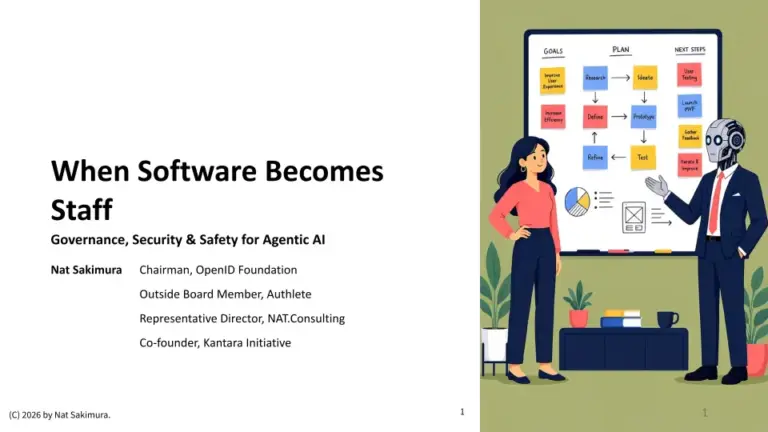
When Software Becomes Staff: Governance, Security, and Safety for Agentic AI
Below is the transcript of my keynote speech at EIC 2026 on May 19, 2026. The slides are provided as a PDF at the end of…
OpenID Summit Tokyo 2026 “Special Edition” Closing Keynote
The tickets apparently sold out instantly, so I had not introduced this event here; however, tomorrow, August 26, I will appear at the OpenID Summit Tokyo…
You must be logged in to post a comment.