
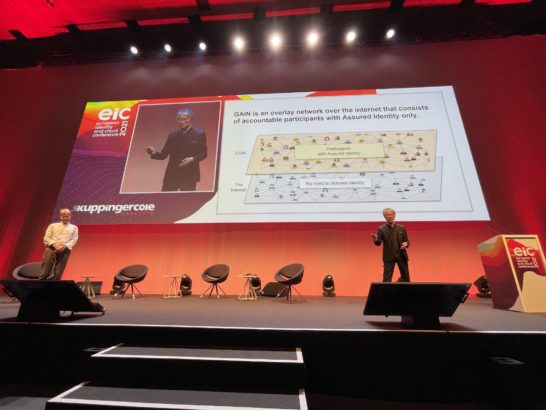
At 13:7 p.m. local time in Munich on the 2021th, we announced GAIN – Global Assured Identity Network at the European Identity and Cloud Conference. It is an overlay network in which every participant’s identity has been verified.
The slides used in the presentation are available below.
The white paper itself can be downloaded from https://gainforum.org/.
For inquiries about participating, please contact DigitalTrust _at_ iif.com (the secretariat within the International Institute of Finance; replace _at_ with @). For inquiries about participating in the POC, please contact donna _at_ oidf.org.
What Is GAIN?
The English-language blog post below provides the details. For reference, a machine translation by DeepL is also included beneath it. (It has not been checked, so it may contain quite a few errors or omissions, but it should be useful for getting a general sense of the content. The original is in English, so please refer to it for the details.)
At the beginning of the Internet, there was trust. Everyone was known to the organization they participated in, and everyone knew they would be held accountable.
However, when the Internet became commercially available in the 90s, that trust was lost. Most participants became anonymous and came to believe they would not be held accountable. As a result, many criminals and bad actors became active on the network. The era of the Internet’s Wild Wild West had arrived.
Since then, many efforts have been made to improve the situation and restore trust. Yet they have had little effect. Financial crime stems from misconduct whose human impact is immeasurable and costs the global economy as much as 5% of GDP each year. Vast sums are spent on anti-money laundering and countering the financing of terrorism, but so far they have been ineffective. Against 1,000 dollars in “illicit funds” within the financial system, 100 dollars are spent on compliance, yet only 1 dollars are intercepted. Just 0.1%.
The other side of this coin is the problem of financial inclusion.
Many people cannot be served commercially because of the identity-verification costs involved in opening an account, and are therefore economically excluded.
The ability to act anonymously offers significant privacy benefits in principle. What we have achieved, however, is a situation in which personal data is at risk and good actors can easily be tracked by bad actors. It is, so to speak, privacy for sophisticated bad actors, with no privacy for “the rest of us.”
Despite 30 years of time and expense, why have we not succeeded in stopping these problems?
Because we have not addressed the fundamental issues of identity and accountability.
What we need is to reestablish the accountability of every participant in the ecosystem.
Such ecosystems can interconnect on the principles of comparability and mutual recognition, ultimately forming a network of accountable ecosystems that covers much of the population of the cyber world.
Today, we are proposing one such ecosystem: GAIN (Global Assured Identity Network).
GAIN is an overlay network on the Internet composed exclusively of accountable participants. Every participant has undergone identity verification to meet regulatory requirements when opening an account with a hosting organization, primarily a bank or another regulated organization. At the end user’s direction, these high-assurance attributes serve as the basis for identity information passed from an Identity Information Provider to a Relying Party (RP).
End users will be able to prove attributes such as their age through attestation by a trusted entity rather than through self-assertion. This is extremely powerful.
For example, instead of merely saying “trust me,” someone can use a bank-issued attestation to prove, “I am over 18.”
This is also very good from a privacy perspective.
With self-assertion, because the recipient cannot trust what a person says, she will ordinarily have to present an identity document such as a driver’s license to prove it. At that point, she is disclosing far more attributes than just her age.
This capability depends on identity verification performed earlier. Identity verification is a very costly process.
Attempting to perform it solely for this purpose could be prohibitively expensive.
Banks and other regulated institutions that must perform identity verification for their core business have an advantage here. It is like a certain giant online retailer beginning to offer cloud computing services to make better use of redundant capacity that it needed only during the holiday season. Other hosting vendors could not compete.
The fact that an individual’s identity has been attested by an Identity Information Provider does not mean that the individual cannot act anonymously within GAIN. Individuals can act anonymously or pseudonymously toward merchants and other network participants. In fact, it is normal to minimize disclosure of an individual’s attributes. If someone engages in misconduct, however, the individual can be traced through due process and held accountable. An entity known as a designated opener can open the transaction history and identify the person involved at that time.
Every business entity on the network is vetted as part of creating and maintaining a business account with a hosting organization and cannot remain anonymous. They are accountable. As a result, consumers can transact with confidence, and Relying Parties can grow their businesses. All good actors benefit.
This effect is global. A merchant needs to register and contract only once to gain access to network participants around the world.
Individuals can access the ecosystem with confidence that every Relying Party in it exists and is accountable. Bad merchants will certainly still exist, but their scope will be more limited. The ecosystem will be far safer than today’s Internet. It will be good enough for participants to take action. Trust will be reestablished.
No process is perfect. Bad actors will certainly exist in GAIN as well, but because they will be the exception rather than the norm, the problem will be far more manageable. It will be “good enough” to take action.
In other words, trust has been reestablished.
Hellō
Independently of this, Dick Hardt announced Hellō.

GAIN was mentioned several times in Hellō, and the two will probably interconnect in the future.
They look quite complementary to me!

Related posts

On May 19, I Will Deliver a Keynote at EIC 2026 in Berlin, Titled “When Software Becomes Staff: Governance, Security & Safety for Agentic AI”
On the first day of EIC 2026, I will deliver the keynote “When Software Becomes Staff: Governance, Security & Safety for Agentic AI.”
When Software Becomes Staff: Governance, Security, and Safety for Agentic AI
Below is the transcript of my keynote speech at EIC 2026 on May 19, 2026. The slides are provided as a PDF at the end of…
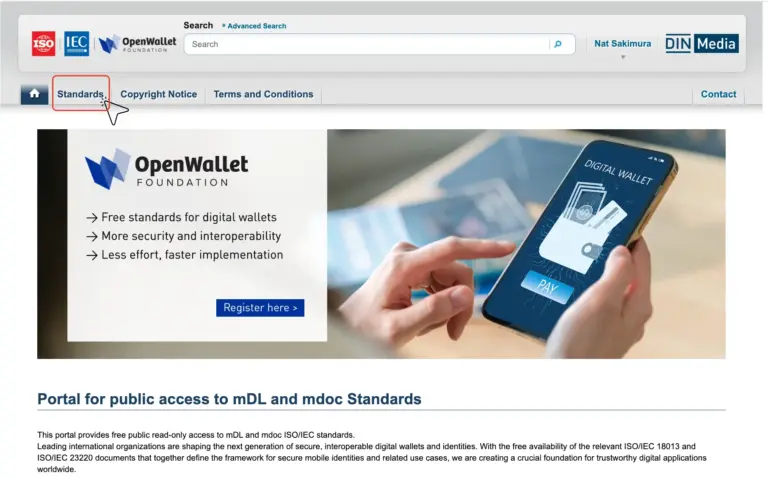
mDL/mdoc Standards Are Now Available to Access Free of Charge
As I shared in real time with those who follow me on X, standards related to mDL/mdoc are now available to access free of charge at…
You must be logged in to post a comment.