
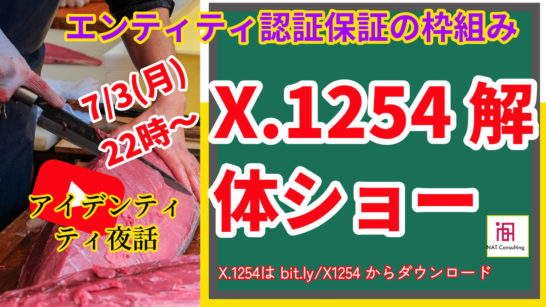
After saying for ages that I would do it but never getting around to it, I am finally holding a session to explain ISO/IEC 29115 | ITU-T X.1254 (2012)1. On July 3 (Monday), it will begin at 22. It may be a somewhat leisurely read-through, but I intend to keep it to a little over 1 hour. Accordingly, I will not scrutinize every line of the original text. The idea is to “tear it down” so that you understand its structure and how to read it, allowing you to study and appreciate it carefully afterward.
ISO/IEC 29115 | ITU-T X.1254 (2012) is referenced by OpenID Connect and likewise by eIDAS 1, making it a surprisingly influential document. The recently published OECD Recommendation on the Governance of Digital Identity, which I discussed on June 19, also mentions LoA2 and mapping (correspondence). ISO/IEC 29115 also serves as a “yardstick” for mapping the levels defined by each country’s trust framework to the LoAs in ISO/IEC 29115 and establishing correspondences, so I believe this is the kind of mapping that the Recommendation envisages. In Japan, NIST SP 800-63 is consulted relatively often, but internationally this document may be the standard reference.
This time, I will give a broad overview of the document’s structure and the reasons behind it, comparing it with NIST SP 800-63 along the way. I would also like to consider what we would change if we were revising it now.
The document can be downloaded from https://bit.ly/X1254.
So, if this topic is relevant to your work, please do join us.

Footnotes
- https://www.itu.int/ITU-T/recommendations/rec.aspx?rec=11608&lang=en The texts are almost identical, but there are 4 differences
- Levels of Assurance. These indicate the levels of entity authentication.
Related posts
When Software Becomes Staff: Governance, Security, and Safety for Agentic AI
Below is the transcript of my keynote speech at EIC 2026 on May 19, 2026. The slides are provided as a PDF at the end of…
mDL/mdoc Standards Are Now Available to Access Free of Charge
As I shared in real time with those who follow me on X, standards related to mDL/mdoc are now available to access free of charge at…

IPA’s Mr. Tsuda Receives FORBES Japan’s “30 Under 30” Award
Mr. Tsuda of IPA, whom I think is one of the ID geeks, has been selected for FOEBES JAPAN 30Under30 2026. He is the second member…