
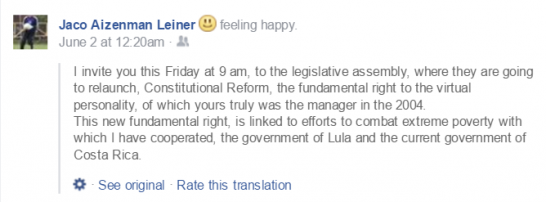
It appears that a movement to enshrine in the constitution an individual’s right to decide whether or not to have a Virtual Personality (or Digital Identity, as it might be called in English), which had been attempted for a time in 2004, was revived in the Costa Rican Congress on 6/3.
Regarding that case about the right to identity at the Osaka District Court1, I said on the ID geek board:
“Overseas, I think the right to identity generally means the right to prove one’s identity so that one can enjoy education and various other rights. For example, there is the United Nations’ THE 2030 AGENDA FOR SUSTAINABLE DEVELOPMENT, Goal 16.9 2, and so on. It is mainly for Thin filed people (people who have very few documents with which to prove their identity)—in Japan, children without family registration, or in Europe today, refugees.
“Come to think of it, there was a campaign to amend the constitution in Costa Rica in 2004, and I met a Supreme Court justice, 1 of its leaders. It is quite different from this case in Japan.” Having said that, I felt nostalgic and looked at Jaco Aizenman Leiner‘s timeline, where I found this:
Let’s all go to Congress at 9 a.m. this Friday. The campaign I was promoting back in 2004 to add the right to have a digital identity to the fundamental human rights enshrined in the constitution is being relaunched. This new fundamental human right is connected to the eradication of extreme poverty, an area in which I have worked with the Lula government and the current Costa Rican administration.
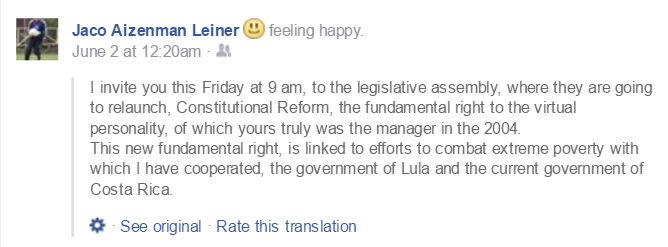
Jaco Aizenman Leiner, who made this post, was a fellow member of the XDI.org board back in 2004 and was instrumental in arranging the Costa Rica visit mentioned above. We both later left XDI.org, but fate has a way of making our paths cross again like this.
Footnotes
- Sankei Shimbun, “Right Not to Be Impersonated on Social Media: ‘Right to Identity’ Recognized for the First Time; Osaka District Court Takes a Step Forward in Preventing Harm” (2016/6/10) http://www.sankei.com/west/news/160610/wst1606100078-n1.html
- By 2030, provide legal identity for all, including birth registration
Related posts
Data Sustains Lives—MyDataConference 2026 Opening Address
The following is the opening address for the MyData Japan Conference 2026, delivered by Nat Sakimura in his capacity as Chair of the General Incorporated Association…

The MyData Conference 2026 Is This Wednesday. See You at Hitotsubashi Hall!
I have been posting announcements on X every few days, and the MyDataJapan Conference 2026 is this Wednesday. There are many highlights: Naohiro Fujie, Representative Director…
Unsubmitted Public Comment on the Call for Comments on the Draft First Report of the Youth Protection Working Group on Information Distribution in the Digital Space
July 823:59 was the deadline for the call for comments on the draft first report. I ended the FAPI WG early and23:40 began the submission process…
You must be logged in to post a comment.