
The following is the opening address for the MyData Japan Conference 2026, delivered by Nat Sakimura in his capacity as Chair of the General Incorporated Association MyData Japan. (Date and time: July 29, 2026 10:05〜10:20)
Regarding Yesterday’s Kumamoto Earthquake
Good morning, everyone.
Thank you for joining us at MyData Japan 2026.
Before turning to the main topic, I would like to say a few words about yesterday’s earthquake in Kumamoto.
At approximately 4:27 p.m. yesterday, a major earthquake struck with its epicentre in the Kumamoto region of Kumamoto Prefecture, registering a seismic intensity of 7 on the Japanese scale in Uki City and Hikawa Town.
The full extent of the damage is not yet clear, and search-and-rescue operations and efforts to confirm the safety of residents are still underway.
To all those who spent the night in anxiety over aftershocks, and to everyone affected by this disaster, I offer my heartfelt sympathies.
I pray that everyone’s safety will be confirmed, that those awaiting rescue will be reached as soon as possible, and that the affected areas will remain safe.
I also express my deepest respect to everyone engaged in rescue, medical care, recovery, and support under dangerous conditions.
Data Sustains Lives
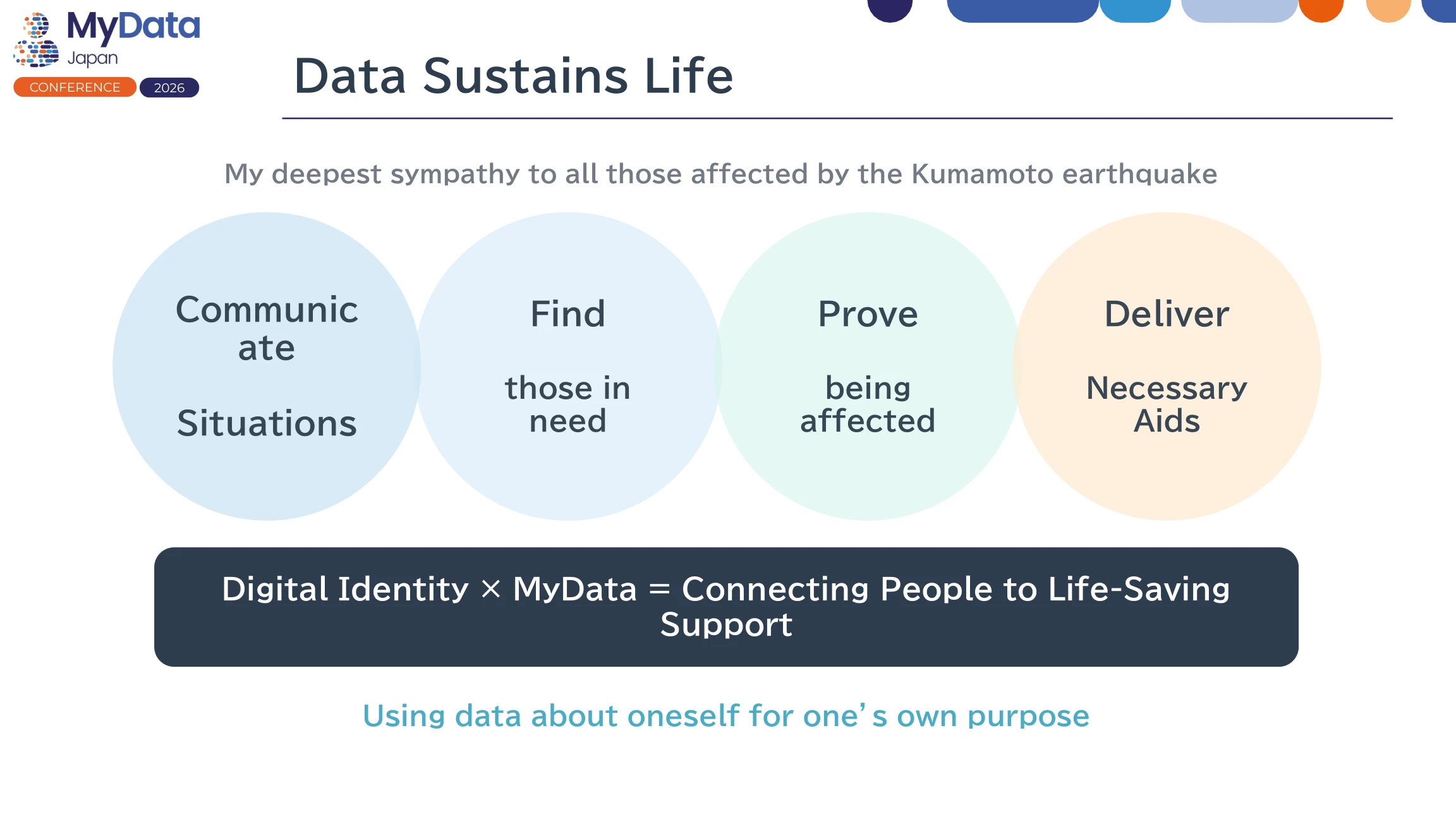
In disasters such as this, digital identity and MyData are not abstract ideals.
- To say, “I am safe.”
- To ask for help.
- To find people who are no longer able to ask for help themselves.
- To prove that one is affected by the disaster and eligible to receive necessary support.
- And to deliver support quickly and reliably to those who need it.
Data about ourselves is involved in every one of these things.
- For people to be able to use data about themselves for their own purposes.
- To be able to communicate their situation without revealing more information than necessary.
- To connect people with support even when communications are disrupted, devices are lost, and ordinary identification documents cannot be taken with them.
That is, quite literally, the power to connect lives.
And that is precisely where MyData begins.
Empowering People with Their Own Data
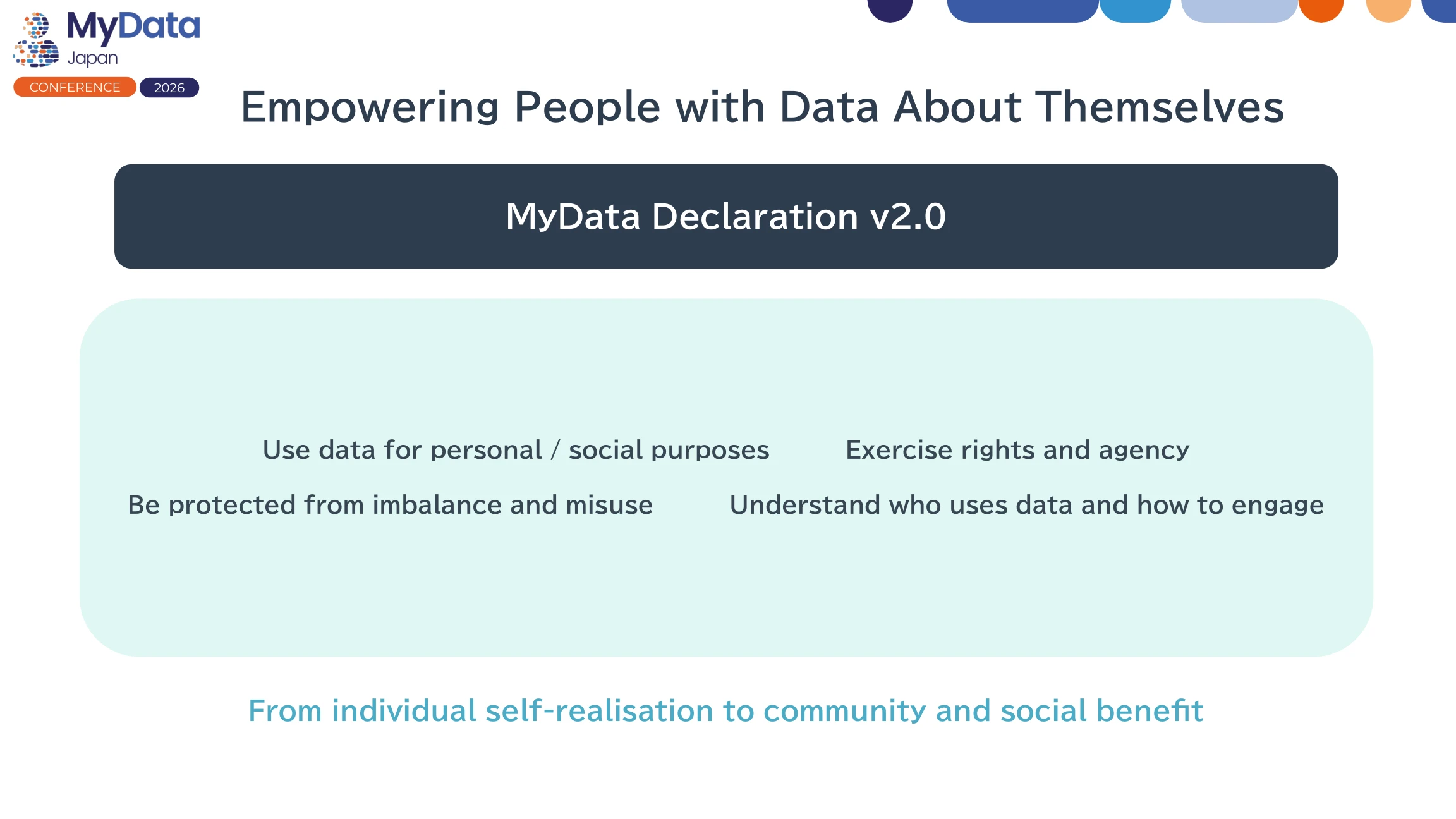
The MyData Declaration, revised this year, begins with these words.
MyData aims to empower individuals by improving their right to self-determination regarding their personal data.
At the center of this is not data.
It is people.
- To be able to use their own data for their own purposes.
- To be able to exercise their human rights and legal rights concerning data effectively.
- To be safely protected from imbalances and abuses of power concerning data.
- To know who collects and uses data.
- To understand how they can participate in that use.
- And this empowerment does not benefit individuals alone.
- It also benefits communities and society, creating self-realization and new opportunities.
The Declaration seeks a fair, transparent, and human-centric data ecosystem.
One Entity, Many Identities
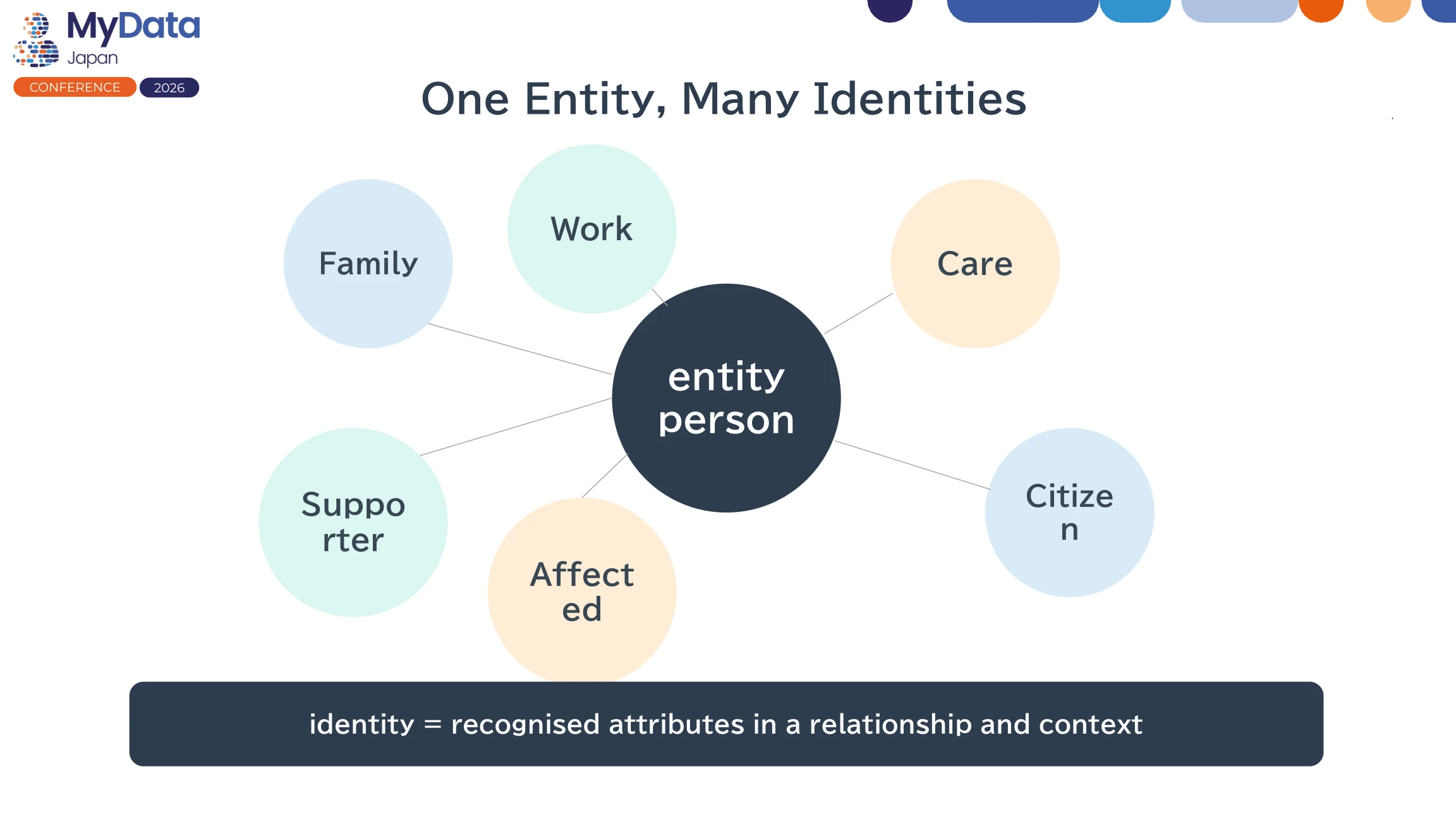
What, then, does it mean in concrete terms for people to be empowered by data?
A person is not a single profile.
As an entity, I am one person.
But as an identity, I am not just one.
- I am someone in relation to my family.
- I am someone at work.
- I am a patient.
- I am a citizen.
- I am a friend.
- I am someone seeking support as a disaster survivor.
- I am someone providing support.
An identity is not a fixed number.
It is a set of recognized attributes presented within a particular relationship and context.
We use data about ourselves to present ourselves to others.
- We show the attributes that are needed and withhold those that are not.
- If there is a misunderstanding, we add other information.
In this way, we build relationships and gradually adjust them in the direction we want.
To be able to use data about ourselves to represent ourselves better and build relationships.
This is an important aspect of the agency that MyData seeks.
Contexts Overlap
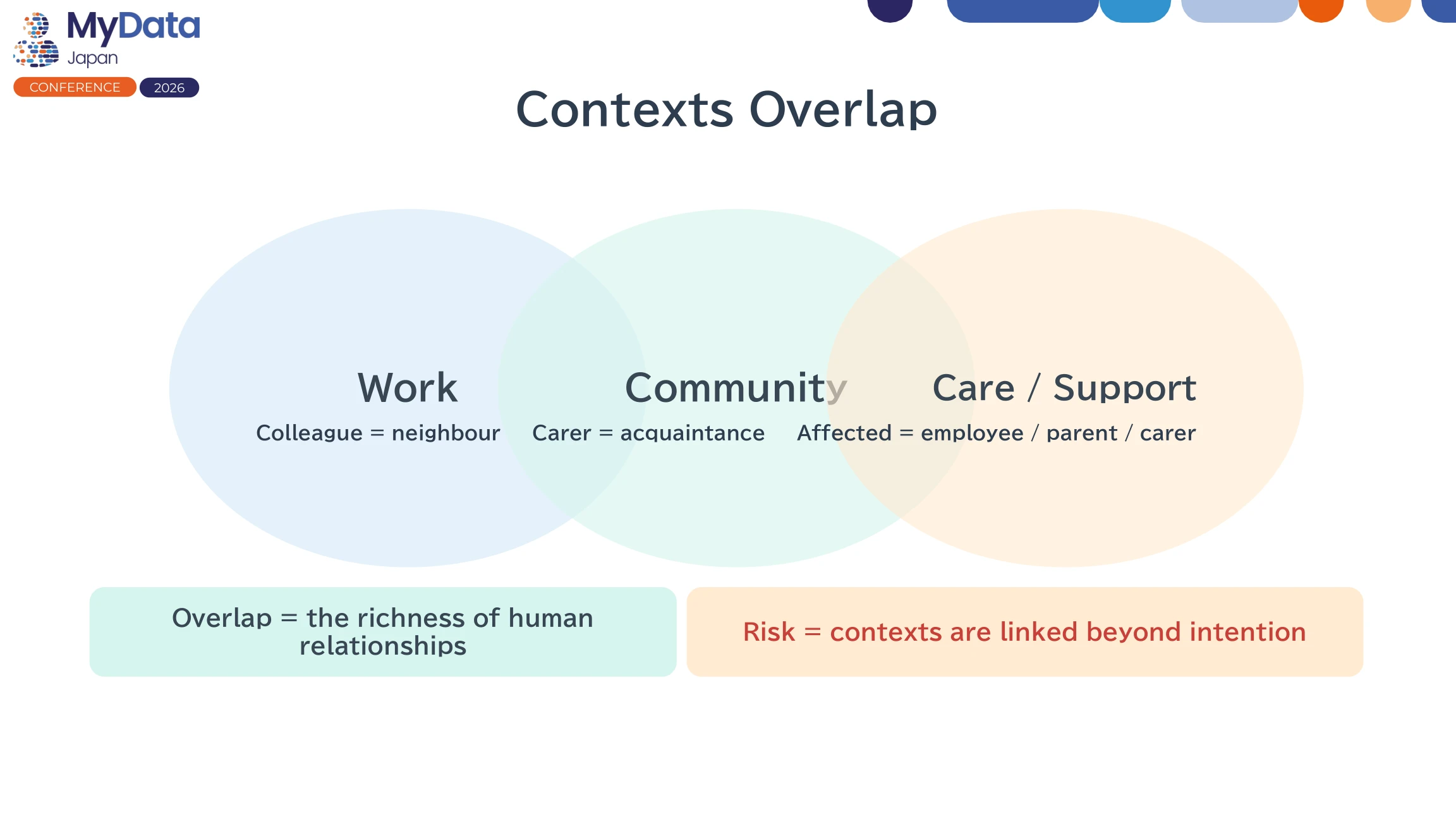
Real-world contexts are not neatly separated.
- A colleague may also be a neighbor.
- A healthcare professional may also be an old acquaintance.
- A government official may also be a member of the local community.
- A disaster survivor may simultaneously be an employee, a parent, and a caregiver.
This overlap is not a bad thing.
It is a sign of the richness of human relationships.
Problems arise when data is used outside the context that the person intended.
- Information disclosed for healthcare is used in an employment assessment.
- Information disclosed to receive support is used for advertising or profiling.
- Actions in one setting are used to infer a person’s character in another.
- Multiple contexts are combined without the person’s knowledge and fixed into a single profile.
The same data can help a person in one relationship and harm them in another.
It is not the mere existence of data that diminishes a person’s well-being.
What matters is by whom, in what context, and for what purpose the data was used.
Protect People: Data Protection Is the Means
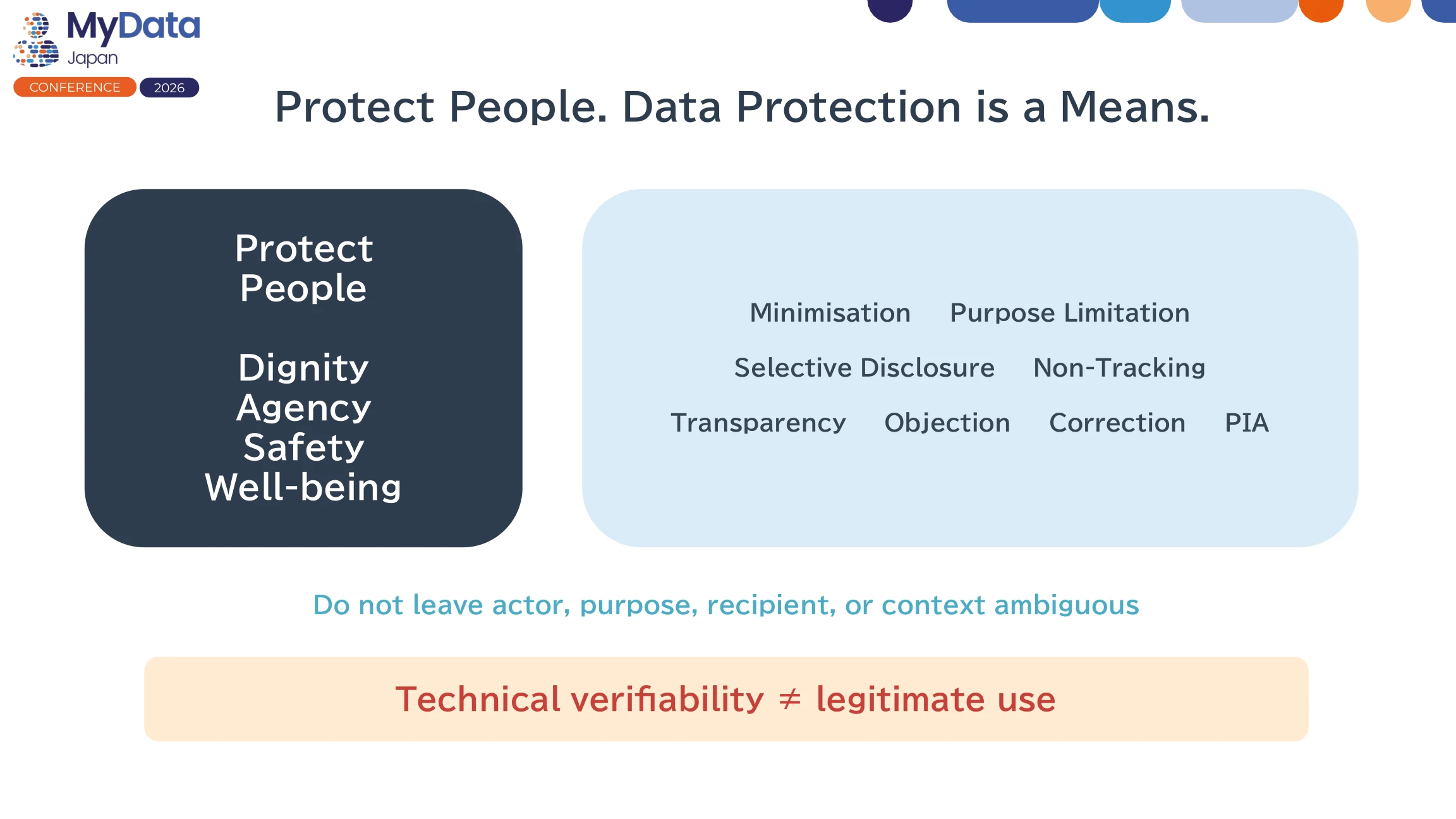
Therefore, what must be protected is not the data itself.
What must be protected is people.
It is human dignity.
It is people’s ability to build relationships, express themselves, and live better lives.
Data protection is the means to that end.
- Minimize collection.
- Minimize the data processed.
- Limit the purpose.
- Selectively disclose only the necessary attributes.
- Avoid identifiers that enable tracking across contexts.
- Make use transparent.
- Enable people to request explanations, object, and remedy errors or disadvantages.
- And conduct a Privacy Impact Analysis.
A PIA is not an exercise in ticking boxes on a checklist. It must assess:
- Who will be affected, and how?
- Beyond average benefits, who will suffer the greatest harm?
- Is there another design that can avoid or reduce that impact?
It is a process of continually revisiting these questions.
I have written standards and protocols as Project Leader for ISO/IEC 29100 “Privacy framework” and as the principal author of OpenID Connect and an author of JWT and JWS.
The lesson repeatedly pressed upon us is that the subject, purpose, recipient, and context must never be left ambiguous.
Even correctly signed data can harm people if it is passed to an unintended party for an unintended purpose.
Technical verifiability is not the same as legitimacy of use.
Able to Choose. Able to Entrust. Not Penalised for Not Choosing.
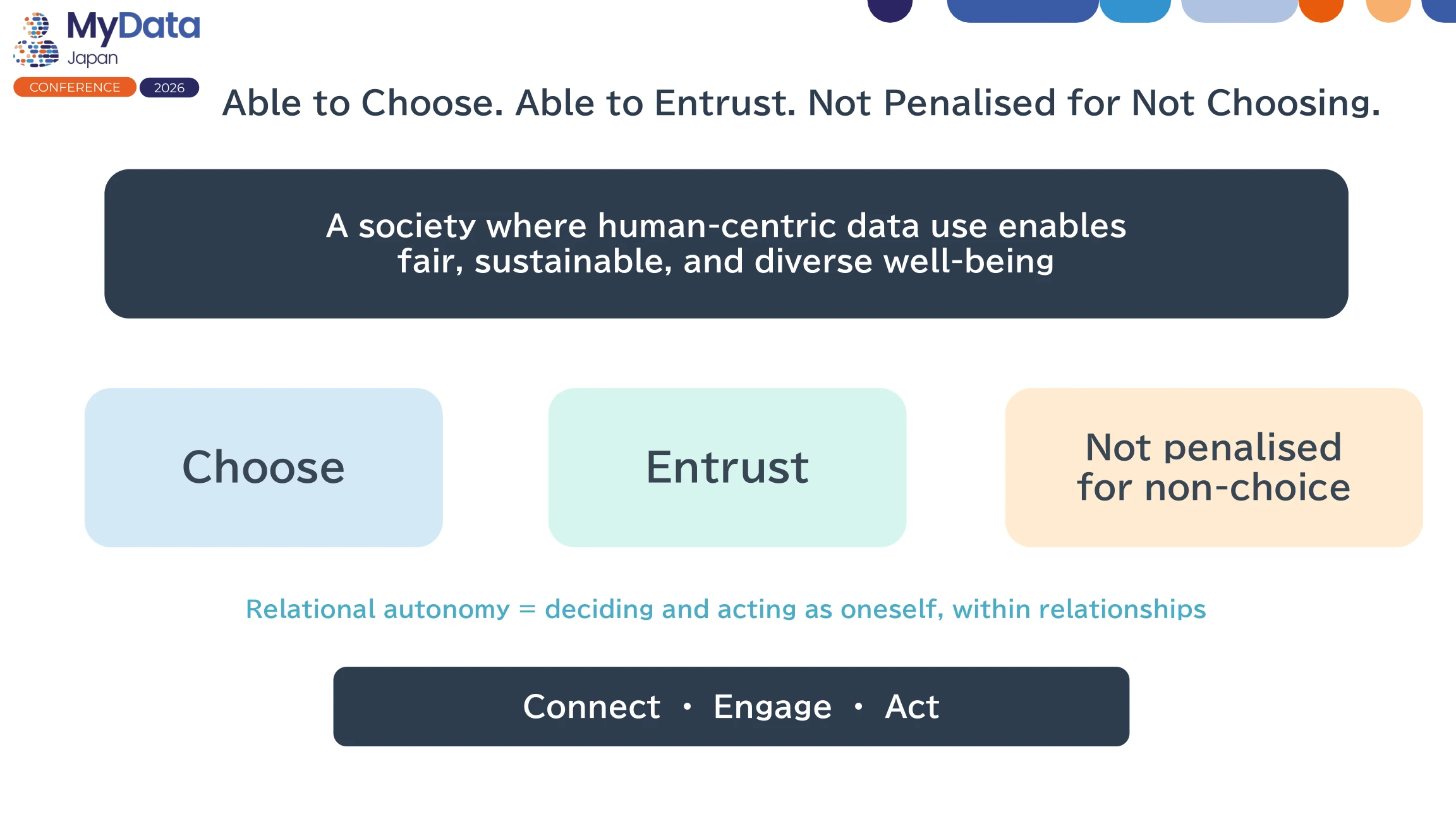
MyDataJapan Vision 2026 defines the society it seeks as follows.
A society where fair, sustainable, and diverse well-being can be achieved through human-centric data use.
This Vision does not treat people as isolated decision-makers.
It advocates relational autonomy.
Autonomy does not mean relying on no one and making every decision alone.
It means being able to decide and act as oneself through relationships with others and within one’s social environment.
That is why three things are necessary.
- To be able to choose.
- To be able to entrust decisions to people and systems one can trust.
- And not to be disadvantaged by choosing neither.
Increase transparency and accountability in data use.
Enable individuals to access and participate.
Create mechanisms that allow data to be managed and used appropriately and easily.
Improve one’s own life and society by understanding and making use of one’s data.
Connect.
Engage.
Act.
This is the Vision of MyData Japan.
2026: Context Is “Inferred” and “Acted Upon”
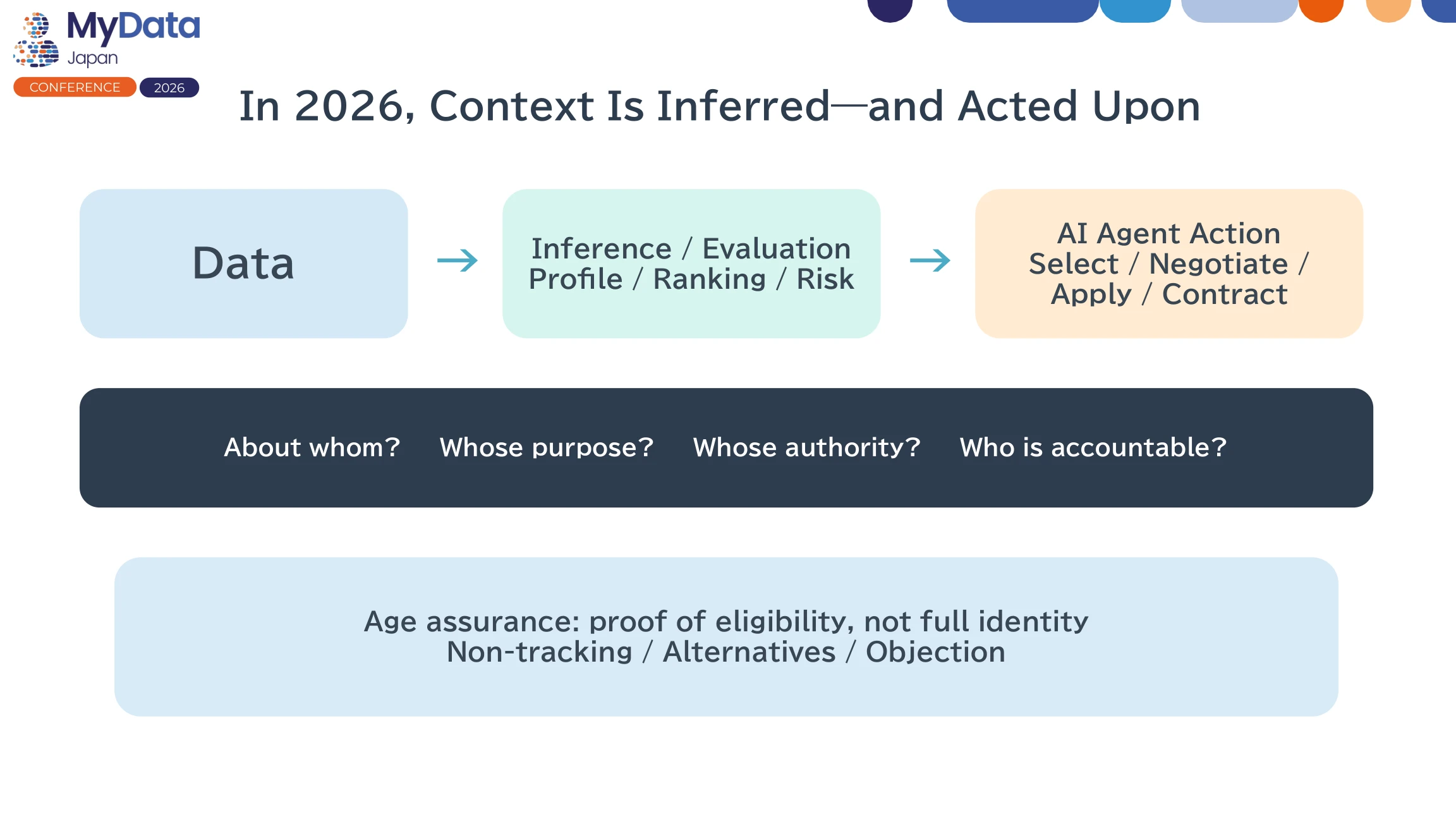
Why, then, are we Revisiting MyData now?
Because AI has shifted the center of gravity of the issues surrounding data.
AI does not deal only with attributes that have been explicitly presented.
From data, it infers new attributes, tendencies, risks, and profiles.
It recommends, ranks, and decides.
AI agents go further and act on those decisions.
- Search.
- Select.
- Negotiate.
- Purchase.
- Apply.
- Enter into contracts.
The question is no longer only who holds the data.
- Who constructs an identity about whom?
- For which context?
- Whose purpose does it serve?
- Under whose authority does it act?
- And who is accountable for the outcome?
The same applies to age assurance.
The purpose is not to verify age.
The purpose is to provide people, including young people, with a safe and inclusive digital space that does not diminish opportunities for expression, learning, and participation.
If all that is needed is proof that someone meets a specified age requirement, there is no need to collect their full identity.
But minimizing attributes alone is not enough.
- No tracking.
- Alternative methods must be available.
- People must be able to challenge and correct erroneous determinations.
Design must always begin with the impact on people, not with the means.
Today’s Program Examines One Question from Different Angles
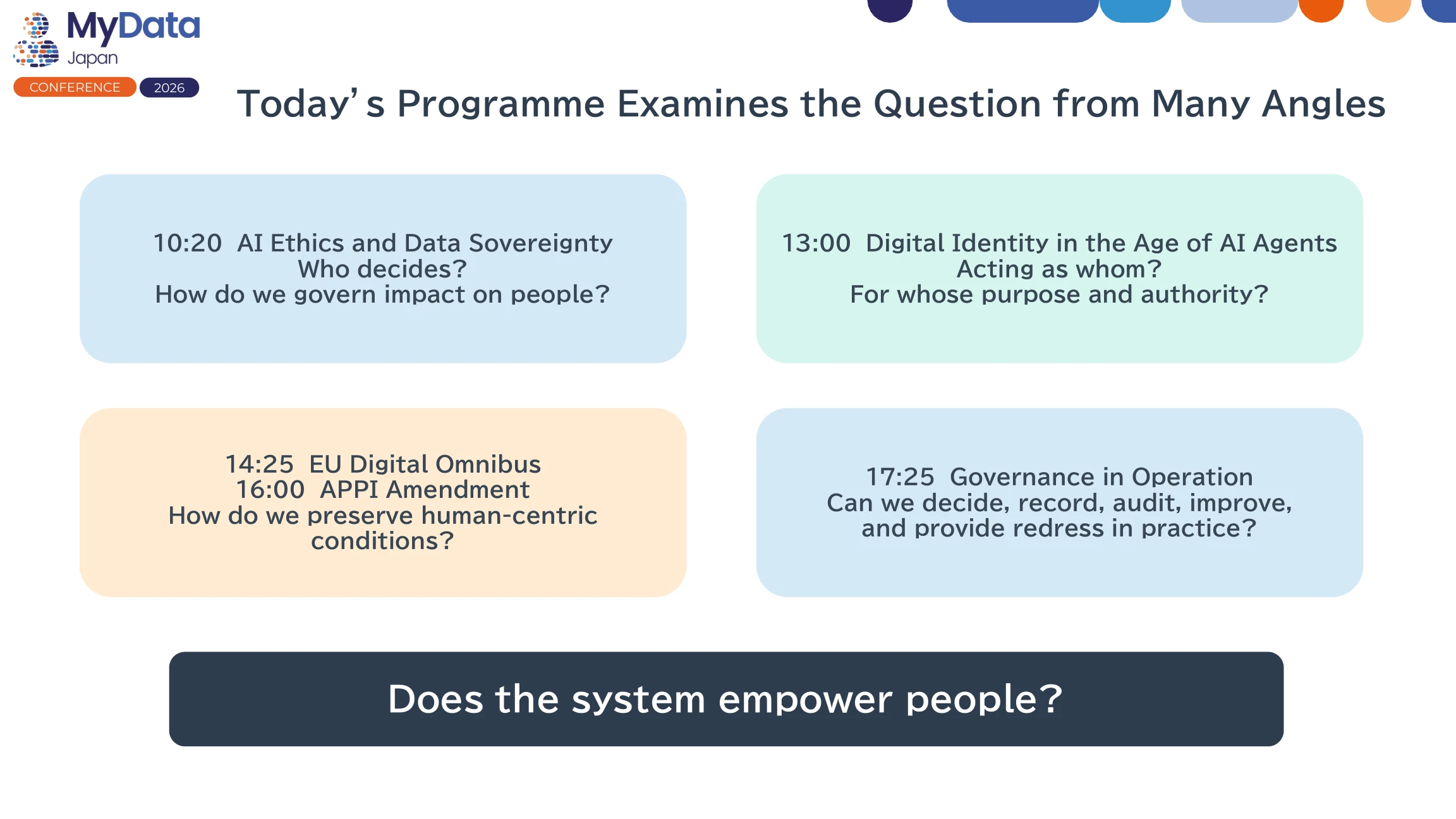
Every part of today’s program is connected to this issue.
10:20 — AI Ethics and Data Sovereignty.
How do we govern the impact on people without leaving it solely to individual ethics or only to organizational checklists?
13:00 — Digital Identity in the Age of AI Agents.
As whom does an agent act, for whose purpose, and under whose authority?
14:25 — the EU Digital Omnibus, and at 16 — the amended Act on the Protection of Personal Information.
How do we preserve the human-centric conditions of transparency, accountability, objection, and redress while reducing overlaps and inconsistencies among regulatory frameworks?
17:25 — The Reality of Governance Operations.
Can principles and guidelines be turned into mechanisms that enable decisions, records, audits, improvements, and redress in actual practice?
None of these are separate issues.
Does the system empower people?
Or does it confine people within profiles in which they cannot participate?
It is a day for considering that single question from the different perspectives of technology, institutions, business, and society.
Revisiting MyData
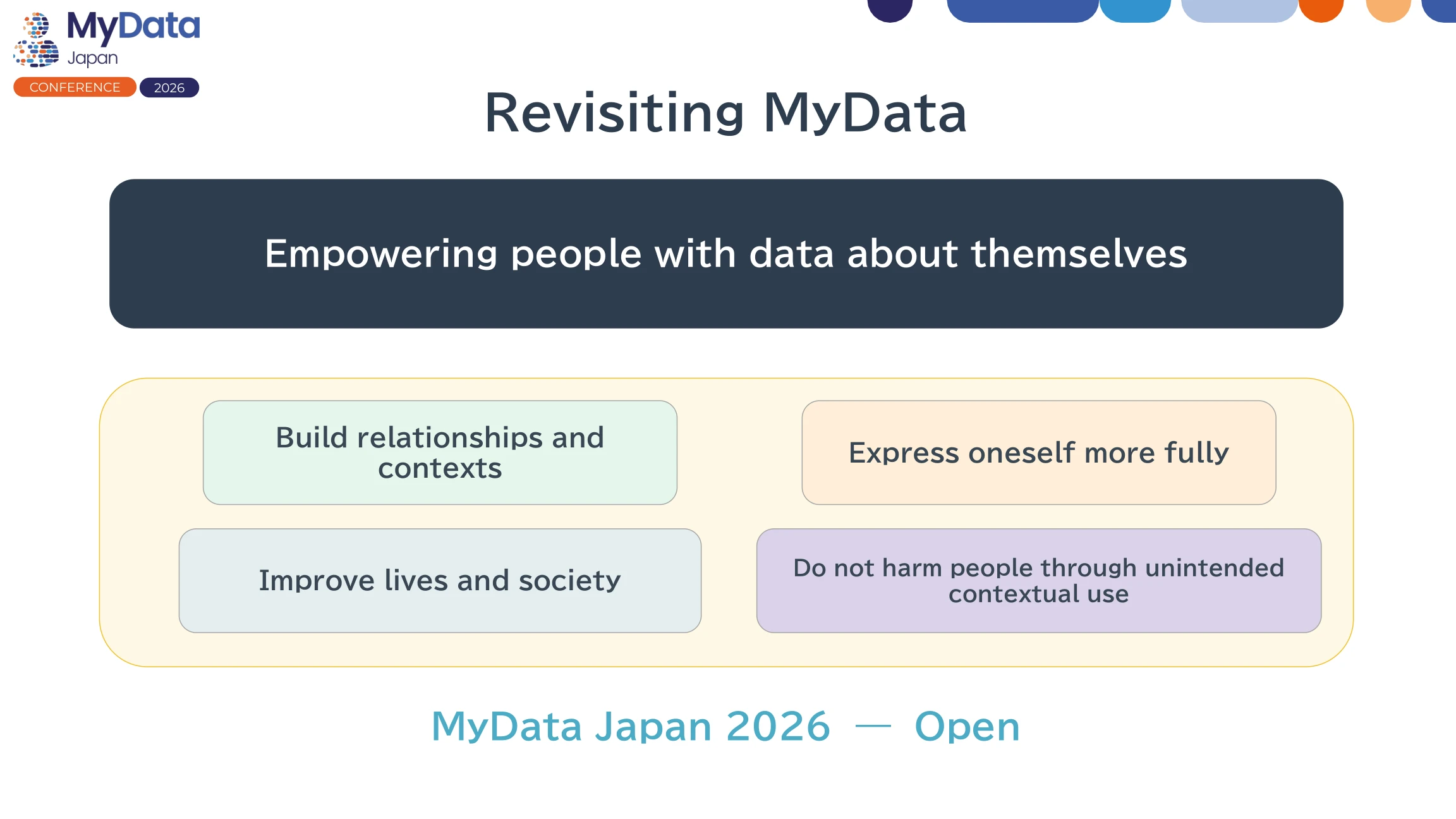
Revisiting MyData does not mean returning to the past.
It means returning to the purpose.
- The purpose is not to lock data away.
- Nor is data circulation itself the purpose.
- It is for people to be able to use data about themselves for their own purposes and for the purposes of their communities and society.
- It is to use that data to build relationships and contexts and to express themselves better.
- It is, as a result, to improve their own lives, their communities, and society.
- And it is to avoid harming people or diminishing their well-being through use outside the intended context.
In each of today’s sessions, please keep asking these questions.
- Who is the person there?
- What relationships and contexts is that person in?
- For whose purpose is the processing being done?
- What data is truly necessary?
- Can the person understand, participate, object, and obtain redress?
Empower people with their own data.
That is MyData.
I hope today’s dialogue will be the next step toward that goal.
With that, I hereby open MyData Japan 2026.
Thank you very much.
MyData-Japan-2026-Opening-Remarks-ver.3-englishRelated posts
MyDataJapan 2025 Opening Declaration<br>
Good morning, everyone. Thank you sincerely for joining MyData Japan 2025. Those gathered here today include people from companies and government, engineers, researchers, and citizens—people with…
You must be logged in to post a comment.