
At 0:30 Japan time, NASA announced that liquid water exists on Mars.
Although this liquid water has a very high salt (perchlorate) concentration, NASA says it has found evidence of it. It was not, however, observed directly. Chemical substances absorb distinctive spectra. When streaks known as Recurring Slope Lineae (RSL), which appear seasonally on Mars, were analyzed in satellite images, they were found to be consistent with perchlorate. Because atmospheric pressure at the Martian surface is low, fresh water evaporates at 10 degrees Celsius. This perchlorate water, however, remains liquid from 70 degrees below zero to around 24 degrees, so scientists apparently infer that liquid water is present in the RSL. This water seems to flow seasonally from around the tops of some mountains, leaving long, narrow, dark traces, and then evaporates each year. At NASA’s press conference [0], video showed this water flowing out, or perhaps seeping out—I am not sure which. It appears that Mars is not the dry planet previously imagined, but one with moist air and soil.
We still do not know whether life exists there. However, discovering where water is located provides an excellent clue as to where to look for life. That said, because we do not know what form Martian life might take, we do not even know what to search for, making this a very difficult exploration.
Meanwhile, discovering water means that securing drinking water and rocket fuel will be easier when humans are sent to Mars.
NASA says that equipment it will send in 2020 will conduct an experiment to produce oxygen from carbon dioxide, which makes up much of the Martian atmosphere.
The presence of both water and carbon dioxide also means that growing plants appears possible in certain greenhouse environments. [1]
The next puzzle to solve is where this water comes from.
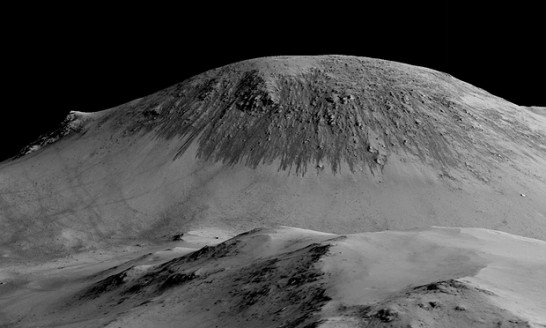
[0] I am watching NASA’s announcement live right now. Questions are being accepted on twitter with #askNASA. A recording can be viewed at http://www.nasa.gov/multimedia/nasatv/index.html A summarized video is available on Facebook → https://www.facebook.com/NASA/videos/10153573742721772/
[1] Meanwhile, American journalists appear concerned that spacecraft sent from Earth could biologically contaminate Mars.
[2] Nasa scientists find evidence of flowing water on Mars
Related posts

Is This Really a Good Idea? The UK Follows Australia in Moving to Ban Social Media for Children under 16
Prompted by the UK’s ban on social media use by those under 16, this article examines the legislative basis and proportionality of social media regulation intended…

Surveillance or Efficiency? The UK’s Major Shift to a “Mandatory Digital ID Wallet”—More Than 1.6 million Sign a Parliamentary Petition in a Single Night
I posted breaking news on X, but on September 26 the UK government announced a plan to introduce digital ID through the "GOV.UK digital wallet." It…

Age Verification: The UK Online Safety Act Is Being Toyed With in All Kinds of Ways—Bypassing It With VPNs and Evading Biometrics With Death Stranding
What Is the UK's Online Safety Act? The UK's Online Safety Act formally became law after receiving Royal Assent on October 26, 2023, and came into…
You must be logged in to post a comment.