
In both the East and the West, privacy is a word often discussed on the basis of a vague understanding.
So here, I would like to take a little time to consider what privacy actually means.
1. The Etymology of Privacy
According to the Online Etymology Dictionary, the word privacy appeared in the 15 century and consists of private + -cy. “-cy” is a suffix that turns a word stem into a noun. In other words, privacy is the noun form of “private.”
“Private” appeared in the latter half of the 14 century and comes from the Latin “privatus” (separated from others and assigned to oneself, in contrast with the public “publicus” and the communal “communis”). In other words, it means something one can decide for oneself; accordingly, “privacy” refers to oneself, one’s possessions, and other “things over which one can exercise self-determination.” Thus, viewing the right to privacy as a “right of self-determination” is not far off the mark, even from an etymological perspective.
2. The Right to Privacy in Legal Literature[1]
Meanwhile, among legal professionals, the right to privacy is often described as “the right to be left alone.” I believe this expression became well known through Warren and Brandeis’s famous article “The Right to Privacy”[2], which quotes Judge Cooley’s book “Law of Torts”[3]. However, I think the Japanese translation of this phrase as “the right to be left alone” is somewhat misleading. Let us look at Judge Cooley’s definition.
Personal immunity. The right to one’s person may be said to be a right of complete immunity: to be let alone. The corresponding duty is, not to inflict an injury, and not, within such proximity as might render it successful, to attempt the infliction of an injury. In this particular the duty goes beyond what is required in most cases; for usually an unexecuted purpose or an unsuccessful attempt is not noticed. But the attempt to commit a battery involves many elements of injury not always present in breaches of duty; it involves usually an insult, a putting in fear, a sudden call upon the energies for prompt and effectual resistance. There is very likely a shock to the nerves, and the peace and quiet of the individual is disturbed for a period of greater or less duration. There is consequently abundant reason in support of the rule of law which makes the assault a legal wrong, even though no battery takes place. Indeed, in this case the law goes still further and makes the attempted blow a criminal offense also. [4]
In other words, the “right to be let alone” is presented as an explanation of the “right of complete personal immunity[5].” The corresponding “duty,” meanwhile, is not to infringe another person’s rights or engage in conduct that threatens to do so (a tort). Reading the explanation that follows makes it clear that the “person” includes not only the body but also the mind. Put another way, the “right to be let alone” is “the inviolable right to freedom of an individual’s body and mind,” which is far removed from the impression that ordinary Japanese readers receive from the Japanese phrase meaning “the right to be left alone.”
Warren and Brandeis take a similar view, regarding the right to privacy as an extremely fundamental right to freedom of self-determination concerning oneself, and treating freedom of speech and expression as rights derived from the right to privacy[6]. This view was also carried forward in the “Privacy Bill of Rights” announced by President Obama in 2012[7]. I feel it is not far off the mark to call the right to privacy a right to “freedom.”
Warren and Brandeis go on to discuss how the right to privacy differs from property rights and copyright, how it differs from defamation, why intent or negligence is not required for an invasion of the right to privacy, and the circumstances in which the right may be limited[8]. It is a short article, so I strongly recommend reading it. It is available online at the MIT website.
3. Conclusion
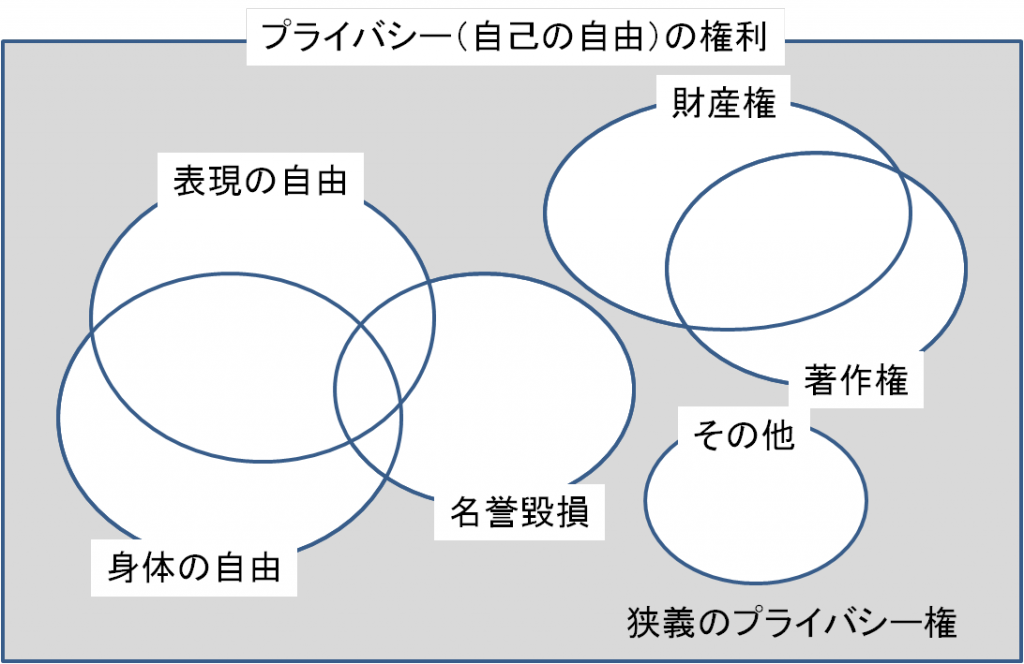
Thus, tracing the concept through either its etymology or the legal literature leads to the same result. Namely, the right to privacy is the right of self-determination concerning the possession, use, disclosure, and disposal of one’s own body, property, and thoughts. More simply put, it is the sovereignty of the self over oneself—that is, the human right to freedom. However, many parts of this right can be addressed by other laws and, to that extent, should be addressed under those specific laws. The part left after removing those elements appears to be what is called the right to privacy in the narrow sense. I think that framing it as “what remains” may be one reason why privacy in the narrow sense is so difficult to understand. The diagram below illustrates the idea. Although it is not included in the diagram, in Europe, the “European Convention on Human Rights” adds, in Article 8, the “Right to respect for private and family life” (in Japan, this is sometimes called privacy, but as explained above, I believe it is one of the component rights included within the right to privacy).
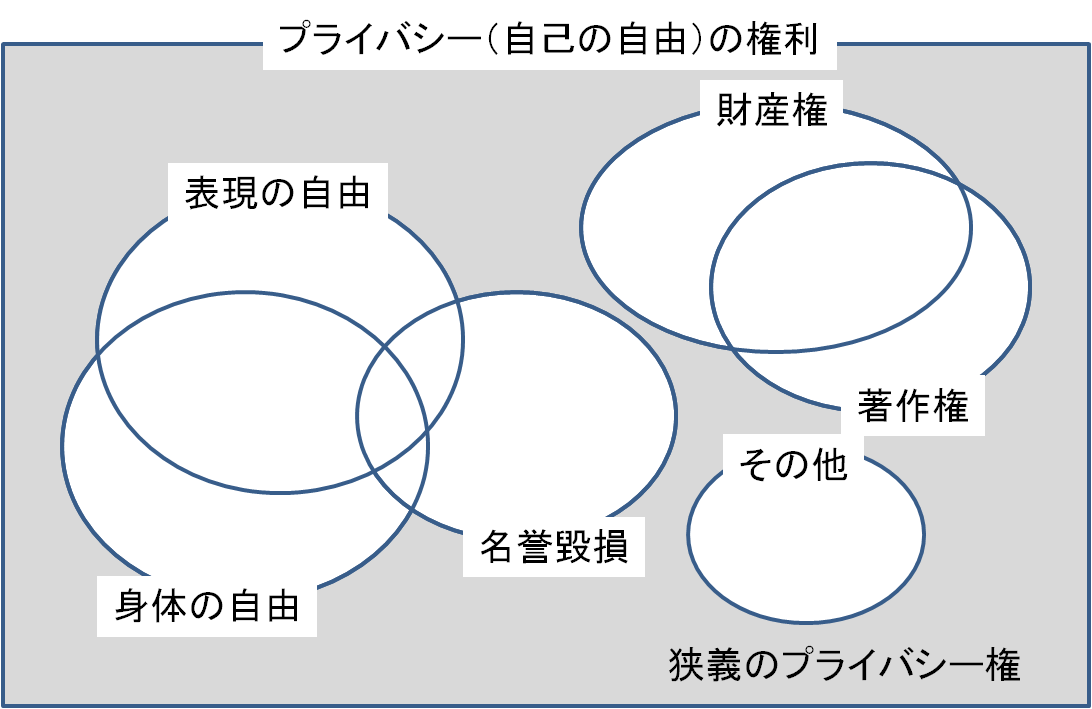
One of the major rights that remains within this “right to privacy in the narrow sense” is the so-called “right to control one’s own information.” This, I think, is why the right to control one’s own information, or the right to shape one’s own public image, is so often discussed as a right to privacy. It also explains why some people argue that “there is no need to enact a law specifically protecting privacy (because protecting privacy is already a matter of course).” In Japan, privacy is not expressly addressed in statutory language. Nevertheless, the Supreme Court’s decision of September 12, Heisei 15 in the Waseda University Jiang Zemin case states that “it is natural for a person to wish that information they do not want others to know should not be disclosed indiscriminately, and that expectation deserves protection.” One could therefore conclude that privacy is already protected in substance and that this is sufficient. On the other hand, I think expressly covering it in a form that is as clear as possible and can serve as concrete guidance for conduct would reduce the number of infringements. In many cases, even winning a lawsuit cannot restore relationships and other circumstances to their former state; by then, it is effectively too late. It is therefore meaningful to establish the protection in a form everyone can readily understand.
The protection of personal information, which is often discussed alongside privacy, is merely one means of protecting the right to privacy. It is not the essence of that right. What must be protected is privacy, not personal information. I believe that is a distinction we must not lose sight of.
[1] As someone who is not a legal expert, I have some reservations about discussing legal literature, but it cannot be avoided here…
[2] Warren and Brandeis, “The Right to Privacy”, Harvard Law Review, Vol. IV December 15, 1890 No. 5 (I initially rendered Warren’s name in Japanese as “Waren,” but “Wōren” seems to be the common Japanese spelling. Pronunciation-wise, I think it is somewhere between the two.)
[3] Thomas McIntyre Cooley, “Law of Torts”, Callaghan, 1888
[4] Reproduced from http://www.law.louisville.edu/library/collections/brandeis/node/227. Underlining added by the author.
[5] “Immunity” can mean inviolability or a privilege against interference, among other things, and is difficult to render naturally in Japanese. Since “diplomatic immunity” means diplomatic privilege, perhaps “complete personal immunity” means complete personal privilege—that is, freedom.
[6] “These considerations lead to the conclusion that the protection afforded to thoughts, sentiments, and emotions, expressed through the medium of writing or of the arts, so far as it consists in preventing publication, is merely an instance of the enforcement of the more general right of the individual to be let alone. ”
[7] Consumer Privacy Bill of Rights (http://1.usa.gov/privrights )
[8] Incidentally, the idea that equality means an equal degree of restriction—that is, concession—of freedom also appears in Enjolras’s speech in Les Misérables. Liberty, society, equality, fraternity. See this article.
Related posts

MyData Japan submitted comments in response to the public consultation on the “Order Partially Amending the Regulation for Enforcement of the Act on Certification Business of the Japan Agency for Local Authority Information Systems Pertaining to Electronic Signatures, etc.”
In response to the public consultation announced on January 26 regarding the "Draft Order Partially Amending the Regulation for Enforcement of the Act on Certification Business…

The MyData Conference 2026 Is This Wednesday. See You at Hitotsubashi Hall!
I have been posting announcements on X every few days, and the MyDataJapan Conference 2026 is this Wednesday. There are many highlights: Naohiro Fujie, Representative Director…
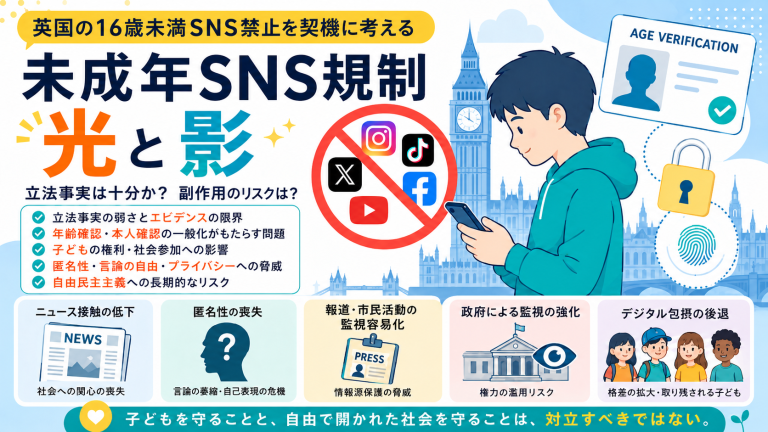
Is This Really a Good Idea? The UK Follows Australia in Moving to Ban Social Media for Children under 16
Prompted by the UK’s ban on social media use by those under 16, this article examines the legislative basis and proportionality of social media regulation intended…
You must be logged in to post a comment.