
An Asahi Newstar program in which experts discuss how corrupt the Japanese mass media are. I already thought they were corrupt, but much of the discussion convincingly explains the structural problems behind it. I strongly encourage everyone to watch it.
Part 1
▼ Repeated use of sensational images designed to win ratings
There is no point in broadcasting every detail of crimes and accidents; it is abnormal.
This confuses exhaustive detail with investigative journalism.
Rather than journalistically important details, emotional hooks are excessively highlighted.
This is an easy way to gain ratings, but it is agitation and far removed from the media’s duty.
A dismemberment murder does not deserve 25 minutes of coverage, even if it gets ratings.
▼ Excessive reliance on safe, visually compelling footage
Only “sanitized images” that do not show the brutality of war are used.
This risks making people lose their aversion to war.
Why was footage of Matsui’s injury shown so often?
Because there was no blood: it was “safe” footage that could still attract ratings.
Part 2
▼ Incidents, accidents, and fires are not matters for nationwide coverage, but they provide safe, visually compelling footage.
▼ Such images appeal to viewers’ emotions, but the media need not use them.
They need not be banned, but should not lead the news or be shown at length. There is much more that needs reporting.
Straight-news programs should cover many matters briefly, objectively, and journalistically.
▼ Why incidents and accidents receive major coverage
It is not the result of journalistic deliberation.
It follows instructions from writers brought in by anchors and personalities.
Those anchors are selected from entertainment backgrounds that make them extremely ratings-conscious, so such instructions are predictable.
It is like opium: they are addicted.
▼ Structural problem: Japanese television is produced within a high-cost structure
Incident reporting is cheap. The variety-show format can be produced cheaply.
Only the anchor’s fee is needed. Visiting experts and conducting interviews costs money, and experts may not say what the station wants.
▼ NHK’s 7 o’clock news and Close-up Gendai are reasonably good.
▼ Recently, however, NHK too crossed the line.
When the Hills representative appeared at the head of the 6-party talks, I expected a development, but it was about Matsuzaka.
▼ The 7 p.m. news is not subject to mandatory-broadcast orders, yet it leads with such stories. Ratings are cited, but securing the budget seems the real reason.
▼ Reporting on suicides caused by bullying
There must be many types of suicide among elementary and junior-high students, yet all are labeled bullying.
In November a principal in Kitakyushu died by suicide; the media caused it.
Newspapers and television ran wild, reporting that he had concealed bullying.
In fact he had reported “monetary extortion” and other matters to the board of education. The board said it had received no report of “bullying,” and the media repeated this.
The principal had actively addressed problems at his former school too.
Yet the media accepted the board’s statement unquestioningly and made him a scapegoat.
Reporting must rest on careful investigation, but everyone skipped that and stampeded across the bridge, with this result.
TBS News 23 exposed the truth. Until then, everyone presumably thought the principal had hidden bullying.
▼ The Mino Monta problem
Even within TBS, Mino Monta’s Asa Zuba provides extremely biased reporting.
On bullying it blames everything on schools.
Things cannot be so simple. This contributed to the principal’s suicide.
The anchor explodes in anger for television, knowingly calculating the dramatic effect.
Part 3
▼ Listing television stations on the stock exchange is problematic
It is fatal for a news organization, because it can do only what makes money.
▼ Fortune-telling segments in news programs
Broadcasting rules say fortune-telling is unscientific and should not be aired, so why air it?
▼ Information programs and news programs
News programs must broadcast facts.
Information programs may be fiction.
Listen carefully and programs such as Asa Zuba call themselves “information programs.”
▼ Saying things “bluntly” requires enormous verification.
Responsible statements cannot be made so glibly.
▼ Political performance and ability to execute
Politicians have come to be judged by performance rather than ability.
The United States was once similar, but performance-oriented politicians have now been weeded out.
There is no sign of that happening in Japan.
Part 4
▼ Significance of whether new entrants are permitted
The example of C-SPAN in the United States. Would new media entrants change things?
▼ Problems with Japan’s Diet
The U.S. and British legislatures are where laws are actually made.
In Japan bureaucrats draft laws and legislators merely deliberate over them.
That is why the U.S. and British proceedings are interesting while Japan’s are not, so nobody watches.
With no substance, only performance and additives remain, such as whether Makiko Tanaka is entertaining.
▼ There are no high-status programs
▼ Entry barriers caused by the press-club system
Because only the 5 major media organizations can join press clubs, others cannot gather news.
▼ Media hypocrisy
If footage makes compelling television, the media find some pretext to broadcast it.
For example, while saying, “They keep showing this outrageous news endlessly,” they endlessly show that same “outrageous” news.
▼ Television does not report news unless it supplies compelling images
Even genuinely important matters go unreported.
Even on pensions, it avoids the essence and selects what looks good.
▼ Japanese news uses language that is too difficult
One reason is that the media simply repeat government announcements: they are government mouthpieces.
Part 5
▼ What can be inferred from reports saying someone “gave a statement”
If reporters interviewed the person directly, they could say the person “said” it.
They say “gave a statement” because the information comes from a written statement handed over by the head of the First Investigation Division.
▼ “Press clubs only receive documents, so they are no great advantage?”
The 5 major media organizations use that claim to justify excluding others. But it is wrong.
▼ Obtaining information from public servants outside press conferences is fundamentally illegal
Public servants have confidentiality obligations and must not answer questions outside public press conferences (press clubs).
If information is obtained through “independent reporting,” the official violates confidentiality and the reporter may be accused of solicitation.
▼ If other companies enter press clubs, they may “ask what must not be asked”
The respondent can then only deny or evade. If televised, this reveals the problem with choreographed reporting.
▼ 16 companies control all administrative information
Information in magazines is merely material passed on by those 16 companies, because magazines cannot attend press conferences.
▼ The media opposed the freedom-of-information law most strongly
It would erode their vested interests.
Nevertheless, the law’s enactment considerably improved matters.
▼ Problems with informal press gatherings
Reporters may not write what they hear there.
Such relationships between politicians and reporters would be unthinkable overseas.
▼ Overseas reporters’ view: reporting in private settings is illegal
▼ Media protected by village rules, and the authorities that benefit most
▼ The absence of changes of government is highly exceptional worldwide
The media supports near-single-party rule.
▼ In Japan reporting creates politics
Policy is decided in informal gatherings. Nabetune writes haiku for dying politicians. (This is fabrication and concealment, not reporting.)
Part 6
▼ Reporters’ foolish questions
“Prime Minister, what do you think of Matsui’s home run?”
Ridiculous. Apparently that female reporter was removed from the prime-minister beat.
▼ Media cross-ownership eliminates mutual criticism
Newspapers should criticize television, and television should criticize newspapers.
In Japan both have the same capital owners, so this does not work.
▼ Sensationalism and forgetfulness: media scrums
The media heats up quickly and cools down quickly.
Even while pursuing an important issue, it abandons it and forgets when something scandalous occurs.
▼ Use of outside commentators
They are asked to say what stations cannot say, as an “accident” on live television.
Principled program producers use this tactic.
▼ Sponsors and media self-censorship
▼ Media and government are closer than ever
▼ Anchors and commercials (sponsors)
In the past, even weather presenters did not appear in commercials while working on news programs (the News Station and Megumi Oishi example).
Now even principal anchors appear in commercials.
▼ Mino Monta’s ubiquitous-commercial problem
Anchors wield enormous authority, so staff may self-censor.
Viewers should suspect sponsor interference, but in Japan that mechanism does not function: a media-literacy problem.
This also relates to criticism between media.
▼ The media fails to fulfill its own responsibility
Britain: unnecessary contact between bureaucrats and politicians is not permitted.
Japan: they are deeply entangled; one cannot tell which is the politician.
The commercial issue is not solely the anchor’s problem.
Stations and the commercial-broadcasting industry should not employ such people.
Japan: anchors and stations are deeply entangled.
Part 7
▼ Celebrity commercial appearances reveal Japan’s low media literacy
They would be unthinkable in Europe or the United States.
▼ Dependence on television
Japanese media offers only 5 networks and 16 companies.
The only choice citizens have is to turn off the television.
But television is addictive....
▼ Tobacco advertising restrictions show the dysfunction of Japanese media
In Europe and the United States, governments and media debate restrictions on tobacco commercials.
In Japan, JT voluntarily restricted them in response to a citizens’ movement; the media did not fulfill its role.
Related posts
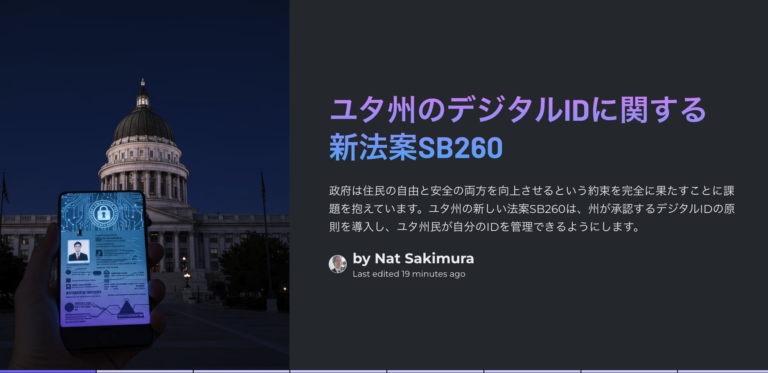
Anyone Who Thinks Identity Is Given by the State or Government Should Sit Up and Read This: Utah Digital ID Bill SB260 and the Transformation Brought by a User-Centric Digital ID System
As digital technology evolves, our dependence on personal information and data continues to grow. Yet many government-provided ID systems do not always give sufficient consideration to…

The Provider Liability Limitation Act Has Become the Information Distribution Platform Act (May 10)
Following deliberations by the Ministry of Internal Affairs and Communications’ Study Group on Platforms, of which I was also a member, the amended “Provider Liability Limitation…

MyData Japan submitted comments in response to the public consultation on the “Order Partially Amending the Regulation for Enforcement of the Act on Certification Business of the Japan Agency for Local Authority Information Systems Pertaining to Electronic Signatures, etc.”
In response to the public consultation announced on January 26 regarding the "Draft Order Partially Amending the Regulation for Enforcement of the Act on Certification Business…