
Personally, I find this very interesting, but I still cannot shake the faint sense of unease that surrounds Horiemon. Whether it is the way he makes profits or the professional baseball uproar, it seems to stem from the fact that none of his methods are straightforward.
Even this time, if he truly wanted Fuji Television under his control, he should have made a tender offer for Fuji Television; going through Nippon Broadcasting is clearly an indirect and improper route.
Of course, Horiemon does not have the financial resources to make a tender offer for Fuji Television. There also seem to be various questions about how he acquired Nippon Broadcasting shares. (If more than 1/3 is acquired off-market, a tender offer is required, but the argument this time is that it was done “within the market” through after-hours trading. In reality, it appears that a block trade was carried out after hours, which feels close to sophistry.)
I think this choice between proceeding openly and resorting to guerrilla tactics is what makes Horiemon seem infinitely more suspicious than Mr. Son and Mr. Mikitani.
Even in this Fuji Television matter, he has angered Fuji Television and many people in the business world, so I have the feeling he may simply be smashed flat and that will be the end of it. Moreover, unlike during the professional baseball episode, when he put up no money at all, he has actually done it this time, so Horiemon may be facing a rather tough contest.
On TV Asahi’s Hōdō Station, an economic commentator said that Fuji Television’s remarks, which seemed to say that this violated the rules of proper conduct, were so Japanese that they would not be accepted in America. But that is not true. If one did this in America, one could seriously end up being killed. In both the United States and Europe, relationships are dry only among ordinary people; at the top, business is conducted on the basis of extremely close personal relationships. As you know, betraying one’s associates can make one an example—such as Roberto Calvi, chairman of Italy’s Banco Ambrosiano, being hanged from a bridge.
In the end, business can only be built on “trust.”
Related posts
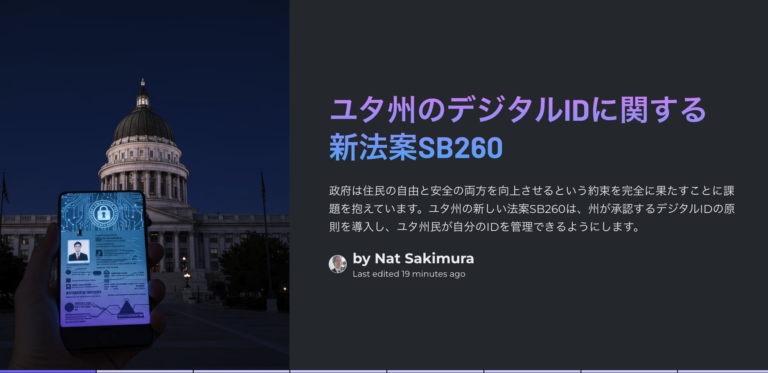
Anyone Who Thinks Identity Is Given by the State or Government Should Sit Up and Read This: Utah Digital ID Bill SB260 and the Transformation Brought by a User-Centric Digital ID System
As digital technology evolves, our dependence on personal information and data continues to grow. Yet many government-provided ID systems do not always give sufficient consideration to…

The Provider Liability Limitation Act Has Become the Information Distribution Platform Act (May 10)
Following deliberations by the Ministry of Internal Affairs and Communications’ Study Group on Platforms, of which I was also a member, the amended “Provider Liability Limitation…

MyData Japan submitted comments in response to the public consultation on the “Order Partially Amending the Regulation for Enforcement of the Act on Certification Business of the Japan Agency for Local Authority Information Systems Pertaining to Electronic Signatures, etc.”
In response to the public consultation announced on January 26 regarding the "Draft Order Partially Amending the Regulation for Enforcement of the Act on Certification Business…