
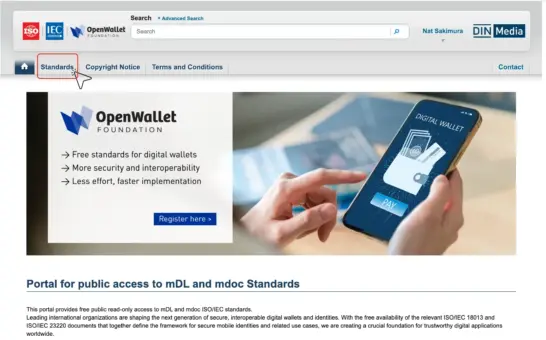
As I shared in real time with those who follow me on X, standards related to mDL/mdoc are now available to access free of charge at https://dinmedia.mdoc.online/en. (If you would like to hear about developments like this as they happen, please follow my X account, @_nat.)
These differ from so-called freely available standards, which can be accessed at no charge (such as ISO/IEC 29100, Privacy framework; many are foundational standards that other standards necessarily reference). Here, sponsors promoting the adoption of mDL/mdoc, such as AAMVA and Austroads, have paid the fees in advance to make access possible. These seem to be called “Sponsored Standards.”
Standards Now Available as Sponsored Standards
The following standards are now accessible as “Sponsored Standards.”
- ISO/IEC 18013-5:2021 – Personal identification — ISO-compliant driving licence — Part 5: Mobile driving licence (mDL) application
- ISO/IEC TS 18013-7:2025 – Personal identification — ISO-compliant driving licence — Part 7: Mobile driving licence (mDL) add-on functions
- ISO/IEC TS 23220-2:2024 – Cards and security devices for personal identification — Building blocks for identity management via mobile devices — Part 2: Data objects and encoding rules for generic eID systems
- ISO/IEC TS 23220-3 – Cards and security devices for personal identification — Building blocks for identity management via mobile devices – Part 3: Protocols and services for issuing phase (currently under development)
- ISO/IEC TS 23220-4:2024 – Cards and security devices for personal identification — Building blocks for identity management via mobile devices — Part 4: Protocols and services for operational phase
- ISO/IEC TR 25219:2024 – Personal identification — ISO-compliant driving licence — Considerations for early adopters of ISO/IEC 18013-7.
Access is view-only, however. The Copyright Notice states the following:
ISO/IEC grants rights of access and use solely on a view-only basis. No other rights of access or use, or purposes, are authorized. For example, none of the following is permitted: copying (including screen captures), reproduction, downloading, printing (including screen printing), storage, distribution, sale, rental, alteration, adaptation, creation of derivative works, modification, publication or republication, sublicensing, use in AI prompts or for AI training (e.g., LLMs), otherwise making the content available in any form by electronic or mechanical means, or circumventing technical protection measures.
(Source) https://dinmedia.mdoc.online/en/copyright-notice
Use of ISO publications is also subject to the separate End Customer License Agreement (revised May 29, 2026). Please refer to it as well.
How to Access the Standards
Access is not simply a matter of clicking a link. You need to complete a registration process and a few other steps.
Registration
You first need to register. On the Sponsored Standards page, below the list of sponsors, there is a section called “Your added value for sustainable success.” Within it, you will find a link labeled “👉 To the registration form“—click that link.

This takes you to a page like the one shown below.
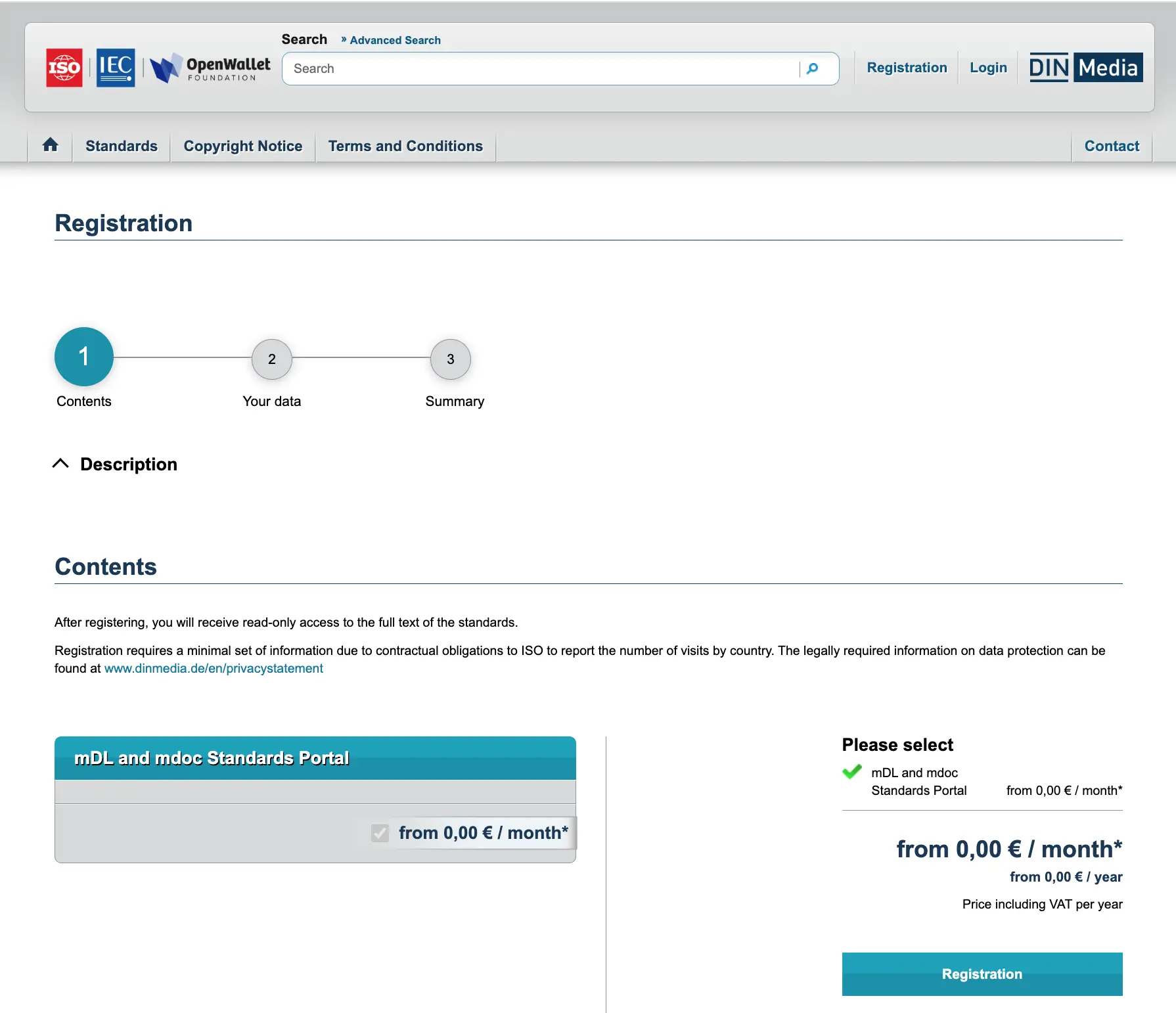
The price is shown as 0.00 euros per month, but farther down it says that only annual subscriptions are available. Well, at 0.00 euros, it hardly matters either way. Clicking the “Registration” button at the bottom right takes you to a form where you enter your name, as shown below. There are links to the Copyright Notice and Terms and Conditions, but, strangely, I cannot see a link to a privacy notice. The Terms and Conditions do not contain a Privacy Notice (which should be kept separate in any case), and the Legal Notice in the footer returns “404 – File Not Found.” I wondered where the privacy notice was, and eventually found a link in the Copyright Notices.
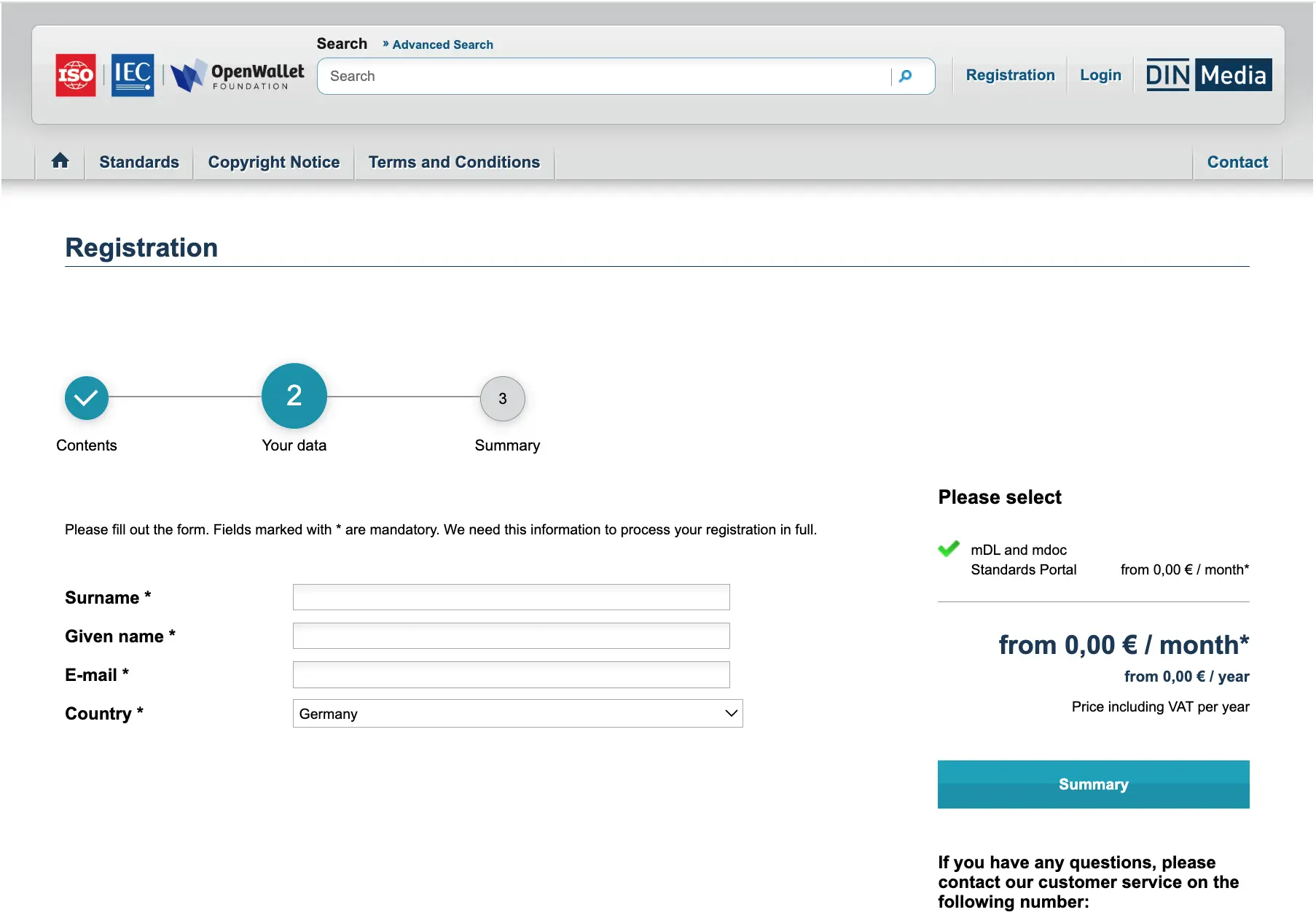
After entering your details, click “Summary” to see a screen where you can check what you entered. This screen has a radio button under “General terms and conditions *”; select “I accept.” (Be good and read the terms and conditions properly, everyone.)
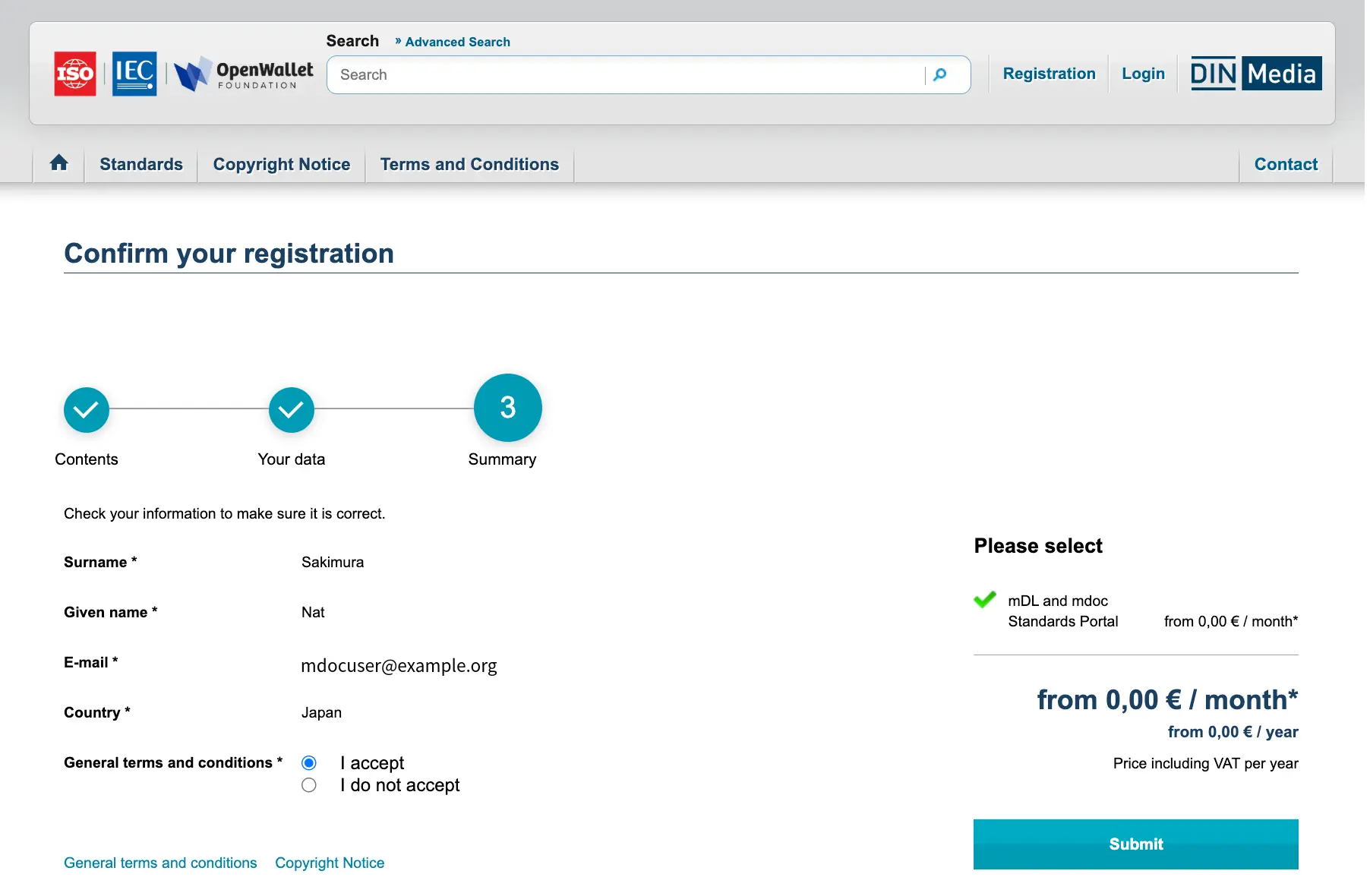
Then click “Submit,” and a screen appears thanking you for registering.
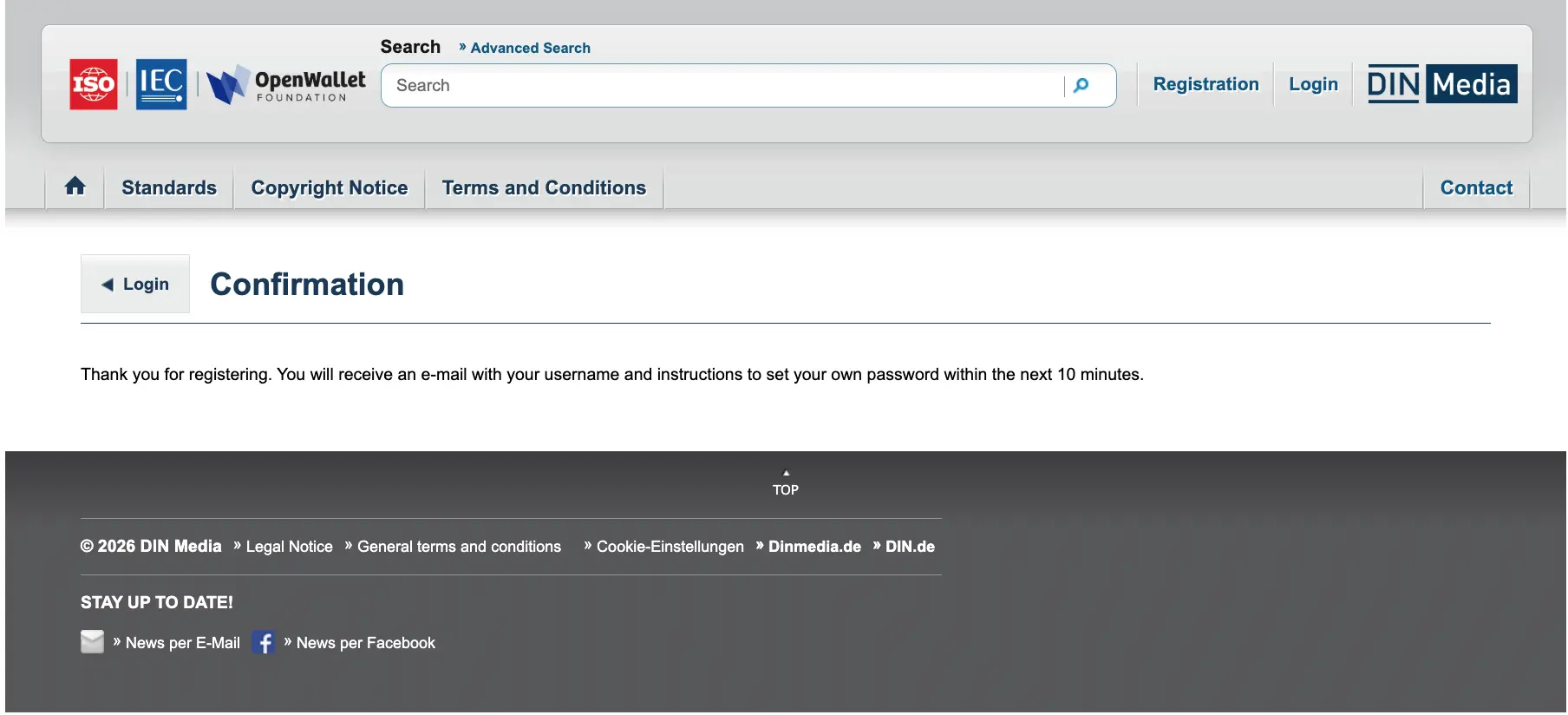
You would hope to receive an email straight away at this point, but it does not arrive immediately. It seems to take about 10 minutes, so have a coffee while you wait.
After about 5 minutes, an email arrived from international@dinmedia.de. It contains a link for creating a password, valid for 3 days; click it. (But passwords, really? For those who already have an ISO Webshop account, I would like to see federated sign-in through ISO. I do not want to create yet another password just for this.)
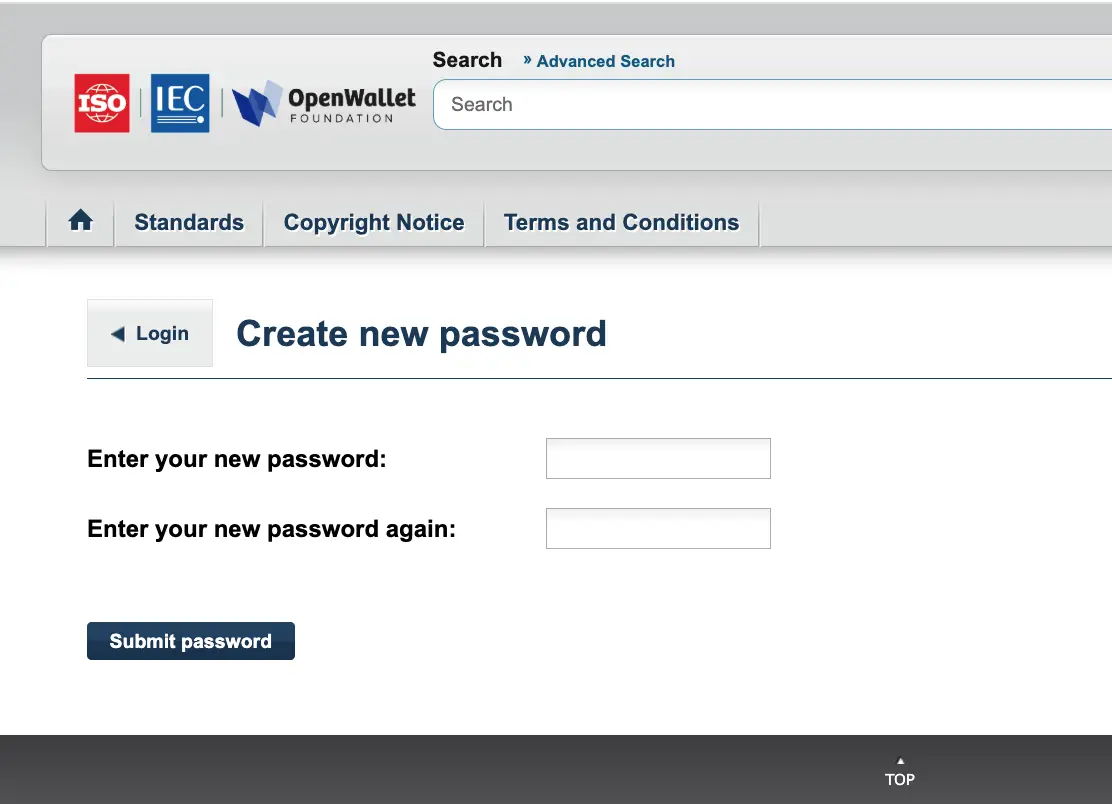
Click “Submit password,” and the message “Change password successful” appears.
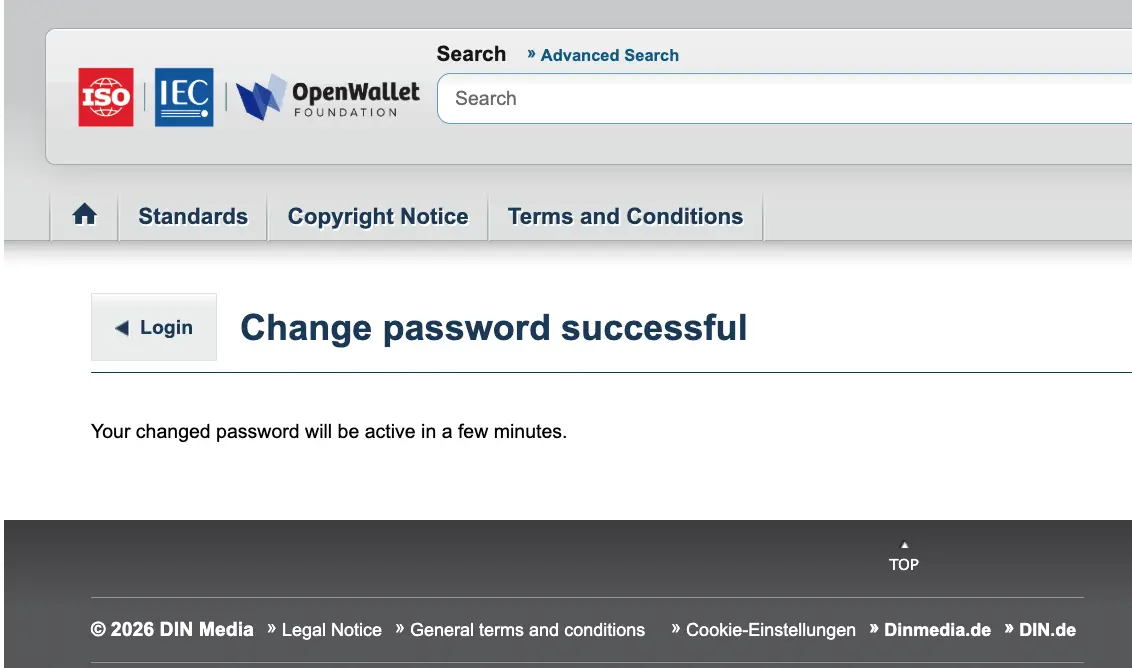
There is a “Login” button here. Click it to sign in with the email address and password you registered, and the home screen appears.
Accessing Sponsored Standards
Once you are logged in, click “Standards” in the menu bar.
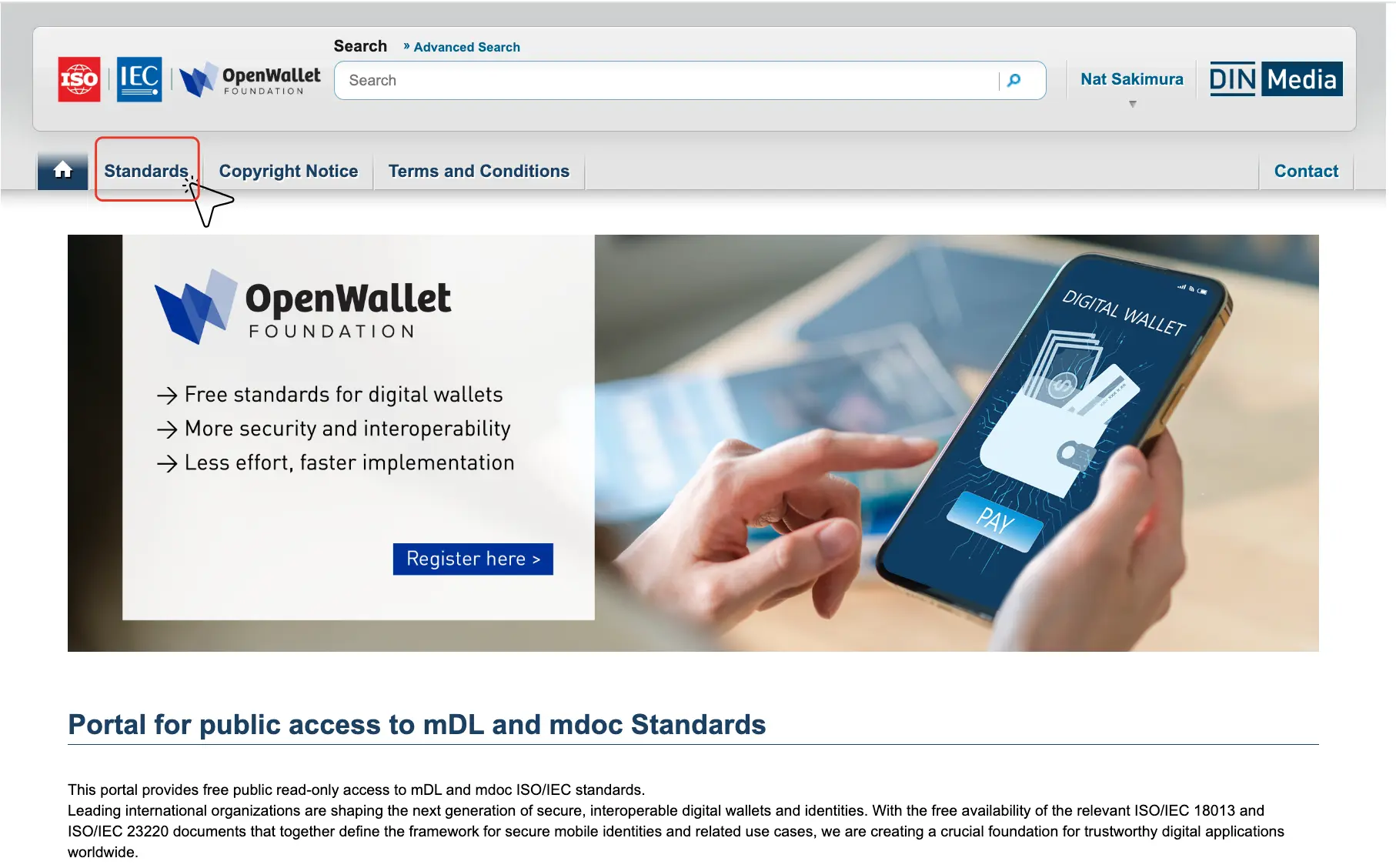
This brings up the list page.
Click the relevant row on this list page to view the standards document in what appears to be an embedded JavaScript PDF viewer.
A Few Extra Thoughts
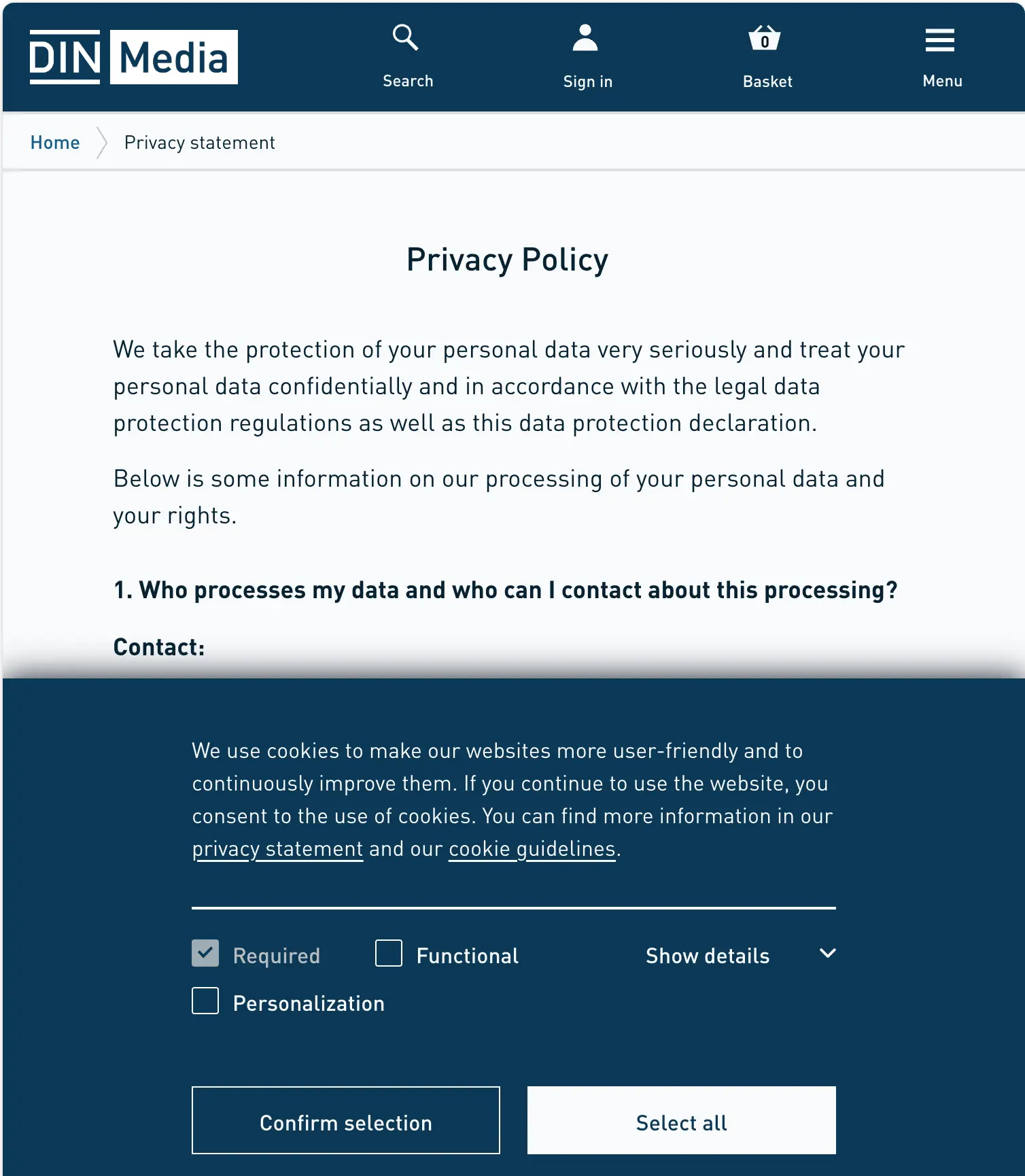
A simple question (1): Is it lawful to require cookie consent before I can read the Privacy Statement and Cookie Guidelines that I need to review before consenting to the cookies required to read the Privacy Policy?
When you open the Privacy Policy, you are asked to consent to cookies. The explanation seems to describe cookies used for the user experience. Yet there is a checked “☑Required” option that cannot be deselected. You cannot even read the Privacy Policy without consenting to cookies. The cookie consent dialog contains links to the privacy statement and cookie guidelines, but the former is a circular reference to itself, and the latter presents the same situation: you cannot read it without consenting to cookies. Is this lawful? Could someone who knows please enlighten me?
A simple question (2): Is it really a good idea to use a domain such as mdoc.online?
To prevent someone from snapping up the domain after it expires, they will have to keep maintaining it indefinitely, even if the sponsors are gone, won’t they? I wonder whether that will be all right… Incidentally, WHOIS does not reveal who administers it.
Related posts
March 2026 Digital Identity Technology Trends
March 2026 was an extremely busy month: even just among the meetings I was involved in, standards-related meetings included JTC 1/SC44, SC27, IETF . ISO/IEC JTC…

OpenAI Launches Sign in with ChatGPT (Based on OpenID Connect)
(Work in progress; last updated 2026-10-02 12:39 JST) On September 29, at DevDay 2026, OpenAI officially announced Sign in with ChatGPT (SIWC). I would like to…
When Software Becomes Staff: Governance, Security, and Safety for Agentic AI
Below is the transcript of my keynote speech at EIC 2026 on May 19, 2026. The slides are provided as a PDF at the end of…
You must be logged in to post a comment.