
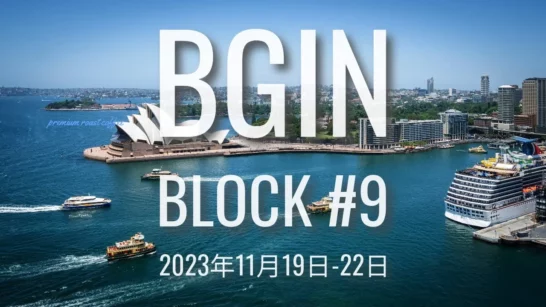
In June 2019, the communiqué adopted at the G20 chaired by Japan explicitly recognized “the importance of multistakeholder dialogue in decentralized finance.” The Blockchain Governance Initiative Network (BGIN) was subsequently established in April 2020. Its 9th general meeting, Block #9, will be held in Sydney, Australia, from November 19 through November 22. BGIN sessions are not panel discussions. Although Main Discussants primarily lead them, anyone may participate. The results are preserved as meeting notes and used in subsequent document development. Numerous stakeholders from Japan, including the Financial Services Agency, Bank of Japan, businesses, engineers, and academia, will participate onsite and join the document-development discussions. Onsite participation is best, but remote participation is also possible, so I warmly invite you to join (register here).
Highlights of Each Day
The highlights of each day are as follows. This was adapted from Professor Matsuo’s Georgetown University blog.
Day 1 (Blockchain Governance)
On day 1, participants will revisit governance of blockchain technology developed through grassroots activity. Blockchain governance was also discussed at the Internet Governance Forum (IGF) held in Kyoto in October. IGF participants, financial regulators, and blockchain engineers will discuss blockchain-governance challenges and align their understanding of appropriate governance. After a lecture from the Ethereum Foundation on Ethereum governance, they will identify governance issues and discuss future documentation work.
Day 2 (Financial Applications)
On the morning of day 2, participants will reconsider what decentralization means in financial blockchain applications, then discuss how CBDCs, deposit tokens, stablecoins, crypto-assets, DeFi, and other things that resemble “money” but differ slightly should coordinate.
The program begins with a keynote on decentralized finance at MakerDAO. Central banks, academia, stablecoin providers, and blockchain engineers will then discuss differences among CBDCs, deposit tokens, stablecoins, crypto-assets, and DeFi; how they should interoperate; and the direction of future documentation.
Next, with Carole House—who coordinated the White House executive order on digital assets—as session chair, the chair of TC307 and NIST members will discuss the U.S. government’s R&D strategy for digital-asset standardization.
The afternoon workshop divides into 2 parallel sessions, each spending 90 minutes editing and discussing concrete documents.
- Barriers for stablecoins
- Transparency of decentralized applications and soundness of DeFi
- CBDCs and privacy
- Smart-contract security and governance
Day 3 (Identity, Key Management, and Privacy)
In the morning, coauthor Fabian Schär will deliver a keynote on new approaches to KYC/AML using the currently debated Privacy Pools, coauthored by Ethereum developer Vitalik Buterin. Zooko Wilcox, head of Zcash and a cypherpunk, will then join a discussion on deployment and multistakeholder understanding.
Participants will then discuss wallets, a vital component of blockchain security, privacy, and business. Led by Daniel Goldscheider, head of the OpenWallet Foundation, they will discuss building secure wallets and integration with multiparty computation.
The afternoon workshop divides into 2 parallel sessions, each spending 90 minutes editing and discussing concrete documents.
- Zero-knowledge proofs and their applications
- Wallet accountability
- Worldcoin’s privacy impact
- Digital identity
Day 4 (Industry Session and Local Blockchain Session)
On day 4, presentations and panels by sponsoring companies and organizations will anchor discussions of industry trends and challenges, while participants will also introduce and discuss development of blockchain trends in Australia.
Further Information
Detailed information, including the official timetable, is available on the dedicated page of the BGIN website. Please take a look.
Related posts

The MyData Conference 2026 Is This Wednesday. See You at Hitotsubashi Hall!
I have been posting announcements on X every few days, and the MyDataJapan Conference 2026 is this Wednesday. There are many highlights: Naohiro Fujie, Representative Director…

OpenID Summit Tokyo 2026 “Special Edition” Closing Keynote
The tickets apparently sold out instantly, so I had not introduced this event here; however, tomorrow, August 26, I will appear at the OpenID Summit Tokyo…

On May 19, I Will Deliver a Keynote at EIC 2026 in Berlin, Titled “When Software Becomes Staff: Governance, Security & Safety for Agentic AI”
On the first day of EIC 2026, I will deliver the keynote “When Software Becomes Staff: Governance, Security & Safety for Agentic AI.”