
![The University of Tokyo Moves from 5th to 28th! Harvard University Takes the Top Spot: Recalculating Diamond's “Universities Producing Useful Talent” Ranking [0]](https://www.sakimura.org/wp-content/uploads/2014/10/b12293c376aace72e4c35672a3220b00-546x702.png)
While looking at Facebook on the train, I came across Weekly Diamond’s (10/18) “Ranking of Universities Producing Useful Talent” [1]. I have not yet obtained the magazine itself, so I do not know the details of the survey, but according to the attached image, respondents were asked to name the top 5 universities in each of the “useful” and “not useful” categories. The results were tallied by assigning 1th place 5 points, 2th place 4 points, …, and 5th place 1 point, and then calculating
“Useful (A)” − “Not Useful (B)”
to produce the ranking. Here is the result.
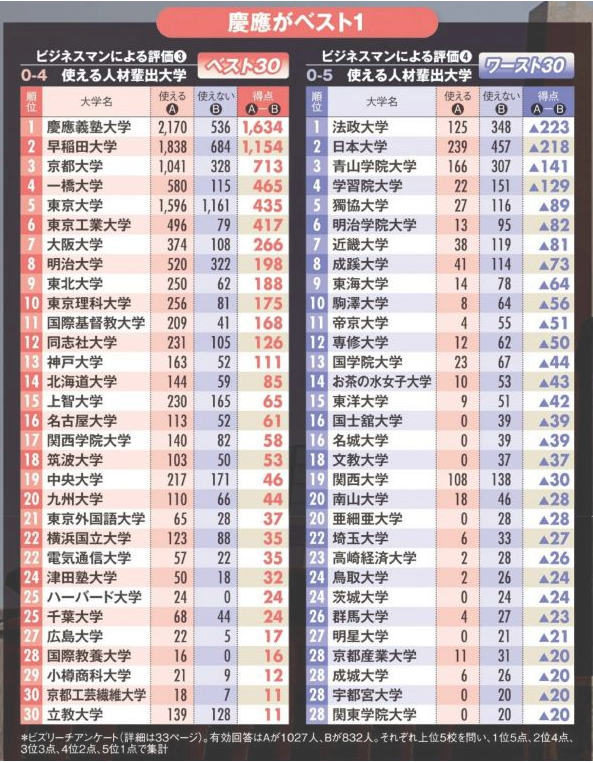
This ranking makes no sense at all.
To begin with, I do not understand what it means to convert ordinal rankings into cardinal numbers and add them together, and subtracting those figures to create a ranking makes even less sense [2]. Still, there is no point lamenting that, so I tried creating a somewhat better ranking by calculating
“Useful Ratio” = “Useful (A)” / (“Useful (A)” + “Not Useful (B)”)
and ranking the results. This is shown in Table 1.
Table 1 — Revised Ranking of Universities Producing Useful Talent
| Rank | Diamond Ranking |
University | Useful (A) |
Not Useful (B) |
Diamond Score (A)-(B) |
(A) Ratio |
| 1 | 25 | Harvard University | 24 | 0 | 24 | 100.00% |
| 2 | 28 | Akita International University | 16 | 0 | 16 | 100.00% |
| 3 | 6 | Tokyo Institute of Technology | 496 | 79 | 417 | 86.26% |
| 4 | 11 | International Christian University | 209 | 41 | 168 | 83.60% |
| 5 | 4 | Hitotsubashi University | 580 | 115 | 465 | 83.45% |
| 6 | 27 | Hiroshima University | 22 | 5 | 17 | 81.48% |
| 7 | 1 | Keio University | 2170 | 536 | 1634 | 80.19% |
| 8 | 9 | Tohoku University | 250 | 62 | 188 | 80.13% |
| 9 | 7 | Osaka University | 374 | 108 | 266 | 77.59% |
| 10 | 3 | Kyoto University | 1041 | 328 | 713 | 76.04% |
| 11 | 10 | Tokyo University of Science | 256 | 81 | 175 | 75.96% |
| 12 | 13 | Kobe University | 163 | 52 | 111 | 75.81% |
| 13 | 24 | Tsuda University | 50 | 18 | 32 | 73.53% |
| 14 | 2 | Waseda University | 1838 | 684 | 1154 | 72.88% |
| 15 | 22 | The University of Electro-Communications | 57 | 22 | 35 | 72.15% |
| 16 | 30 | Kyoto Institute of Technology | 18 | 7 | 11 | 72.00% |
| 17 | 14 | Hokkaido University | 144 | 59 | 85 | 70.94% |
| 18 | 29 | Otaru University of Commerce | 21 | 9 | 12 | 70.00% |
| 19 | 21 | Tokyo University of Foreign Studies | 65 | 28 | 37 | 69.89% |
| 20 | 12 | Doshisha University | 231 | 105 | 126 | 68.75% |
| 21 | 16 | Nagoya University | 113 | 52 | 61 | 68.48% |
| 22 | 17 | Kwansei Gakuin University | 140 | 82 | 58 | 63.06% |
| 23 | 20 | Kyushu University | 110 | 66 | 44 | 62.50% |
| 24 | 8 | Meiji University | 520 | 322 | 198 | 61.76% |
| 25 | 25 | Chiba University | 68 | 44 | 24 | 60.71% |
| 26 | 22 | Yokohama National University | 123 | 88 | 35 | 58.29% |
| 27 | 15 | Sophia University | 230 | 165 | 65 | 58.23% |
| 28 | 5 | The University of Tokyo | 1596 | 1161 | 435 | 57.89% |
| 29 | 19 | Chuo University | 217 | 171 | 46 | 55.93% |
| 30 | 18 | University of Tsukuba | 103 | 82 | 21 | 55.68% |
| 31 | 30 | Rikkyo University | 139 | 128 | 11 | 52.06% |
| 32 | 44 | Kansai University | 108 | 138 | -30 | 43.90% |
| 33 | 60 | Aoyama Gakuin University | 166 | 307 | -141 | 35.10% |
| 34 | 61 | Nihon University | 239 | 457 | -218 | 34.34% |
| 35 | 43 | Nanzan University | 18 | 46 | -28 | 28.13% |
| 36 | 55 | Seikei University | 41 | 114 | -73 | 26.45% |
| 37 | 62 | Hosei University | 125 | 348 | -223 | 26.43% |
| 38 | 35 | Kyoto Sangyo University | 11 | 31 | -20 | 26.19% |
| 39 | 50 | Kokugakuin University | 23 | 67 | -44 | 25.56% |
| 40 | 56 | Kindai University | 38 | 119 | -81 | 24.20% |
| 41 | 58 | Dokkyo University | 27 | 116 | -89 | 18.88% |
| 42 | 34 | Seijo University | 6 | 26 | -20 | 18.75% |
| 43 | 51 | Senshu University | 12 | 62 | -50 | 16.22% |
| 44 | 49 | Ochanomizu University | 10 | 53 | -43 | 15.87% |
| 45 | 41 | Saitama University | 6 | 33 | -27 | 15.38% |
| 46 | 54 | Tokai University | 14 | 78 | -64 | 15.22% |
| 47 | 48 | Toyo University | 9 | 51 | -42 | 15.00% |
| 48 | 37 | Gunma University | 4 | 27 | -23 | 12.90% |
| 49 | 59 | Gakushuin University | 22 | 151 | -129 | 12.72% |
| 50 | 57 | Meiji Gakuin University | 13 | 95 | -82 | 12.04% |
| 51 | 53 | Komazawa University | 8 | 64 | -56 | 11.11% |
| 52 | 39 | Tottori University | 2 | 26 | -24 | 7.14% |
| 53 | 52 | Teikyo University | 4 | 55 | -51 | 6.78% |
| 54 | 40 | Takasaki City University of Economics | 2 | 28 | -26 | 6.67% |
| 55 | 33 | Utsunomiya University | 0 | 20 | -20 | 0.00% |
| 56 | 32 | Kanto Gakuin University | 0 | 20 | -20 | 0.00% |
| 57 | 36 | Meisei University | 0 | 21 | -21 | 0.00% |
| 58 | 38 | Ibaraki University | 0 | 24 | -24 | 0.00% |
| 59 | 42 | Asia University | 0 | 28 | -28 | 0.00% |
| 60 | 45 | Bunkyo University | 0 | 37 | -37 | 0.00% |
| 61 | 47 | Kokushikan University | 0 | 39 | -39 | 0.00% |
| 62 | 46 | Meijo University | 0 | 39 | -39 | 0.00% |
Harvard University, which languished in 25th place in Diamond’s ranking, has now triumphantly risen to the top.
In any case, these figures are still rather difficult to make sense of…. For your reference.
Perhaps I should go buy Weekly Diamond….
[0] After posting this blog entry, I came across a BLOGOS article titled “The University of Tokyo Moves from 5th to 29th! Recalculating the ‘Universities Producing Useful Talent’ Ranking” http://blogos.com/article/96472/ In my calculation, the University of Tokyo was 28th, so I deliberately revised the title to imitate that version. The original title was “Diamond’s ‘Ranking of Universities Producing Useful Talent’—This Won’t Do.”
[1] “Breaking News: The ‘Worst 1’ in the Ranking of Universities Useful in the Workplace Announced” http://netgeek.biz/archives/23399
[2] Since “useful/not useful” is presumably a relative assessment among the people in each workplace, comparing those assessments on the same scale also makes little sense, but let us set that aside.
Related posts
Got an iPad
It happened that the day I arrived in the United States on a business trip was the iPad's launch day, so I went to the Apple…

The Blockchain Book Coming Out Next Month Seems to Have Already Reached No. 1 on Amazon’s Securities and Financial Markets Bestseller Ranking
A book titled “Unresolved Issues in Blockchain Technology,” to which I contributed a chapter, will be published next year on January 18. It is already available…
You must be logged in to post a comment.