
The Ministry of Education, Culture, Sports, Science and Technology has settled on a policy of introducing income-contingent repayment into the university student loan system beginning in fiscal 2018. Income-contingent repayment, a system used in the United Kingdom, Australia, and the United States, varies the monthly repayment amount according to annual income after graduation. Because repayment amounts are determined according to economic conditions and changes in annual income, the burden is lower for people with low incomes and the collection rate can be improved.
Source: EconomicNews.
I was researching this because I was thinking of discussing it at a study group tomorrow, only to discover that it had apparently already been announced.
Income-contingent student loans are offered in Australia, New Zealand, the United Kingdom, and elsewhere. As of 2013, Australia’s HELP was being used by 450,314 people. A similar initiative has also begun for Federal Student Loans in the United States, although it is available only to low-income borrowers.
Because income-contingent student loans do not need to be repaid until income reaches a certain level, they pose less risk to individuals and are easier to take out. They can therefore mitigate inequitable situations in which people abandon plans for further education because they cannot afford tuition. Repayment begins in Australia at an income of AU$53,345 or more, and in the United Kingdom at £21,000. In Australia, the average income of new graduates in every field exceeds this threshold in their 5th year, and repayment is completed on average 8.1 years after it begins. In every country, the tax authority identifies income and, once the income condition is met, the repayment is collected together with taxes. Interest rates vary, including CPI plus alpha, with the rate rising as income increases.
Because most universities in these countries are national institutions, the government also provides the fund. Japan has many private universities, so how to establish this fund may require separate consideration. One possibility might be for each school to provide its own fund. In that case, providing a good education and producing high-income earners would improve returns, so the arrangement could also be expected to help improve the quality of university education.
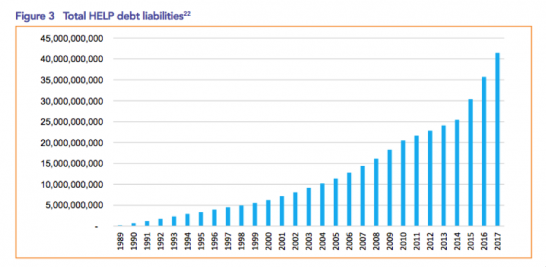
Incidentally, the change in the outstanding balance of Australia’s HELP is shown in Figure 1.
There is also the issue of the amount. According to the article above, the current average annual loan amount is ¥800,000.
As education becomes more advanced, education costs are expected to rise in the future [1], but this amount is nowhere near sufficient. To prevent people from abandoning plans for further education because they cannot afford tuition, the amount of support will also need to be expanded.
In any case, I believe this is a step in the right direction, so I intend to continue following the issue.
[1] At prestigious universities in the United States, tuition alone is said to cost about ¥5 million per year.
Related posts

OpenAI Launches Sign in with ChatGPT (Based on OpenID Connect)
(Work in progress; last updated 2026-10-02 12:39 JST) On September 29, at DevDay 2026, OpenAI officially announced Sign in with ChatGPT (SIWC). I would like to…

When Software Becomes Staff: Governance, Security, and Safety for Agentic AI
Below is the transcript of my keynote speech at EIC 2026 on May 19, 2026. The slides are provided as a PDF at the end of…
mDL/mdoc Standards Are Now Available to Access Free of Charge
As I shared in real time with those who follow me on X, standards related to mDL/mdoc are now available to access free of charge at…
You must be logged in to post a comment.