

There is a question of whether My Number should be kept secret. We have been discussing it here, and considering human behavior, a contrarian view has emerged that it might actually be better to make it public. If it is treated as a secret number, some people will inevitably use it as proof of identity, a credential, or a substitute for some other secret information. But a secret is inherently no longer secret if held by 2 or more parties, and My Number is naturally not secret either. Using it as proof of identity therefore makes identity theft more likely, as has become a major problem with SSNs in the United States. People will surely do this even if told not to and warned that it is a crime.
The idea, then, is that making it public outright might make accidents easier to prevent because nobody would use it as a substitute for a secret. There is some logic to that. It is paradoxical and probably difficult to accept, though.
The people proposing this are actually the same sort who promoted PPIDs, a method of issuing and using a different identifier for each site. Everyone speeds in a car, right? They do it even though they know it is illegal, because they believe they are safe. This would be the same: people will surely do it. To prevent it, either fit a speed limiter linked to the speed limit so the car cannot go faster, or make people understand deeply that it is dangerous. PPID was a movement to install the limiter, but everyone says, “Give me the email address too,” which essentially removes it. That is reality. So perhaps it would be better to make people understand the danger.
There is also the argument that “the U.S. example is merely sloppy operation, while Japan will explicitly prohibit it as a matter of institutional design, so everything will be fine.” But that already feels rather hopeless. It reflects a sense of powerlessness: explaining it and prohibiting it by law will still be futile. Even in the United States, it continues to be used in places where it is actually prohibited. Security and privacy are difficult to understand until one is actually burned. If the safety guard were removed and the blade left exposed, surely people would stop using it foolishly. Chile is apparently already like this: everyone knows other people’s national numbers, so nobody believes that being able to state one proves identity.
The practical risks under consideration appear to include (1) identity theft, (2) record matching, both across fields and over time, and (3) leakage. What would the risk profile of each be when benchmarked against the current situation? Advances in computing power have apparently already made substantial record matching possible even without a number—and some inaccuracy is acceptable for the relevant purposes—so introducing a number would not increase it dramatically. Nor does a number directly increase leakage risk. On the other hand, even if people are told not to verify identity using the number alone, foolish practices such as verifying with the number and date of birth will begin spreading. Identity theft therefore seems likely to face the greatest impact, and the discussion is about how to minimize it.
Ah, there was also (4) government surveillance. But with surveillance cameras and automatic license-plate recognition systems everywhere, would adding another number really increase the risk that much?
In that sense, this is a pessimistic—or cynical—response to the view that “at the institutional-design stage, we can prohibit using the number alone for identity verification and prevent problems by enforcing that prohibition.” The response is that “even if prohibited, people will surely do it, so enforcement can only occur after the fact.” Speeding and drunk driving have not been eliminated either, and enforcement ultimately occurs afterward. This way of thinking carefully observes the extent of human fallibility.
When designing institutions and systems, I hope we can create ones that gently accommodate such human shortcomings as well.
(Written in Orlando, Florida)
Related posts
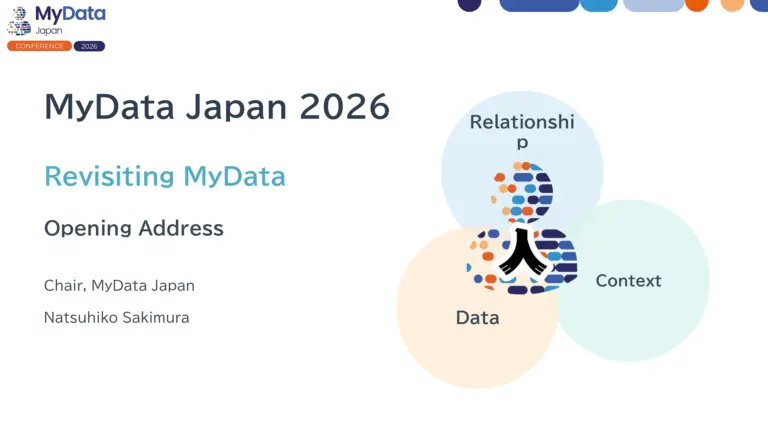
Data Sustains Lives—MyDataConference 2026 Opening Address
The following is the opening address for the MyData Japan Conference 2026, delivered by Nat Sakimura in his capacity as Chair of the General Incorporated Association…

The MyData Conference 2026 Is This Wednesday. See You at Hitotsubashi Hall!
I have been posting announcements on X every few days, and the MyDataJapan Conference 2026 is this Wednesday. There are many highlights: Naohiro Fujie, Representative Director…
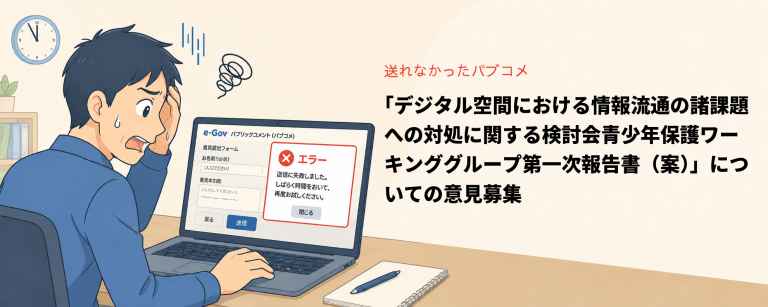
Unsubmitted Public Comment on the Call for Comments on the Draft First Report of the Youth Protection Working Group on Information Distribution in the Digital Space
July 823:59 was the deadline for the call for comments on the draft first report. I ended the FAPI WG early and23:40 began the submission process…