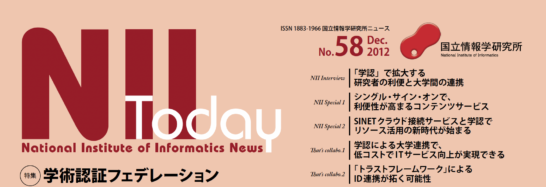
from NII Today: Academic Access Management Federation No.58 Dec. 2012
Overview of the Academic Access Management Federation
The Academic Access Management Federation (commonly known as GakuNin) is a nationwide federation designed to promote collaboration among universities. This innovative system uses single sign-on (SSO) technology to substantially improve university resource management and user convenience.
GakuNin’s greatest feature is that users can seamlessly access multiple services, including electronic journals and databases, with just one ID and password. This frees researchers and students from cumbersome login procedures and enables them to use academic resources more efficiently.
GakuNin began full-scale operation in 2009 and now includes 46 universities, making it a core part of Japan’s academic network.
The Convenience of Single Sign-On
The introduction of single sign-on (SSO) has dramatically changed how users access academic resources. Under conventional systems, users had to enter a different ID and password each time they accessed one of several services, but SSO has eliminated this inconvenience.
Particularly noteworthy is that university resources can now be accessed easily from off campus1. Researchers can therefore use important academic databases from home or while traveling, and students can access learning resources from off campus.
Furthermore, SSO provides not only convenience but also strong security. By centrally managing identity information at the university, it reduces the risk of personal information leaks and creates a more secure access environment.
New Possibilities through Integration with Cloud Services
Another important aspect of GakuNin is its integration with cloud services through SINET (the Science Information Network). This integration enables universities to use high-performance cloud services at low cost.
By integrating GakuNin with various cloud services provided by companies, universities can share resources and substantially reduce the cost of building and maintaining separate systems at each institution.
Shizuoka University and Kyoto University of Education have already built private clouds and begun operating them. These advanced initiatives serve as useful models for other universities.
The Importance of Trust Frameworks and International Collaboration
GakuNin’s reliability is supported by a trust framework. This framework ensures the reliability of user authentication and makes online services both safe and convenient to use.
GakuNin meets international reliability standards, allowing Japanese researchers and students to access overseas services with the same ID. This is a major advantage for international collaborative research and academic exchange.
Tools such as uApprove.jp also provide mechanisms for securely disclosing personal information based on the user’s explicit consent (selective attribute disclosure). This makes it possible to provide the necessary authentication information while protecting privacy.
Future Prospects and Challenges
As GakuNin becomes more widespread, international collaborative research and regional partnerships are expected to develop further. Easier collaboration among multiple universities and research institutions should make more complex and extensive research projects possible.
Challenges remain, however. Authentication infrastructure must be improved, and more universities—especially private universities—need to participate. Currently, 46 universities participate, but given that Japan has more than 700 universities, considerable room for wider adoption remains.
GakuNin can enable a broad range of services extending beyond education and research to areas such as student welfare. New services that benefit both students and researchers are anticipated, including reciprocal library access among multiple universities and the sharing of jointly developed educational content.
The Academic Access Management Federation will likely continue to develop as essential infrastructure for advancing the digitization and efficiency of higher education and research in Japan.
For more details, please see “NII Today: Academic Access Management Federation”.
NIIToday_58Footnotes
- Previously, access was controlled by on-campus IP addresses, so resources could only be accessed from within the university.
Related posts
When Software Becomes Staff: Governance, Security, and Safety for Agentic AI
Below is the transcript of my keynote speech at EIC 2026 on May 19, 2026. The slides are provided as a PDF at the end of…
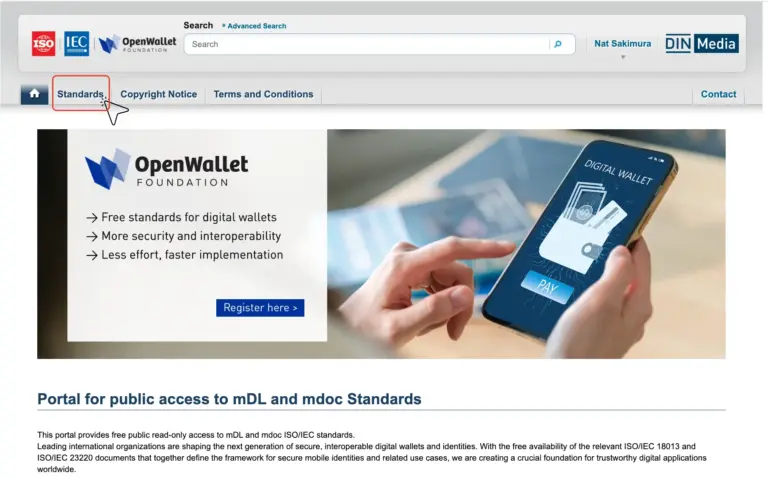
mDL/mdoc Standards Are Now Available to Access Free of Charge
As I shared in real time with those who follow me on X, standards related to mDL/mdoc are now available to access free of charge at…

IPA’s Mr. Tsuda Receives FORBES Japan’s “30 Under 30” Award
Mr. Tsuda of IPA, whom I think is one of the ID geeks, has been selected for FOEBES JAPAN 30Under30 2026. He is the second member…