

This March 13, on the 14th, the following workshop will be held at NIST in the United States. I will also appear as a panelist.
2012 NSTIC/IDtrust Workshop: “Technologies and Standards Enabling the Identity Ecosystem”
March 13-14, 2012
NIST – Administration Building – Green Auditorium – Gaithersburg, MD
| 8:45 am | Welcome – NSTIC GoalsJeremy Grant, NIST |
| 9:15 am | Level – Setting: “An Introduction to the 3rd Epoch of IDtrust”Ian Glazer, Gartner |
| 9:30 am | Keynote-Mapping the Global IDentity EcosystemSpeakers: Karen O’Donoghue, ISOC and Lucy Lynch, ISOC |
| 10:00 am | Panel: Gaps and Challenges for Advancing the Global Identity Ecosystem
Moderator: Lucy Lynch, ISOC Panelists: · Tom Smedinghoff, Edwards Wildman Palmer LLP · John Bradley, OpenID Foundation · Ken Klingenstein, Internet2 · Leif Johansson, NORDUnet · Nat Sakimura, NRI / OpenID Foundation |
I alone was added at the last minute [1], so this has not yet been reflected on the Web Site …
Still, it is always the same sort of group…
Now, what should I talk about?
Possible topics include:
- Differences between consent principles in the United States and Europe: while the EU Data Protection Regulation requires “Explicit Consent,” under the U.S. Consumer Privacy Bill of Rights, implicit consent is acceptable when it is clear from the context.
- What is “meaningful consent”?
- Is it “Data Protection” or “Privacy Protection”?
- Level of Protection, Level of Control.
- The “right to be forgotten” and the “right to reverse consent”
- How realistic is being forgotten (data deletion)?
- Provider Linkability and Consumer Linkability [2]
- Cross-border data issues
- Business models for providing authentication and attribute data: Pareto improvement
and so on.
If you have any suggestions, please let me know in the comments.
[1] I had been approached quite early, but because of scheduling and other matters, it was only yesterday that my trip to the United States was finally decided.
[2] It is a privacy violation when different service providers collude, link users’ information without permission, and create an arbitrary image of them. On the other hand, having users themselves centrally manage what information they provide and where (which necessarily requires linking) can be said to be essential for controlling their own image.
Related posts
NSTIC Webcast to Be Held on August 2
On August 15 and 16, the 1st NSTIC plenary meeting will be held in Chicago. Before the meeting, a preparatory webinar for participants will be held…
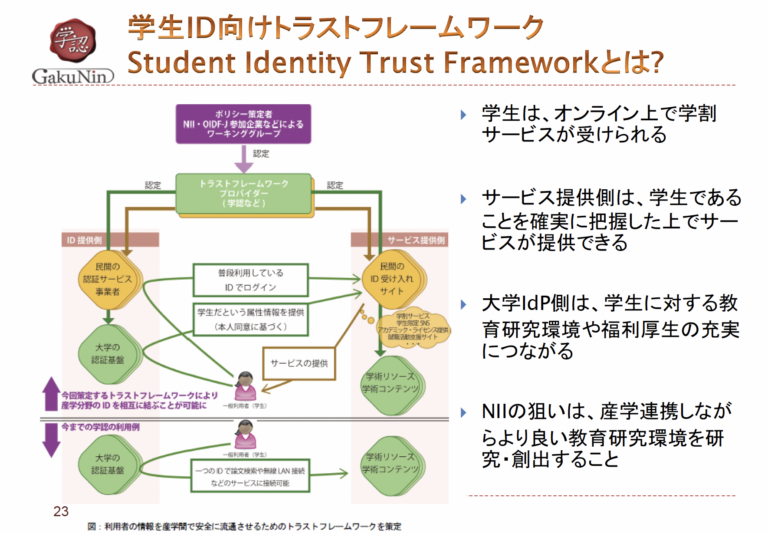
Overview and Future Outlook of the Student ID Trust Framework
On May 17, 2012, the OpenID Foundation Japan Student Identity Trust Framework WG held “Trust Framework Seminar vol. 2: Use Student IDs to Provide Online Student-Discount…
NIST SP800-63-4 (Final) Was Published on August 1
The final version of the NIST SP800-63-4 Digital Identity Guidelines, which identity professionals had been eagerly awaiting, was finally published on 8/1. There are quite a…