
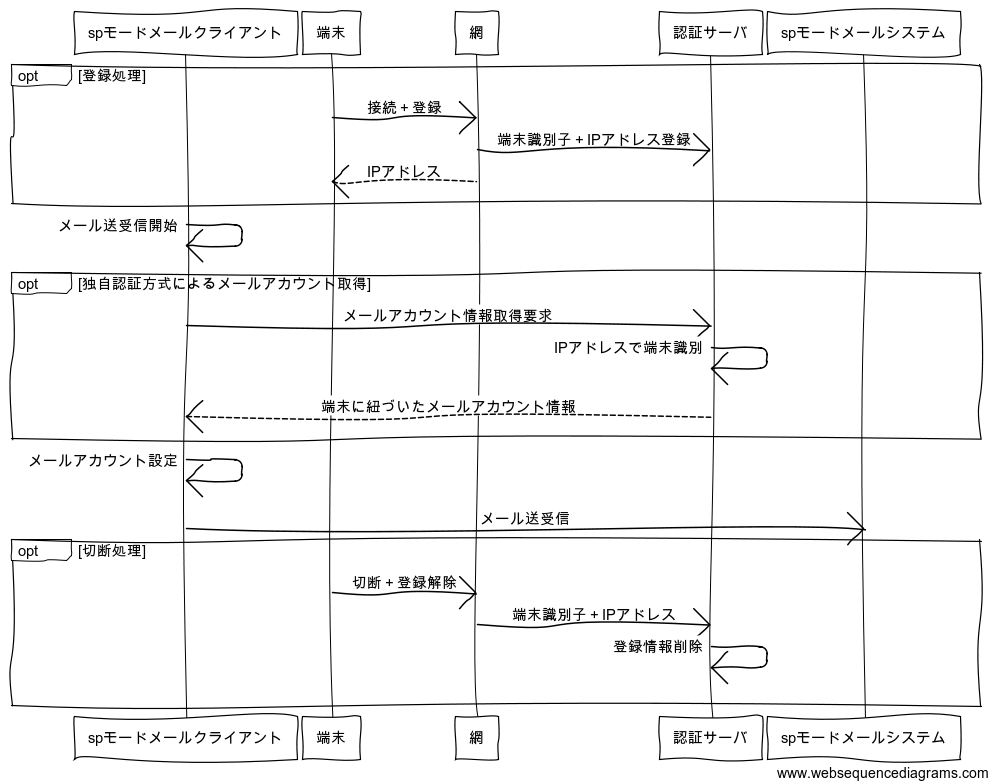
The sp-mode mail problem—the one in which email addresses were switched—has become a hot topic. I could not fully understand it just by reading the articles, so I drew a diagram while referring to sources including NTT DOCOMO Technical Journal Vol. 18 No. 3, Technology Report [1]. Incidentally, “network” here refers to the sp-mode network.
Obtaining an email account using a proprietary authentication method apparently means:
(1) authenticating through a proprietary method that the email application is an official one; and
(2) obtaining user information through an sp-mode connection.
However, I do not know the details. I have a feeling that the key to this incident lies somewhere around here, but I wonder if that is right. In the diagram above, I have shown user authentication over the sp-mode connection as being performed using the IP address. This is an inference based on what I have read in articles and elsewhere. If that is how it works, the present incident can occur: if the registration and disconnection processes do not complete properly, the email address of the person who previously used that IP address gets configured on the device.
If so, that is quite bad. Some have pointed out that the problem was a failure to handle errors properly, but even before that, the authentication design is fundamentally flawed.
Why It Is Flawed
- A reused identifier—an IP address—is used to identify the user.
- Moreover, it is used not only as a user identifier but also as an access token.
First, using an identifier that is not reused as the user identifier is one of the most basic principles. This is why even protocols with a relatively low security level, such as OpenID 2.0, distinguish between the identifier entered by the user and the identifier the system uses for authentication.
But even if we concede 100 steps and say that this is acceptable, the second point remains.
Point 2 is far too problematic by any standard. An access token must always be unique. If you make it reusable, a later user can impersonate the previous user[2]. (Oh—that is what happened this time.)
I assume that something this foolish did not actually happen, so I would very much like the details to be disclosed. Security becomes dangerous when it is not handled openly.
[1] Naofumi Yoshinaga et al., “Smartphone New Services and Features in 2010 — sp-mode Mail Service”
[2] At the registration stage, the system should instead create a token signed over the user identifier, the party authorized to exercise it (audience), its validity period, a nonce, and other data, and give that token to the client. It should then use the token for authentication. That way, a change in the IP address would cause no problem.
Reference Articles
- Important: DOCOMO Suffers sp-mode Outage; Problems Include Email Addresses Being Incorrectly Set or Displayed as Other Addresses, Prompting Temporary Suspension of Many sp-mode Services (2011/12/21)
- A Certain Engineer’s Musings — The SP-mode Mail Outage Was a Design Error
- “Unthinkable” Possibility of Personal Information Leakage—DOCOMO Explains the sp-mode Malfunction — ITmedia +D Mobile (2011/12/21) ← This is written as though the issue were that an email address is personal information and that it was leaked, but the substance of the incident is far more serious. It seems to confuse personal information protection with privacy protection.
- DOCOMO Resolves Bug That “Changed Email Addresses to Someone Else’s”—100,000 People Affected — Keitai Watch
Related posts
Data Sustains Lives—MyDataConference 2026 Opening Address
The following is the opening address for the MyData Japan Conference 2026, delivered by Nat Sakimura in his capacity as Chair of the General Incorporated Association…

The MyData Conference 2026 Is This Wednesday. See You at Hitotsubashi Hall!
I have been posting announcements on X every few days, and the MyDataJapan Conference 2026 is this Wednesday. There are many highlights: Naohiro Fujie, Representative Director…
Unsubmitted Public Comment on the Call for Comments on the Draft First Report of the Youth Protection Working Group on Information Distribution in the Digital Space
July 823:59 was the deadline for the call for comments on the draft first report. I ended the FAPI WG early and23:40 began the submission process…