
Liberty, Equality, Fraternity[1] (Liberté, Égalité, Fraternité) is known as the slogan of the French Revolution and became an official motto around the time of the Third Republic (1870–). Before it became official, however, Les Misérables, written in 1862, included a remarkably stirring speech that the revolutionary Enjolras gives at the barricade just before he is killed in the suppression. I am noting it here.
From the political point of view, there is only one principle—namely, the sovereignty that man possesses over himself. This sovereignty of the self over itself is called Liberty. The state begins where two or more such sovereignties unite. Yet this union entails no diminution of rights. Each individual sovereignty yields a certain portion of itself solely to create a common right. That portion is equal for every person. The identical concession that each person makes to all is called Equality. The common right is nothing other than the protection of all shining upon the right of each. This protection of all over each is called Fraternity. The point where all the sovereignties joining together intersect is called Society. This intersection is a junction, and its point is a knot. Thus the social bond arises. Some call it the social contract, but the two are the same thing: even etymologically, the word contract is formed from the idea of a bond.
(Partially retranslated to more closely reflect the original, based on Aozora Bunko.)
The passage then goes on to explain further that the concept of equality does not mean equality of outcomes—although that is already clear from the passage above—and describes equality of educational opportunity as a concrete measure for achieving equality.
Incidentally, the original French even rhymes and sounds incredibly impressive.
Au point de vue politique, il n’y a qu’un seul principe—la souveraineté de l’homme sur lui-même. Cette souveraineté de moi sur moi s’appelle Liberté. Là où deux ou plusieurs de ces souverainetés s’associent commence l’État. Mais dans cette association il n’y a nulle abdication. Chaque souveraineté concède une certaine quantité d’elle-même pour former le droit commun. Cette quantité est la même pour tous. Cette identité de concession que chacun fait à tous s’appelle Égalité. Le droit commun n’est pas autre chose que la protection de tous rayonnant sur le droit de chacun. Cette protection de tous sur chacun s’appelle Fraternité. Le point d’intersection de toutes ces souverainetés qui s’agrègent s’appelle Société. Cette intersection étant une jonction, ce point est un nœud. De là ce qu’on appelle le lien social. Quelques-uns disent contrat social, ce qui est la même chose, le mot contrat étant étymologiquement formé avec l’idée de lien. (Victor Hugo, Les Misérables Tome V Chapitre V)
When considering actual policies and laws, too, I believe they should be formulated on the basis of firmly held principles such as these. Policies and laws without principles may seem sound at the time, but they give rise to various problems later. I think Japan tends to treat such principles relatively lightly. Instead of dismissing them as naïve idealism, should we not engage with principles more seriously?
[1] In Japan, this is also often translated as “universal love,” but because the word derives from the Latin frater (brother), it should properly be translated as “brotherly love,” or at least “fraternity.”
Related posts
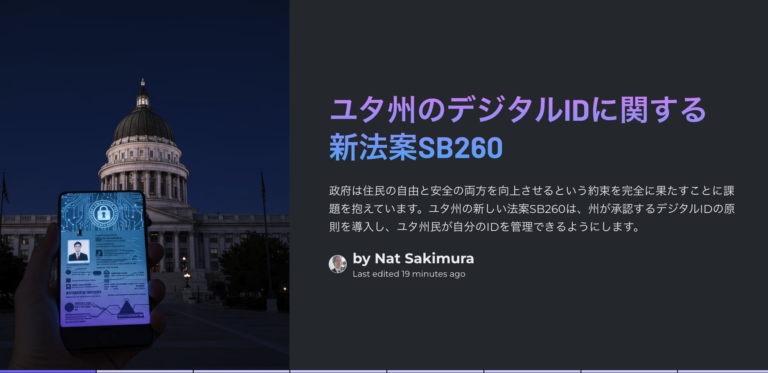
Anyone Who Thinks Identity Is Given by the State or Government Should Sit Up and Read This: Utah Digital ID Bill SB260 and the Transformation Brought by a User-Centric Digital ID System
As digital technology evolves, our dependence on personal information and data continues to grow. Yet many government-provided ID systems do not always give sufficient consideration to…

The Provider Liability Limitation Act Has Become the Information Distribution Platform Act (May 10)
Following deliberations by the Ministry of Internal Affairs and Communications’ Study Group on Platforms, of which I was also a member, the amended “Provider Liability Limitation…

MyData Japan submitted comments in response to the public consultation on the “Order Partially Amending the Regulation for Enforcement of the Act on Certification Business of the Japan Agency for Local Authority Information Systems Pertaining to Electronic Signatures, etc.”
In response to the public consultation announced on January 26 regarding the "Draft Order Partially Amending the Regulation for Enforcement of the Act on Certification Business…