
In view of the fact that many municipal offices have ceased functioning due to the off the Pacific coast of Tohoku Earthquake (Great East Japan Earthquake), the Residents System Division of the Local Administration Bureau at the Ministry of Internal Affairs and Communications has issued “Handling of Basic Resident Registration Operations Related to the off the Pacific coast of Tohoku Earthquake and Other Disasters (Notice)”. It states:
・Prefectures should appropriately use identity verification information held by the Basic Resident Registration Network, such as names and addresses, for checking residents’ safety and performing urgent administrative work for disaster victims, when provided for by prefectural ordinance.・When a person moves in from a disaster-affected municipality that cannot issue a moving-out certificate, the receiving municipality should have the resident report their name, address, date of moving in, date of birth, family-register details, and other information, and accept the moving-in notification by using identity verification information held by the Basic Resident Registration Network.
This is a step forward, as it enables disaster victims to move their residence registration to another municipality.
However, I believe this alone will create several issues in the future. For example:
- [P1] Because disaster victims may move among various municipalities, relying on the address in the Basic 4 Information, even though it is unsuitable as contact information, will eventually increase costs.
- [P2] Because disaster victims’ 4 Information has already been exposed, impersonation is extremely easy. If someone impersonates a survivor, the duplicate registration will eventually become apparent and the fraud will likely be discovered then. But if someone assumes the identity of a deceased victim, there is a substantial likelihood that nothing can be done. (An example of exposed 4 Information)
- [P3] When impersonation results in duplicate registrations for a living person, it is difficult to determine which registration is legitimate.
- [P4] Receiving municipalities will presumably provide public assistance and similar support for the time being, but naturally they have not budgeted for this (*1). The national government must provide aid for disaster victims, but subsequent administration will be difficult unless victims are issued something like a disaster victim certificate.
- [P5] Delivering financial assistance to disaster victims will become difficult. (Example: Disaster victim support payments: only 14% deposited as processing falls behind @47News)
- [P6] Fear that leaving a shelter or the local area will make assistance unavailable will discourage relocation from shelters, delaying the rebuilding of people’s lives.
- [P7] Fear of the collapse of local communities will also discourage those who wish to move away.
- And so on.
Considering all of this, merely enabling people to transfer their residence registration to a new municipality is not enough. Disaster victims need to be issued a qualification credential in the form of a disaster victim certificate. Naturally, this also requires a database (registry). A disaster victim certificate does not have to be on paper. It would be sufficient if it could be obtained online after leaving the disaster area.
The workflow would be as follows.
1. Prepare in advance a database (registry) capable of storing the following items (*2).
- Name*
- Date of birth*
- Sex*
- Facial photograph* (*4)
- Address on the resident record at the time of the disaster* (plus postal code)
- Email address (Because addresses will keep changing, they are not useful as contact details. If a person does not have an email address, issue one on the spot. Use it as the temporary identifier thereafter.)
- Mobile phone number and home telephone number at the time of the disaster
- Password (used later to review registration details and for similar purposes)
- Guardian (especially for minors; primarily a parent in the case of a minor)
- Whether an identity document was verified
- Type of identity document
- Registration officer
- Date and time of registration
- Place of registration
If the registration operation can handle the workload, the following information would also be useful.
- Names and safety status of family members
- Names and contact details of people the victim wishes to contact
- History of evacuation destinations
2. Create a registration system for the database above. The registration process would be as follows.
- Access the system from a device
- Authenticate the device and its user/operator
- Enter the required information on the displayed screen
Something at this level could be built very quickly, and could even be used from a mobile phone.
3. Train registration officers. The training need only cover the minimum essentials, such as taking photographs, using the system, and the code of ethics.
4. Begin registration in disaster areas or at locations where disaster victims gather. Conducting it at locations where victims gather is extremely important. As stated in “Disaster Victim Credentials Are Urgently Needed”, a gathering place for disaster victims makes mutual authentication between individuals within the local community possible. Once people have dispersed outside the community, this becomes extremely difficult.
5. Collect the data in batches and check it for consistency against the Basic Resident Registration Network and similar sources (*3). If it does not match, contact the person using the collected contact information and temporarily suspend the relevant disaster victim certificate.
Disaster victims have already begun dispersing throughout the country (*5). Unless this is started as soon as possible, I fear it will become very difficult later on….
(*1) In the short term, receiving destinations will likely emerge, as in the 3/19 relocation of residents of Futaba, Fukushima Prefecture, to Saitama City. However, even this arrangement only lasts through March for now, and what comes afterward is unclear.
(*2) This merges Mr. @manabou’s “Supporting Disaster Victims through E-Government and Using Disaster Victim Support Systems” with material the author had written separately.
(*3) It would simplify matters if data from the Basic Resident Registration Network could be used from the outset, but that will probably be difficult in the short term.
(*4) In these circumstances, it is unrealistic to ask elderly people and others to remember passwords or use IC cards. When someone has relocated with nothing but the clothes they are wearing, the “face” is an important means of verifying their identity. It is therefore important to obtain a facial photograph and record it in the database. Moreover, because records are created in connection with the disaster-affected community, if doubts arise about possible impersonation, the photograph can be shown to people from the same community for confirmation. Hashed DNA may also merit consideration once the technology has stabilized. It would be especially useful for identifying people who have died. With facial photographs alone, bereaved families could be forced to examine many bodies. A DNA-based method would be far kinder to survivors. However, questions remain open for discussion, including whether there is general social consensus for collecting and storing such information in a database and how its extension to the entire population could avoid being unconstitutional.
(*5) There is still time because relocation currently takes place by shelter or community. Particular caution will be required once people begin to disperse.
Revision History
I wrote this under severe time constraints due to various circumstances, and omitted many things I had initially intended to include, so I am adding them gradually.
- 2011/3/19 Added information about hashed DNA as (*4)
- 2011/3/25 Added information about mutual authentication within local communities. Also expanded (*4) to explain the significance of facial photographs and added discussion of legal concerns regarding such a database.
- 2011/5/28 Added P5-P7
Related posts
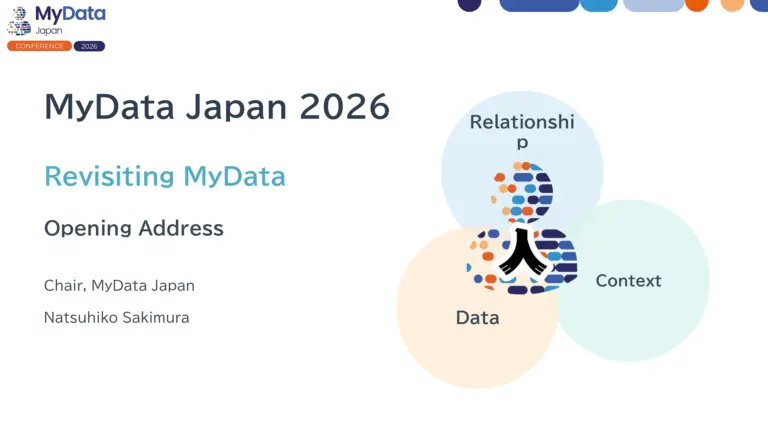
Data Sustains Lives—MyDataConference 2026 Opening Address
The following is the opening address for the MyData Japan Conference 2026, delivered by Nat Sakimura in his capacity as Chair of the General Incorporated Association…

The MyData Conference 2026 Is This Wednesday. See You at Hitotsubashi Hall!
I have been posting announcements on X every few days, and the MyDataJapan Conference 2026 is this Wednesday. There are many highlights: Naohiro Fujie, Representative Director…
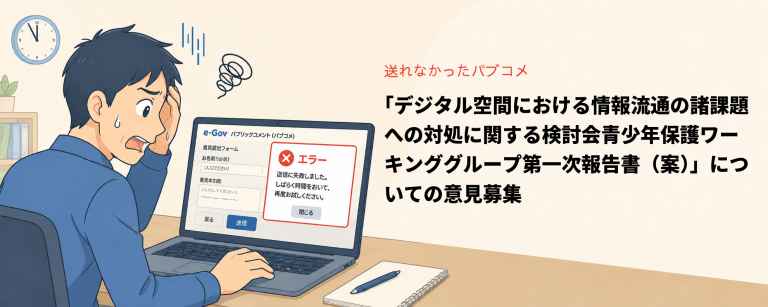
Unsubmitted Public Comment on the Call for Comments on the Draft First Report of the Youth Protection Working Group on Information Distribution in the Digital Space
July 823:59 was the deadline for the call for comments on the draft first report. I ended the FAPI WG early and23:40 began the submission process…