
Today is the day of the GIE symposium “Considering National ID,” but the opening speech in the panel discussion is only 5 minutes long. In 5 minutes I have no choice but to narrow down what I say drastically, leaving no time to discuss first principles. I will speak about only a small part of the subject in the flow of the presentations by the panelists before and after me. Since that does not mean I consider only that part important, I thought I would summarize the broader picture here.
First, to begin the discussion, we must define a “national ID system.” We can define what the government intended by analyzing the national ID system on the basis of the document announced on May 11 this year that was one of the sources of the term, the “New Information and Communications Technology Strategy”.
I will quote it below.
I. Basic Understanding
The essence of the information and communications technology revolution is a revolution in information sovereignty. A transition from a society led by government and providers to one led by citizens as taxpayers and consumers requires greater transparency through thorough disclosure of information, and information and communications technology has a major role to play in achieving this.
In a citizen-led society, knowledge and information are shared at the civic level, enabling a transition to a new “knowledge and information society” and dramatically improving citizens’ quality of life.
This information and communications technology strategy (IT strategy) is not an extension of past IT strategies. It is a strategy focused on priority strategies (3 pillars) that support a discontinuous leap toward establishing a new society of popular sovereignty. Together with the separately formulated New Growth Strategy, it should also support Japan’s sustainable growth.Accordingly, in implementing the strategy, the causes of the ineffectiveness of related policies to date will be thoroughly investigated. Concrete coordination will be advanced between policies other than the IT strategy, among relevant ministries and agencies, between the national and local governments, and between government and the private sector, and the entire nation will vigorously promote the early establishment of a new society of popular sovereignty.
II. 3 Pillars and Objectives
From the perspective of “popular sovereignty,” the government will first carry out a thorough information and communications technology revolution within government to realize citizen-oriented electronic administration. In addition, through the comprehensive use of information and communications technology, it will restore local community ties, create new markets, and pursue international expansion.
1. Realizing Citizen-Oriented Electronic Administration
○ By 2020, citizens will be able, as needed, to complete major application procedures and obtain certificates closely related to everyday life from home, the office, or other places outside government service counters, 7 days a week, 24 hours a day, through a one-stop process. As part of this, by 2013, at least 50% of citizens will be able to use services through government kiosk terminals installed in convenience stores, government agencies, post offices, and other locations.
○ By 2013 in the national government, and by 2020 in at least 50% of local governments, fair and convenient electronic administration will be implemented efficiently and without waste, allowing citizens to monitor government and control information about themselves, so that citizens can experience greater visibility and renewal in government.
○ By 2013, with due consideration for personal information protection, government information will be disclosed in a form permitting 2-stage use and, in principle, all such information will be readily obtainable over the Internet, enabling citizens to experience open government.
The national ID system is included under this “Realizing Citizen-Oriented Electronic Administration.”
Incidentally, the remaining 2 pillars are:
2. Restoring Local Community Ties
3. Creating New Markets and Pursuing International Expansion
However, since these do not relate directly to the definition of the national ID system, I will skip them here.
Let us quote the document again.
III. Strategies by Field
1. Realizing Citizen-Oriented Electronic Administration
(1) Administrative Renewal and Visibility Using Information and Communications Technology
【Priority Measures】
○ Identify frequently used government services for which availability 7 days a week, 24 hours a day would provide substantial benefits to citizens (for example, obtaining certificates such as certificates of residence, seal-registration certificates, and family-register certificates), and make them available online or offline, including through cooperation with the private sector (for example, through government kiosk terminals).
○ To increase confidence in social security and operate it in an integrated manner with taxation, establish a so-called national ID system usable for both public- and private-sector services as a common foundation for electronic administration. At the same time, establish institutions and systems in the national and local governments that enable individuals to monitor and control the use of information about themselves.
○ Establish a government CIO as a command center with substantive authority to advance electronic administration, and promote administrative efficiency in coordination with administrative renewal. As a prerequisite, review the cost-effectiveness of past government investments in information and communications technology and organize the lessons learned. On the basis of those lessons, when advancing electronic administration, including the measures above, intensively review operations (administrative renewal) in areas with high cost-effectiveness and then establish a common information and communications technology infrastructure. The use of cloud computing and coordination of corporate codes will also be undertaken as part of this effort.
At last, the term “national ID system” appears.
This section (1), Administrative Renewal and Visibility Using Information and Communications Technology, is to be implemented through:
i) Formulating basic policy for advancing electronic administration
ii) Formulating a plan for the online use of government services
iii) Fundamental reform of government portals and improved access to government services
iv) Introducing a national ID system and establishing mechanisms for citizens to monitor government
v) Integrating and consolidating government information systems
vi) Realizing nationwide common electronic government services
vii) Utilizing the “forum for consultation between the national and local governments”
Only under “iv) Introducing a national ID system and establishing mechanisms for citizens to monitor government” are the details of the national ID system finally described.
iv) Introducing a National ID System and Establishing Mechanisms for Citizens to Monitor Government
While ensuring consistency with consideration of a common number for social security and taxation, a national ID system will be introduced by 2013 as a common foundation for electronic administration that ensures personal information protection and enables data coordination among ministries, agencies, and local governments. In conjunction with this, a third-party body will be established to monitor operations and access by government agencies, and public IC cards will be reorganized and rationalized. The possibility of coordination with private-sector IDs will also be considered to provide convenient services over the Internet. Furthermore, appropriate use of information by government agencies will be promoted so that, in principle, information already held by government agencies need not be entered or attached when applying for various government procedures, and a mechanism will be established through which citizens can confirm the contents of information about themselves held by government agencies. 【Cabinet Secretariat; Ministry of Internal Affairs and Communications; Ministry of Finance; Ministry of Education, Culture, Sports, Science and Technology; Ministry of Health, Labour and Welfare; Ministry of Economy, Trade and Industry; etc.】
From the above, the national ID system can be defined as follows.
【Definition】The national ID system is a common foundation for electronic administration that, while ensuring consistency with consideration of a common number for social security and taxation, ensures personal information protection and enables data coordination among ministries, agencies, and local governments. It is also an institution and system that allows individuals to monitor and control the use of information about themselves by national and local governments.
The purpose of the national ID system can also be summarized as follows.
【Vision】Shift information sovereignty from government and providers to citizens as taxpayers and consumers, realize a transition to a new “knowledge and information society” through the sharing of knowledge and information at the civic level, and dramatically improve citizens’ quality of life.
The basic means of realizing this is:
【Strategy】Transparency through thorough disclosure of information
The action for achieving this is “1. Realizing Citizen-Oriented Electronic Administration,” which is to be pursued through (1) Administrative Renewal and Visibility Using Information and Communications Technology and (2) Establishing Open Government and Related Measures.
【Action】
1. Realizing Citizen-Oriented Electronic Administration
(1) Administrative Renewal and Visibility Using Information and Communications Technology
(2) Establishing Open Government and Related Measures
Accordingly, the requirements for a national ID system can be summarized as follows.
Requirements for a National ID System
- A national ID system must reverse information sovereignty, shifting it from a society led by government and providers to one led by citizens as taxpayers and consumers. (This is the fundamental policy. Anything contrary to it is unacceptable even if it satisfies any of the requirements below.)
- A national ID system must enable data coordination among ministries, agencies, and local governments.
- A national ID system must thoroughly protect personal information.
- A national ID system must be an institution and system that allows individuals to monitor and control the use of information about themselves by national and local governments.
- When implementing a national ID system, a third-party body must be established to monitor operations and access by government agencies.
- When implementing a national ID system, public IC cards shall be reorganized and rationalized.
- When implementing a national ID system, the possibility of coordination with private-sector IDs shall be considered in order to provide convenient services over the Internet.
- A national ID system must promote the appropriate use of information by government agencies so that, in principle, information already held by government agencies need not be entered or attached when applying for various government procedures.
- A national ID system must establish a mechanism through which citizens can confirm the contents of information about themselves held by government agencies.
Having organized all of this, perhaps today’s discussion will be a little easier?
(To be continued…)
Related posts
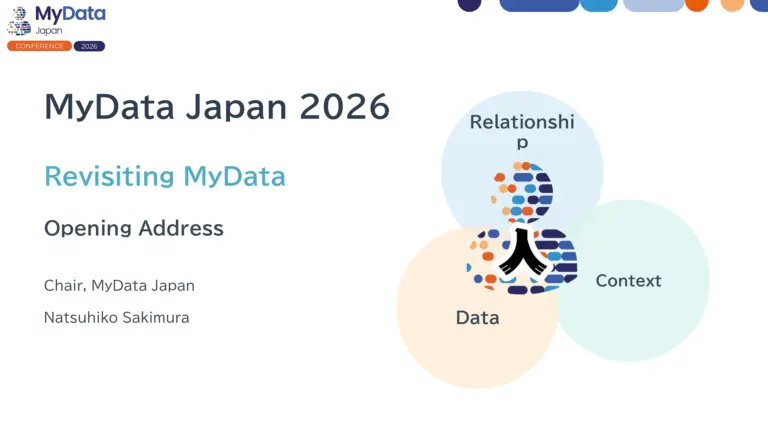
Data Sustains Lives—MyDataConference 2026 Opening Address
The following is the opening address for the MyData Japan Conference 2026, delivered by Nat Sakimura in his capacity as Chair of the General Incorporated Association…

The MyData Conference 2026 Is This Wednesday. See You at Hitotsubashi Hall!
I have been posting announcements on X every few days, and the MyDataJapan Conference 2026 is this Wednesday. There are many highlights: Naohiro Fujie, Representative Director…

Unsubmitted Public Comment on the Call for Comments on the Draft First Report of the Youth Protection Working Group on Information Distribution in the Digital Space
July 823:59 was the deadline for the call for comments on the draft first report. I ended the FAPI WG early and23:40 began the submission process…