 A new organization, the Kantara Initiative, which aims to serve as a “bridge” between identity technologies and organizations, has been officially launched.
Kantara means “bridge” in Swahili. It derives from an Arabic word meaning “harmony.”
I proposed the name at the founders’ meeting in February, and it was later formally adopted through a vote. When I proposed it, my hope was that citizen-centric systems would achieve broader adoption by building bridges among the various identity-related organizations and standards and bringing them into harmony.
Now, the Kantara Initiative (KI) has several major distinguishing features.
(1) Participation in work groups is free
OASIS Open has a well-developed environment, and it is relatively easy to create a new working group. Personally, I think it is close to the ideal model, but there is one issue: participation requires a fee. Consequently, even when an expert in the field agrees to participate after being invited, they may ultimately be unable to do so. Because participation in KI is free, this problem does not arise.
(2) Bicameral system
It also has a major distinguishing feature in terms of governance: unusually for an organization of this kind, it adopts a bicameral system. KI calls the two bodies the Leadership Council and the Board of Trustees.
KI’s principal matters are decided by its work groups, in which participation is free. The Leadership Council is a deliberative body composed of representatives from each work group, and it also prepares such things as budget proposals. It is, so to speak, an executive board. In terms of the British system, it might be called the House of Commons.
Meanwhile, the Board of Trustee (board of directors) consists of representatives of sponsoring companies that provide funding at the trustee level and 2 representatives of the Leadership Council. Its principal function is compliance. It also oversees the organization’s administrative machinery, including the secretariat. It is, so to speak, the audit committee of a company with committees. In terms of the British system, it is the House of Lords.
This structure was adopted to give the people who actually carry out the work the greatest possible authority while ensuring that their time would not be consumed by the organization’s day-to-day administration and compliance. Another major benefit of this separation is that sponsoring companies are prevented from interfering unnecessarily in the activities.
I proposed this at the Stockholm meeting in July 2008, where it was adopted.
I believe there are very few examples of international organizations of this kind whose organizational structure and name are both based on proposals from Japan. In that respect, I think we have every right to be proud. It can be called a good start.
However, what truly matters is the work from here onward.
The question going forward will be how much of a presence Japan can establish through these activities.
Since participation is free, I hope people from Japan will also take an active part in the work group activities.
If you have an idea such as “I would like to do something like this,” please do contact me.
Related posts
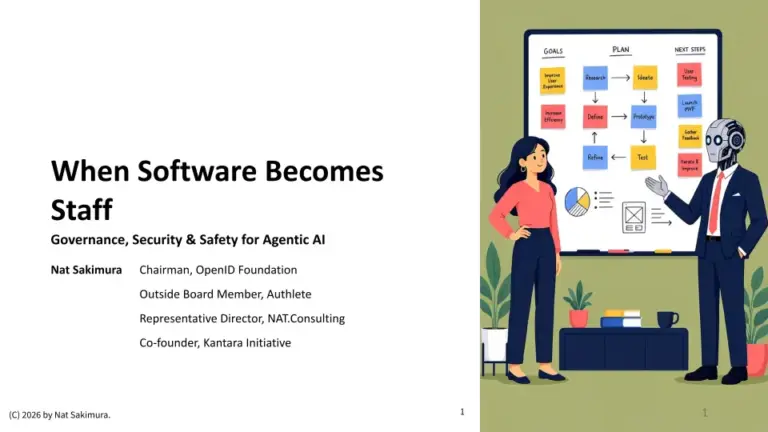
When Software Becomes Staff: Governance, Security, and Safety for Agentic AI
Below is the transcript of my keynote speech at EIC 2026 on May 19, 2026. The slides are provided as a PDF at the end of…
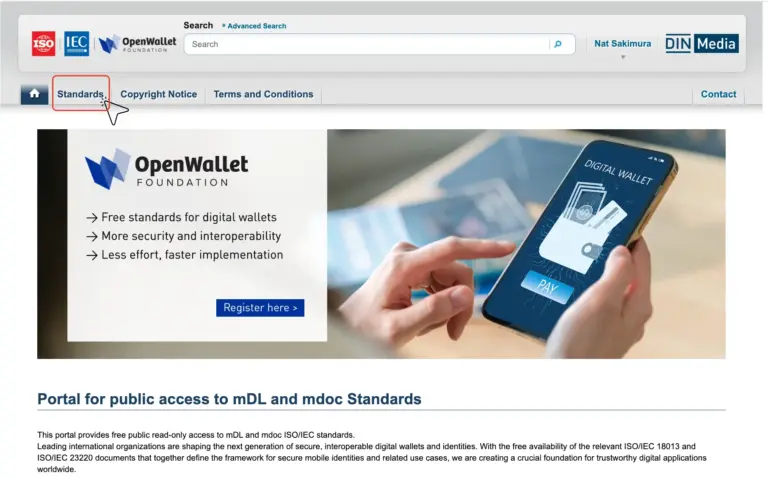
mDL/mdoc Standards Are Now Available to Access Free of Charge
As I shared in real time with those who follow me on X, standards related to mDL/mdoc are now available to access free of charge at…

IPA’s Mr. Tsuda Receives FORBES Japan’s “30 Under 30” Award
Mr. Tsuda of IPA, whom I think is one of the ID geeks, has been selected for FOEBES JAPAN 30Under30 2026. He is the second member…