
- What is a CIO?
- Are CIOs quickly fired?
- What CIO-related materials are available?
I have briefly summarized them below.
Q.1 What is a CIO?
A CIO has generally been understood as the senior executive responsible for a company’s information technology and systems. In fact, CIOs were once often an extension of the head of information systems and primarily held technical posts. In recent years, however, that situation has been changing, with greater emphasis placed on Information than on Technology. Typically, a head of information systems (VP of IT) or similar officer serves beneath the CIO, though some organizations have begun appointing a Chief Technical Officer (CTO) as the executive responsible for technology. Instead, the CIO has become a post requiring a deep understanding of the essence of the business, including which system investments should be made to improve its flow. It is no longer unusual for CIOs to come from a power-user background rather than a technical profession.
Within the company hierarchy, the CIO often reports to the CEO, COO, or CFO, frequently sits on the board, and is often positioned above the CTO. In some companies, it has become relatively uncommon for the CEO to hear directly from the CTO; information instead comes through the CIO. In such cases, the CIO receives technical support from people with engineering backgrounds, such as a Chief Telecommunication Officer and Chief Technology Architect. In that sense, the meaning of CIO has evolved, and one might say that yesterday’s CIO is today’s CTO. Beyond this model, there are many other divisions of responsibility between CIO and CTO, such as “the CIO handles internal systems while the CTO pursues business applications of technology,” and no consensus has been reached. Gartner’s definition of a CIO, however, is close to the model described above.
Gartner’s Definition of a CIO
CIO Mission
To provide vision and leadership for IT development and implementation initiatives needed to maintain a competitive advantage in a constantly changing corporate environment.
Reporting
Reports to a senior executive (CEO, COO, or CFO). A senior manager responsible for IT policy itself and for aligning IT strategy with business strategy. The typical title is “Vice President and Chief Information Officer.”
Areas of Responsibility
- Business technology planning: sponsor the collaborative planning process
- Application development: develop existing and new applications at the enterprise level and coordinate development among departments at the departmental level
- IT infrastructure and architecture (computers, networks, etc.): ensure appropriate investment in new installations and existing components
- Resource procurement: decide whether to “build or buy” and “outsource or provide in-house”
- Partnerships: establish strategic partnerships with key IT suppliers
- Technology transfer: provide technologies that make it easier and more profitable for customers and vendors to do business with the company
- Customer satisfaction: maintain contact with internal and external users and continuously ensure their satisfaction
- Training: provide training to ensure effective use of existing and new systems
Qualifications Required of a CIO
- A deep understanding of the company’s business.
- Experience demonstrating the ability to deliver business-required capabilities through IT while managing costs and risks.
- Experience judging whether new technologies can be applied to the business.
- The ability to understand and communicate effectively with nontechnical users within the company.
- Skill in managing organizations, including centralized IS resources and applications, while coordinating resources and initiatives across departments.
- The ability to develop concepts for multiple simultaneous IT projects, launch them, and cut them over by their deadlines.
- The ability to fit into existing management, be a good listener, and serve as an eloquent advocate for the IT vision.
Q.2 Are CIOs quickly fired?
 It is commonly said that CIO tenures in the United States are very short, at 2–3 years. However, a survey conducted in 96 shows that this is not necessarily true. According to a joint survey by CIO Magazine and Human Resource Magazine, the average CIO tenure is 6.8 years. Nevertheless, because this is the shortest tenure among executives, that fact may have been exaggerated into the impression that it is 2–3 years.
Of course, some CIOs do actually leave after 2–3 years. But the same is true of other posts, and the rate at which CIOs are dismissed after a short period actually appears lower than for other positions.
Q.3 What CIO-related materials are available in Japanese?
Recent articles in magazines published by Nikkei BP include the following.
Nikkei Information Strategy 1996, 1/February issue, no. 58
“Facing ‘Change or Die,’ Japanese Companies Experience Growing Pains: Presidents Declare Themselves CIOs and Accelerate Business Reform” — 174
Nikkei Information Strategy September 1996 issue, no. 54
“1th Survey of Japan’s Information Leaders / Are CIOs Unnecessary? Information Leaders in the Intranet Age / The Need for Strong Leadership and a Sense of the Times” — 076
Nikkei Information Strategy December 1996 issue, no. 57
“Mitsubishi Corporation: President Declares Himself CIO and Accelerates Business Reform” — 230
Nikkei Computer June 23, 1997 issue, no. 420
“Challenges Facing Japanese Companies Revealed by a CIO Survey: Dependence on Mainframes and Neglect of Networks and Internationalization” — 164
Nikkei Information Strategy October 1998 issue, no. 078
“Overseas / Survey of Top U.S. Corporate Executives: CIOs Return to the Spotlight” — 148
Nikkei Watcher on IT Business October 2, 1998 issue, no. 061
“Prioritizing Economic Effects over Technology: Where Should Empowered CIOs Go on the Offensive?” — 45
Related posts

Why Identity Federation Helps Improve Privacy
I received an inquiry from a certain party and sent a response, so I am sharing it here. The topic is “Why Identity Federation Helps Improve…
7 Misconceptions About REST
Abroad, the REST-versus-SOAP debate seems already settled[1], for both enterprise and consumer applications. In Japan, however, discussions still reveal considerable confusion, almost like the situation around…
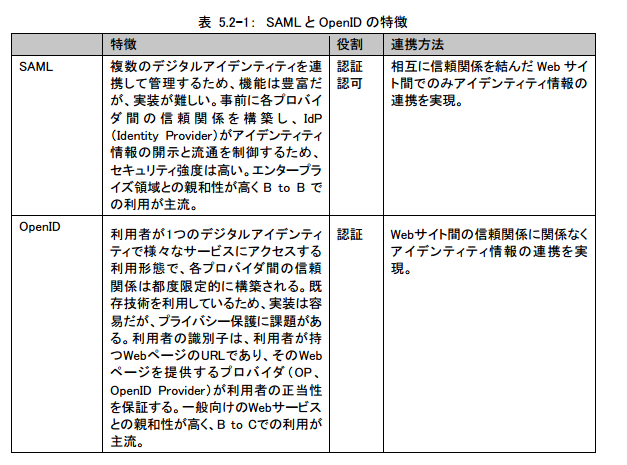
On the SAML/OpenID Comparison Table in IPA’s “Identity Management Technology Guide”
On August 9, the Information-technology Promotion Agency, Japan (IPA) released a draft of a textbook titled “Identity Management Technology Guide” [1]. The 8 edition is still…